Quantum Research Brief

Quantum BriefBRIEF

07/12–07/13· Included 24 items· 9 sources

Jul 12 – Jul 13, 2026 Weekly

02Hardware

Hardware Frontiers

Trapped ion

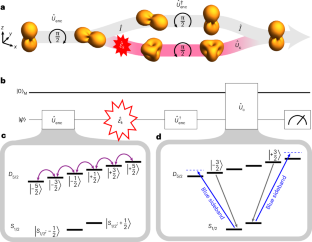
Quantum error correction has been realized on a logical qubit encoded in a single ion, demonstrating high-fidelity operations[4].

Neutral atom

Pasqal’s 100‑qubit Orion quantum computer opens 100 hours of free QPU time for EU academia and industry[13].

Photonic

NRC Canada has successfully coupled a chip‑integrated quantum‑dot single‑photon source with an erbium‑doped fiber quantum memory in the 980 nm band, advancing scalable quantum networks[23]. Gaussian cluster states support large‑scale multi‑mode multiplexing for measurement‑induced quantum computing[14].

Hybrid system

A nonlinear three‑body coupling mechanism between trapped electrons and magnons has been theoretically predicted, offering a new route for hybrid quantum systems[3].

Other

Intel announced a €50 billion investment to expand manufacturing capacity in Leixlip, Ireland, though it is primarily aimed at classical chips[2].

03Algorithms

Algorithms & Software

Saubanere et al. developed a hybrid algorithm based on Rydberg atoms, achieving a 0.651 approximation ratio for the quantum Max‑Cut problem, surpassing the previous record of 0.614[6]. Researchers at the Institut d'Optique Graduate School constructed quantum group codes that reduce the decoding time for non‑Clifford gate circuits from cubic to quasi‑quadratic, alleviating a key bottleneck for practical quantum computing[7]. Filip et al. proposed a Floquet‑space formalization method that accurately simulates coherent dynamics in chiral spin systems, going beyond conventional approximations[8].

04Industry

Industry & Ecosystem

Chips JU and Pasqal launched the Q‑PLANET pilot line, investing €50 million in the industrial‑scale manufacturing of neutral‑atom quantum chips[5]. Nord Quantique announced it has achieved a SPAM error rate below 0.1 % in quantum error correction, improving system performance[18]. Alice & Bob released research comparing the cost difference between quantum error correction and classical error correction, highlighting the high expense of quantum error correction[9]. Ilana Wisby has joined Cambridge Innovation Capital; she previously served as founding CEO of Oxford Quantum Circuits[11]. JIC Venture Growth Investments and Toyota Invention Partners participated in Yaqumo’s seed‑round extension financing[19]. Several quantum companies are collaborating to develop a hybrid system for immune‑targeting peptides[20]. Israeli quantum startups are considering going public via SPAC[21]. Keyfactor secured over $1 billion in growth capital, Qiz Security raised $17 million for post‑quantum cryptography management, and the White House summit pledged more than $2.2 billion to support fault‑tolerant systems by 2028[24].

05Research

Research Frontiers

Collaborative research between Heinrich Heine University Düsseldorf and DLR suggests that quantum mechanics may not require imaginary numbers; real numbers may be sufficient to describe it[15][17]. NTU Singapore exploited the 200‑year‑old Poisson‑spot effect to generate optical skyrmions with a simple method, offering new ideas for future computing[16].

06Editors

Editor's Note

This week’s progress shows that quantum error correction is moving from theory to experimental validation: error correction on a single‑ion logical qubit and Nord Quantique’s low SPAM error rate are both important milestones. The neutral‑atom platform has received large‑scale manufacturing investment in the EU, which is expected to accelerate industrialization. At the same time, the fundamental‑theory question about the necessity of imaginary numbers deserves attention, although its practical impact remains to be assessed. Overall, the field is advancing steadily, but one must guard against hype, especially the valuation risks in SPAC and financing news.