
Hardware Frontiers
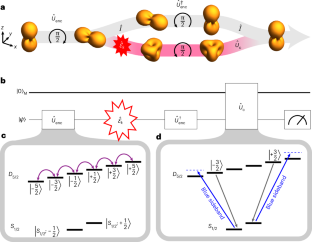
Trapped ion
- An error-correction scheme encoding a logical qubit in a single ion is proposed, promising to significantly reduce the number of physical qubits required[4].
Neutral atom
- EU Chips JU and Pasqal launch the Q-PLANET production line with a €50 million investment, dedicated to industrializing neutral-atom chips, accelerating the route from lab to market[5].
Superconducting/Hybrid Systems
- Theory predicts nonlinear three-body coupling between trapped electrons and magnons, providing a new interaction mechanism for hybrid quantum systems[3].
Photonics
- Using the 200-year-old Poisson spot effect, NTU achieves simple generation of optical skyrmions, potentially offering a new information carrier for optical quantum computing[7].
Algorithms & Software
Quantum error correction
- Nord Quantique achieves SPAM error rate below 0.1%: SPAM is a key bottleneck in quantum error correction; this progress brings its bosonic-encoding scheme closer to fault-tolerant computing requirements[9].
- Error-correction scheme encoding a logical qubit in a single ion: unlike traditional multi-physical-qubit encoding, this scheme promises to reduce resource overhead, holding significant implications for the trapped-ion route[4].
Industry & Ecosystem

- Intel invests €5 billion to expand its Irish wafer fab, providing advanced silicon-based chips for AI and HPC — not a direct quantum investment, but it underpins classical computing infrastructure[2].
- The EU and Pasqal launch the Q-PLANET production line, investing €50 million to build a pan-European backbone for neutral-atom chip manufacturing, strengthening Europe’s autonomy in quantum hardware fabrication[5].
- Yaqumo receives investment from JIC Venture Growth Investments and Toyota Invention Partners in an extended seed round, reflecting investor interest in quantum-safe communication[10].
- Multiple quantum companies collaborate with pharmaceutical firms to develop hybrid AI schemes for immune-targeting peptides, using quantum computing to accelerate drug discovery[11].
- Israeli quantum startups consider going public via SPAC, reflecting a new trend in the sector seeking capital-market financing[12].
Research Frontiers

- HHU and DLR publish in PRL, demonstrating that quantum mechanics can be formulated without imaginary numbers, using only real numbers self-consistently, challenging the necessity of the foundational mathematical framework[6][8].
- Theory proposes nonlinear three-body coupling between trapped electrons and magnons, enabling richer quantum simulation and information processing in hybrid quantum systems[3].
- NTU uses the Poisson-spot effect to generate optical skyrmions — a simple method requiring no special materials, providing a brand-new experimental platform for topological photonics[7].
This Week's Impact
- Quantum Error Correction Roadmap: Nord Quantique’s SPAM progress marks a critical step toward practical bosonic encoding; subsequent attention should focus on whether its logic-gate fidelity improves in tandem[9].
- Industrialization of Neutral Atoms: After the Q-PLANET production line launches, Pasqal is expected to lower chip manufacturing costs and accelerate quantum-processor iteration, creating competitive pressure on other neutral-atom startups[5].
- Fundamental Quantum Research: If the conclusion that imaginary numbers are unnecessary gains wide acceptance, it may influence quantum-mechanics education and future theory construction, but it has no direct near-term impact on experiments[6][8].
- Investment Trends: Yaqumo’s extended seed round and the SPAC moves by Israeli quantum companies indicate that quantum security and quantum-computing application areas are attracting more strategic investors and capital-market attention[10][12].
- Interdisciplinary Applications: The combination of quantum and AI for peptide design, if successful, will substantially shorten the drug-discovery cycle, potentially bringing forward the commercial value of quantum computing in biomedicine[11].
Editor's Note
The most noteworthy signal this week is the accelerating industrialization of the neutral-atom route. While the investment scale of the Q-PLANET production line is not yet comparable to that of the superconducting route, its clear targeting of industrial-grade manufacturing means neutral atoms are no longer confined to laboratory demonstrations. Meanwhile, Nord Quantique’s progress in error correction shows that even in non-mainstream encoding schemes, engineering optimization can yield significant breakthroughs. The paper on the non-necessity of imaginary numbers carries philosophical impact but has no material near-term effect on quantum-computing hardware. Overall, quantum computing is transitioning from "proof-of-principle" to "engineerable manufacturing," and the rising maturity of the industrial ecosystem matters more than any single performance record.