Quantum Research Brief

Quantum BriefBRIEF

07/14–07/20· Included 85 items· 16 sources

Jul 14 – Jul 20, 2026 Weekly

02Hardware

Hardware Frontiers

Trapped ion

  • Quantinuum, in collaboration with the University of Chicago and others, implemented a universal topological gate set by braiding non-Abelian anyons on the H2 processor[24][38]: This is the first demonstration of a universal topological gate set on quantum hardware, marking the transition of topological quantum computing from theory to experiment, and may offer a quantum computing paradigm with inherent immunity to local noise.

Superconducting

  • IBM achieves 25× faster qubit reset[19]: A 25× faster reset speed means dead time between circuits is drastically reduced, which is critical for the pipelined execution of deep quantum algorithms and directly boosts quantum processor throughput.
  • 1QBit reports single-qubit gate fidelity of 99.99% for fluxonium qubits[36]:该保真度追平了离子阱路线的最佳单比特门纪录(Quantinuum Helios 99.9975% 仍略优),但 fluxonium 的超导路线在可扩展性上更具潜力;距离容错阈值(通常 >99.9%) has been met, but two-qubit gate fidelity and coherence time still need further improvement.

Photonic

  • Quantum Source and Israel DDR&D demonstrated a deterministic polarization-entangled photon source based on a single rubidium atom[26][60]: The first demonstration of a calibration-independent single-atom entangled photon source solves a key bottleneck of source unpredictability in photonic quantum networks, potentially simplifying the deployment of quantum repeaters.
  • QuiX Quantum delivers the Carina 8-qubit photonic quantum computing demonstration platform[73]: The platform is based on 4-qubit graph states and a 10 MHz clock cycle, serving as a universal photonic quantum computing prototype funded by Germany’s DLR; its chip-integrated photon sources and multiplexed resource-state generation technology may improve the scalability of the photonic route, but the end-to-end loss budget has not been disclosed.
  • Quantum Source Alpha Labs proposes a blueprint for a hybrid photonic-atomic fault-tolerant architecture[27]: The scheme uses cavity QED to address bottlenecks in photon loss and atomic scalability, providing a new path for building fault-tolerant quantum networks, but it has not yet been experimentally verified.

Neutral atom

  • No major neutral-atom hardware news this week.

Other

  • Sandia National Laboratories develops an integration platform for AlScN piezoelectric phononics and superconducting circuits[35]: This work couples superconducting qubits with low-loss microwave phonons, potentially enabling hybrid quantum systems, but it is still in the early research stage.
  • ESA installed its first on-premises quantum computer (Equal1 Bell-1) at its Earth Observation centre[28]: This is the first actual deployment of a quantum computer in a space agency’s HPC data centre, marking the entry of quantum-classical hybrid computing into the practical evaluation phase for remote sensing data analysis.

In-depth analysis · Members only

Per-item analysis is members-only

This section contains 1 in-depth per-article analysis (background / key points / commentary), with source attribution and credibility assessment. The daily brief and this issue’s summary remain free.

Unlock with the membership code received during registration · Enter once for full-text access

03Algorithms

Algorithms & Software

  • IBM releases Qiskit v2.5, integrating new quantum circuit optimization and error mitigation tools[19]: The new version is optimized for quantum volume and circuit depth, helping to reduce the runtime overhead of NISQ algorithms.
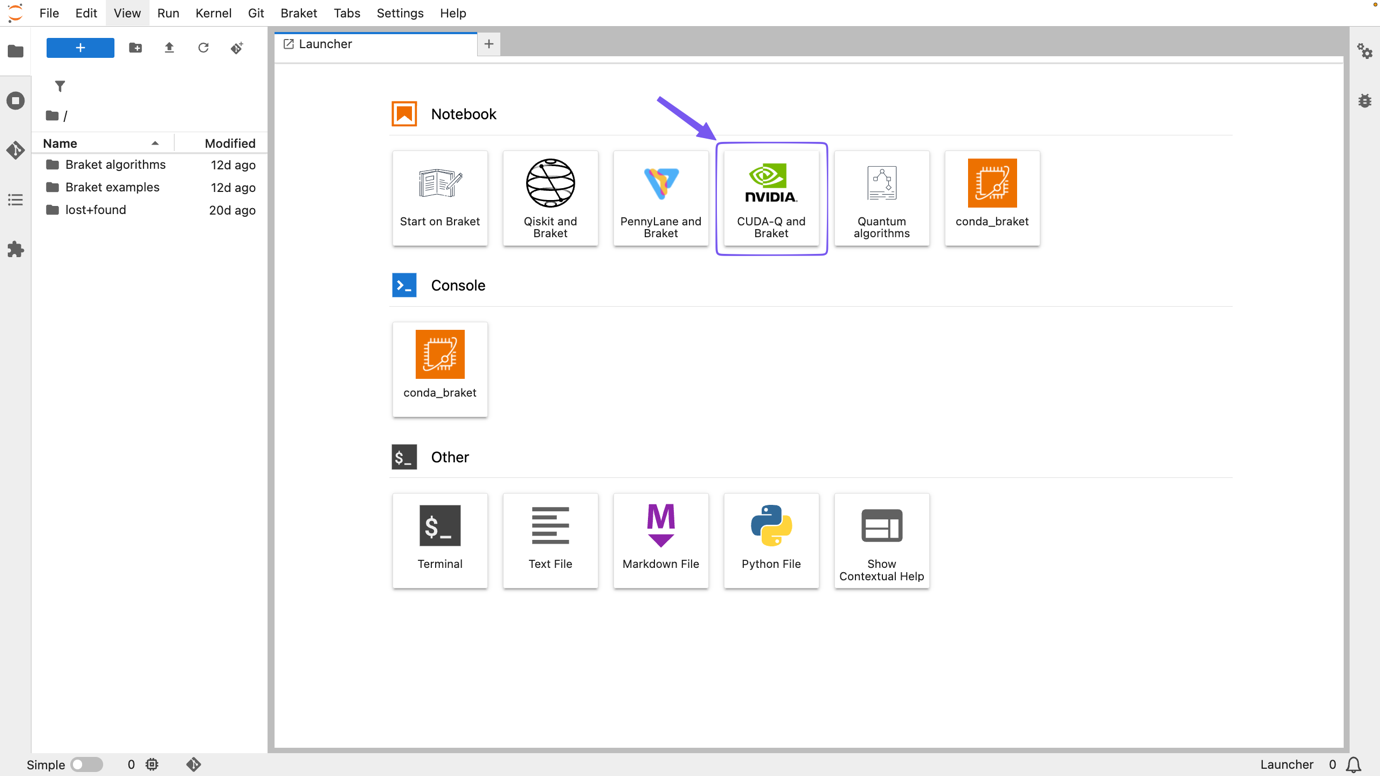
  • Amazon Braket integrates the NVIDIA CUDA-Q Application Hub and academic libraries[5]: This allows researchers to directly access peer-reviewed quantum-classical hybrid application examples, lowering the barrier to quantum algorithm development.
  • Research proposes a near-optimal parameter tuning method for level-1 QAOA (Quantum 10, 2158)[44]: Analytical expressions for QAOA parameters are provided for the Ising model, avoiding expensive classical optimization and potentially accelerating quantum solutions for combinatorial optimization problems.
  • Shadow Pauli Flow is introduced to characterize determinism in measurement-based quantum computing (Quantum 10, 2163)[45]: This provides a new theoretical tool for measurement-based quantum computing, aiding the design of more efficient graph-state quantum circuits.
  • Research proves a complexity lower bound for preparing graph states with Clifford circuits (Quantum 10, 2165)[46]: This reveals the minimum number of elementary operations required for graph state preparation, offering guidance for quantum compilation and resource estimation.
04Industry

Industry & Ecosystem

Funding & IPOs

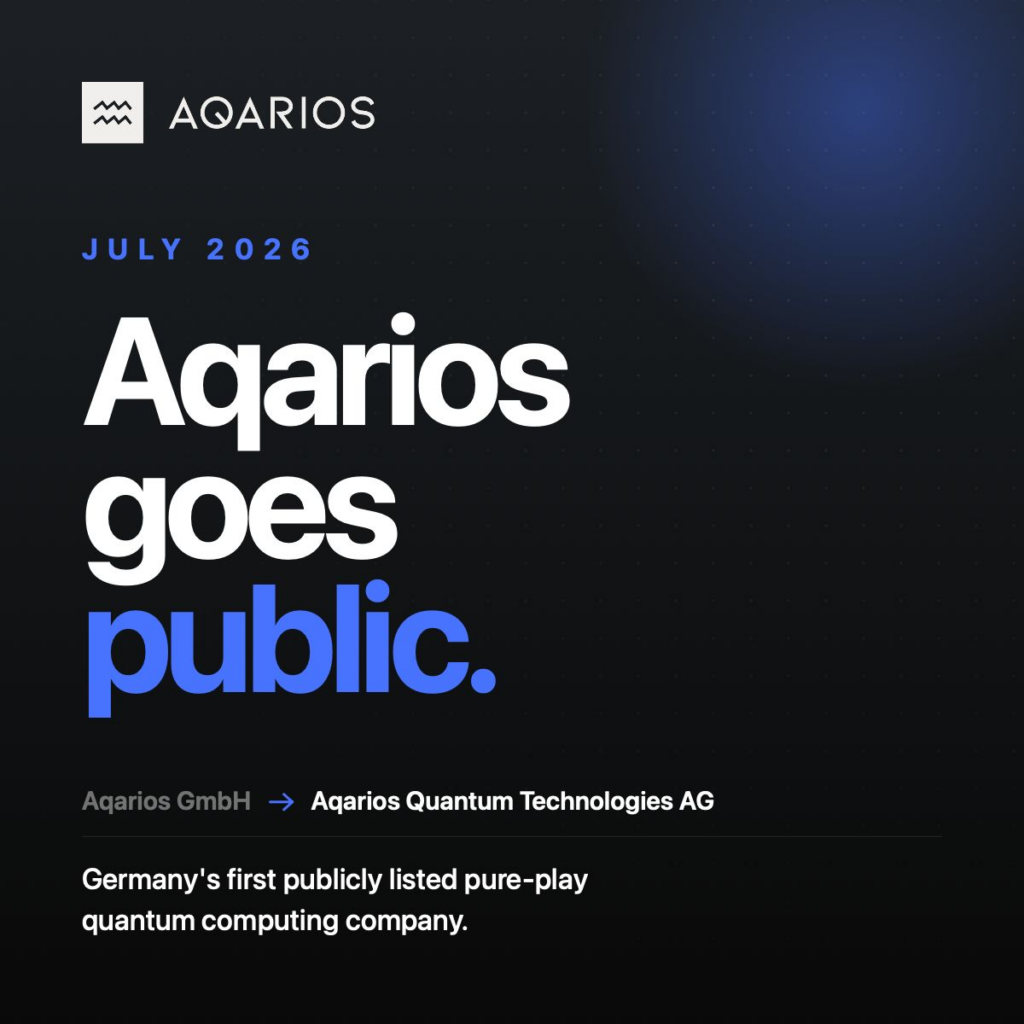
  • Aqarios lists on the Düsseldorf Stock Exchange via SPAC, becoming Germany’s first pure-play public quantum company[21]: This marks the entry of European quantum software companies into the public capital market, potentially providing a listing pathway reference for other European quantum startups.
  • Singapore’s pQCee completes a $3.9 million seed funding round[22][68]: The post-quantum cryptography (PQC) startup receives backing from government-affiliated investors, indicating an accelerating transition of PQC from academic research to enterprise procurement.
  • Photon Queue receives a $500,000 grant to establish operations in New Mexico[79]: The grant supports the development of free-space quantum memory and facilitates collaboration with Sandia National Laboratories.

Strategic Partnerships & Appointments

  • Pasqal appoints Mark Armstrong as Chief Business Officer for EMEA and APAC[20]: Armstrong comes from HPE, and his HPC and AI sales background may help Pasqal expand its customer base in industrial quantum computing applications.
  • PsiQuantum and Haiqu announce executive appointments[20][62][64]: Denise Ruffner (former IBM Quantum executive) joins Haiqu to lead business development, reflecting that quantum software companies are actively recruiting business talent with large tech company experience.
  • Intel and Google Cloud expand strategic cooperation, deploying Gemini AI to accelerate enterprise digital transformation[14]: Although not direct quantum news, Intel’s AI transformation may indirectly affect the allocation of its quantum computing R&D resources.

Policy & Education

  • Tennessee, USA, launches the TN QuantumWorks K-12 quantum education initiative[23][66][77]: This is one of the first quantum education programs in the U.S. covering all K-12 stages, aiming to cultivate the future quantum workforce and holding strategic significance for the long-term talent pipeline of the quantum industry.
  • The new UK Prime Minister may abolish DSIT, raising concerns about policy uncertainty for the UK quantum industry[31]: If DSIT is abolished, the funding and coordination mechanisms of the UK quantum strategy could be affected, negatively impacting the fundraising environment for UK quantum startups.

Post-Quantum Cryptography & Cybersecurity

  • Aliro Technologies and zerothird demonstrate an entanglement-based QKD network on Cisco 8000 series routers[70]: The first integration of entanglement-based QKD with commercial routers, achieving quantum-secure MACsec encryption, marking an important step toward the practical use of quantum-safe communication.
  • QuSecure’s QuProtect R3 is listed on the AWS Intelligence Community Marketplace[74]: U.S. federal government agencies can procure the post-quantum cryptography platform through AWS, accelerating the deployment of PQC in critical government systems.

Other

  • Digital Catapult and NQCC launch the third phase of the QTAP program, introducing the banking and healthcare sectors[25][61][71]: The application of quantum technologies is expanding from traditional manufacturing to the finance and healthcare industries, indicating that industrial interest in quantum optimization is diversifying.
  • BQP receives a SpaceWERX SBIR contract to develop quantum-assisted AI for space situational awareness[76]: Quantum machine learning is applied for the first time to space object classification, potentially improving space surveillance efficiency.
  • QTREX Quantum receives orders from government customers and begins production of shielded RF monolithic components[78]: This indicates that specialized RF components for quantum materials have entered the commercial delivery phase.
05Research

Research Frontiers

  • Quantinuum, with the University of Chicago and others, implements a universal topological gate set on a quantum processor for the first time (Nature)[24][38]: Achieving a universal gate set by braiding non-Abelian anyons is a major milestone for topological quantum computing.
  • Columbia University discovers the first candidate material for a fractional topological insulator[37]: This discovery fills a 15-year experimental gap since the theoretical prediction, providing a new platform for studying fractionalized excitations and topological order.
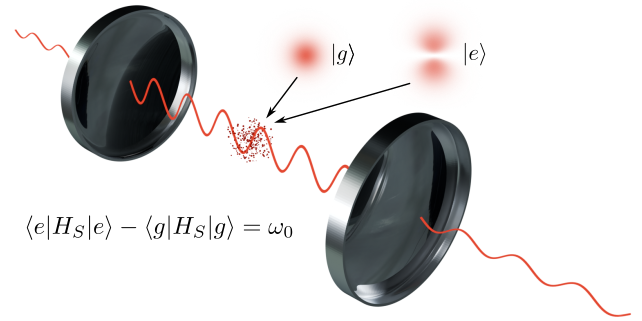
  • Research demonstrates superabsorption in non-Markovian cooperative radiation (Quantum 10, 2159)[43]: The transition from superradiance to superabsorption in a two-emitter cavity QED system is precisely resolved, with potential applications for quantum batteries and quantum metrology.
  • Exact quantum many-body scars are discovered in a two-dimensional quantum gauge model (Quantum 10, 2164)[47]: The first discovery of exact quantum scars in a higher-dimensional system, providing a new paradigm for understanding non-thermalizing phenomena.
  • A fast quantum measurement tomography protocol achieves optimal error bounds (Quantum 10, 2162)[40]: The new protocol achieves optimal sample complexity with extremely low classical post-processing cost, potentially accelerating quantum measurement characterization.
  • Quantum zero-knowledge proof for verifier-initiated quantum message authentication (arXiv)[16]: A quantum signature scheme without pre-distributed authentication material is proposed, holding significant implications for secure authentication in scalable quantum networks.
  • All-mechanical coherence protection and fast control of spin qubits (arXiv)[18]: Using phonons to achieve coherence protection and fast manipulation of spin qubits provides a key experimental foundation for phononic quantum networks.
  • Enhanced single-photon emission by suppressing radiative decay (arXiv)[4]: By suppressing undesired radiative transitions, the brightness and purity of single-photon sources are improved, aiding efficient spin-photon interfaces in quantum networks.
06Impact

This Week's Impact

  1. Topological quantum computing moves from theory to experiment: Quantinuum’s demonstration of a universal topological gate set[24][38]provides experimental feasibility endorsement for the topological quantum computing route, potentially attracting more resources and talent to this direction, especially giving a direct boost to fault-tolerant computing schemes relying on topological protection.
  1. Quantum hardware performance metrics continue to improve: IBM’s 25× reset acceleration[19]and 1QBit’s 99.99% single-qubit gate fidelity[36]indicate that the superconducting route is continuously approaching practical requirements in operational speed and precision, but the two-qubit gate fidelity and coherence time for fluxonium remain weak points.
  1. Post-quantum cryptography and QKD enter the actual deployment phase: Aliro/zerothird’s integration of entanglement-based QKD with Cisco routers[70]and QuSecure’s listing on AWS ICMP[74]indicate that quantum-safe communication is moving from laboratory demonstrations to commercial network integration, with the government and financial sectors likely to be early adopters.
  1. Accelerating the Systematization of Quantum Education: Tennessee’s K-12 quantum education initiative[23][66][77]shows that the U.S. is systematically building a quantum talent pipeline, which may alleviate the talent shortage in the quantum industry within 5-10 years and influence other states and countries to follow suit.
  1. UK quantum industry policy faces uncertainty: Rumors that the new Prime Minister may abolish DSIT[31]have raised industry concerns about the continuity of the UK quantum strategy. If policy support weakens, UK quantum startups may face fundraising difficulties, and some talent and companies may migrate to the U.S. or continental Europe.
07Editors

Editor's Note

The most striking development this week is undoubtedly Quantinuum’s breakthrough in topological quantum computing. This is not only a milestone for the technical route but also sends a signal to the industry: topological protection is no longer a purely theoretical concept but an operation achievable on existing hardware. However, the actual fidelity, scalability, and comparison with traditional error correction schemes for this topological gate set still await further disclosure. From an industrial perspective, the commercialization pace of post-quantum cryptography and QKD is clearly accelerating, with the finance, government, and defense sectors becoming early adopters. Meanwhile, the emerging trend of quantum education extending from universities to K-12 is noteworthy, reflecting the quantum industry’s urgent need for a long-term talent pipeline. The policy uncertainty in the UK serves as a reminder that the industrialization of quantum technology is highly dependent on stable government support, and any political change could alter the regional competitive landscape.