Quantum Research Brief

Quantum BriefBRIEF

07/22–07/23· Included 43 items· 13 sources

Jul 22 – Jul 23, 2026 Weekly

—— Infleqtion to deploy first fault-tolerant neutral atom quantum computer

02Hardware

Hardware Frontiers

Neutral atom

  • Infleqtion deploys fault-tolerant neutral-atom quantum computer: The company announced it will deploy a fault-tolerant neutral-atom quantum computer at the Chicago Quantum Innovation Center in Illinois and has newly opened the Chicago Quantum Innovation Center.[2]This is the first time a company has publicly committed to deploying a fault-tolerant neutral-atom system. Specific metrics for its fault-tolerance scheme (such as logical qubit count and error rate) have not yet been disclosed, but this move advances the neutral-atom approach from academic demonstration to commercial deployment.
  • QuEra validates quantum thermodynamic sampling: Using a 78-site neutral-atom system to simulate nitrogen-doped graphene, it extracted thermodynamic properties that matched classical calculations.[34]This work validates the feasibility of neutral atoms for materials thermodynamic simulation, but the 78-site scale (compared to the state-of-the-art array size of 1180 qubits) remains small, and there is still a gap to the hundreds of logical qubits required for practical materials simulation.
  • SAXON Q releases room-temperature diamond quantum computers: The German startup SAXON Q launched the SXQ128 (128 qubits) and SXQ512 (512 qubits), based on NV centers and operating at room temperature.[28]These are the first room-temperature diamond quantum processors exceeding 10 physical qubits, but publicly available data on two-qubit gate fidelity for the NV-center approach is limited, far below the 99.9% level of superconducting/ion-trap systems, and coherence time is limited by room temperature, leaving the outlook for fault-tolerant computing unclear.
  • Photon Queue raises $4 million seed round: UIUC spinout Photon Queue completed an oversubscribed $4 million seed round to commercialize room-temperature quantum memory.[29]Room-temperature quantum memory is a key component for building quantum networks, but the technology is still in its early stages, with storage time and fidelity not yet meeting network application requirements.

Photonic

  • PsiQuantum receives $125 million DARPA extension agreement: PsiQuantum signed a performance-oriented agreement with DARPA valued at $125 million to validate its scaled photonic quantum computer.[5][17]This is PsiQuantum's largest government contract to date, indicating DARPA's confidence in its roadmap. However, the photonic approach still needs to solve the end-to-end loss budget problem (the state-of-the-art two-qubit fusion fidelity of 99.22% is a conditional value), and there is still distance to practical utility.

Superconducting

  • Maybell Quantum deploys dilution refrigerators to New Mexico: Maybell Quantum will deploy four dilution refrigerators at the Roadrunner Quantum Lab, providing millikelvin temperature environments.[30]This supports the infrastructure needs of superconducting quantum computing but does not itself constitute a hardware breakthrough.

Hybrid/Other

  • Hitachi, Intel, and AIST collaborate on silicon quantum processors: Hitachi received NEDO project funding to collaborate with Intel and AIST to move silicon spin qubits from academic demonstration to industrial manufacturing.[6]The silicon spin approach has achieved two-qubit gate fidelity of 99.99% (SQC 2025), but the scale is only about 12 qubits; industrial manufacturing is the key bottleneck for scaling.
03Algorithms

Algorithms & Software

Quantum error correction

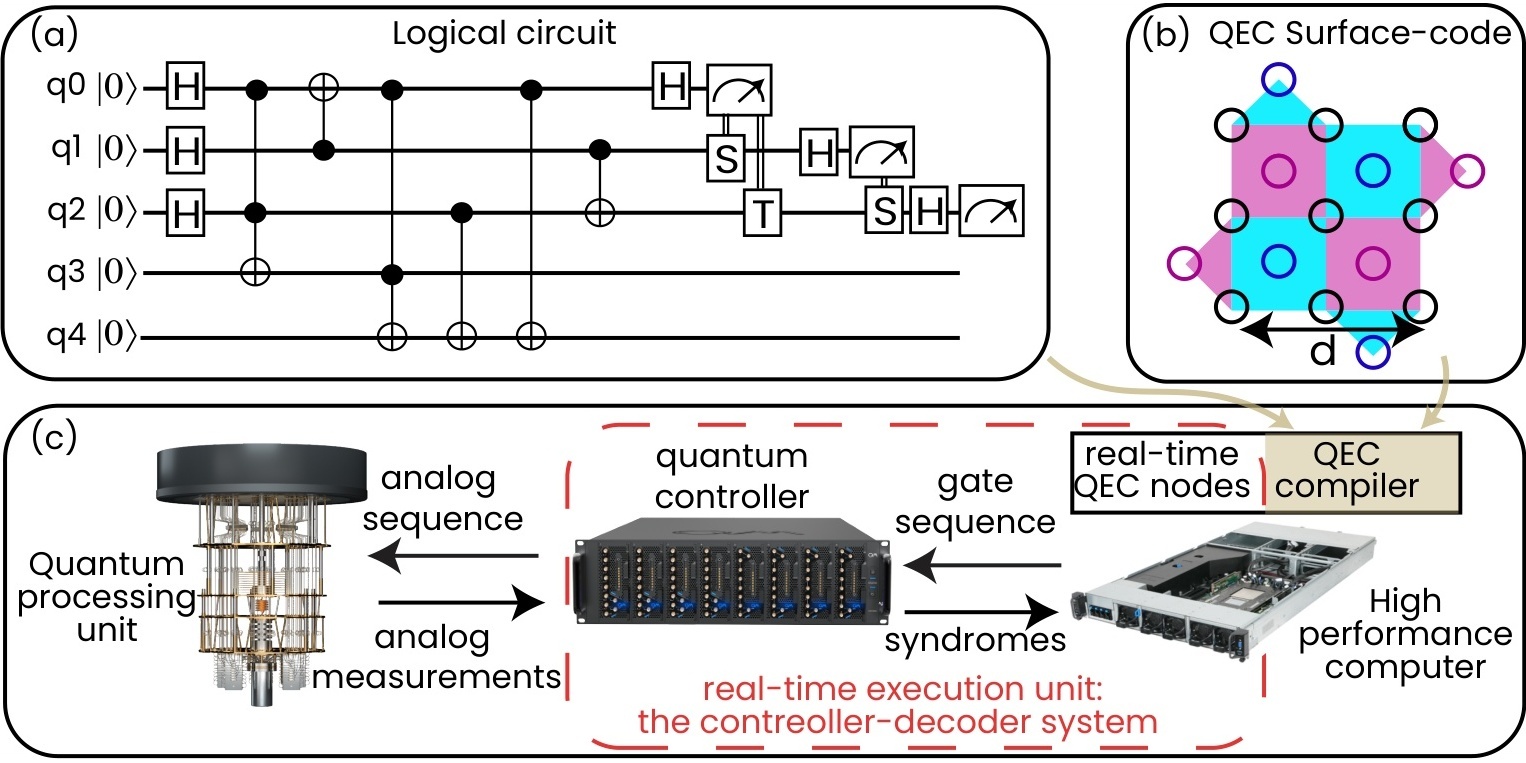
  • Surface-code implementation of Shor's algorithm derives controller-decoder system requirements: Work published in *Quantum* derived the system requirements for controllers and decoders under the surface code by implementing Shor's algorithm.[37]This provides a quantitative basis for hardware-software co-design in future fault-tolerant quantum computers.
  • Rice University joins DOE Quantum Science Center to research QEC: Rice University joined the DOE Quantum Science Center, focusing on quantum error correction research.[43]QEC is central to achieving fault-tolerant computing, but this collaboration is long-term fundamental research with no direct short-term results.

Quantum Algorithms and Theory

  • Quantum geometry framework helps quantum AI memory: A new framework uses quantum geometry to help quantum AI systems remember what they have learned.[13]This work attempts to solve the catastrophic forgetting problem in quantum machine learning but has not yet been validated on real hardware.
  • Optimal number of T gates for quantum state preparation: Work published in *Quantum* provides the optimal asymptotic scaling for the number of T gates required to approximate an arbitrary n-qubit state.[39]This has important implications for resource estimation in fault-tolerant quantum computing.
  • Complete theory of Clifford commutators: A paper published in *Quantum* presents a complete theory of commutators for the Clifford group.[36]The Clifford group is fundamental to quantum error correction and randomized benchmarking; this theoretical work deepens the understanding of its structure.
  • Non-commutative polynomial optimization problems: A paper published in *Quantum* studies non-commutative polynomial optimization with differential constraints.[38]This work extends quantum optimization theory.
04Industry

Industry & Ecosystem

Funding and Contracts

  • Taiyi Quantum raises $42 million: Shanghai startup Taiyi Quantum completed $42 million in financing to advance neutral-atom quantum computing.[11]This is a significant financing event for the neutral-atom approach in China, but technical details have not been disclosed.
  • PsiQuantum $125 million DARPA agreement: See Hardware Frontiers.
  • Photon Queue $4 million seed round: See Hardware Frontiers.
  • Galaxy Digital commits $5 million for Bitcoin quantum readiness: Galaxy Digital launched the Bitcoin Quantum Readiness Initiative, funding the development of quantum-resistant signatures and migration tools.[19]This signals that the financial industry is beginning to take the quantum threat seriously, but the $5 million scale is small, and the actual impact is limited.

Collaborations and Projects

  • Infleqtion awarded three DOE Genesis Mission projects: Infleqtion received three DOE projects for quantum computing and sensing research.[3][12]Genesis Mission is a new DOE program to accelerate AI-driven scientific discovery, with quantum computing listed as a key supporting technology.
  • QPerfect partners with University of Strasbourg: QPerfect will provide a digital twin simulation for aQCess, France's first public neutral-atom quantum computing platform, which targets over 400 ytterbium atoms.[14][20]Digital twins help optimize hardware design, but the platform itself has not yet been built.
  • Quantinuum and SoftBank release joint white paper: The white paper maps quantum chemistry and graph analytics workloads onto Quantinuum's hardware roadmap.[27]This provides industry users with a timeline reference for when quantum advantage may be available.
  • Keyfactor expands post-quantum cryptography partner program: Keyfactor expanded its global partner program and established a Post-Quantum Cryptography Center of Excellence.[15][21]This helps enterprises prepare for PQC migration.

Policy & Ecosystem

  • DOE invests in Fermilab projects to accelerate AI scientific discovery: The DOE invested in Fermilab projects using AI to accelerate scientific discovery, with quantum computing as one component.[1].
  • US pledges $5 billion for government-backed AI scientific research: A senior White House science advisor faced congressional questioning over research funding cuts.[7]This funding may indirectly benefit quantum computing.
  • QOMPASS Alliance calls for a European Quantum Plan: The QOMPASS Alliance released a position paper calling for a dedicated European Quantum Plan with an independent budget.[32]This reflects concerns over the inadequacy of the current coordination model in Europe.
  • Shanghai startup showcases data-center-ready quantum computer at WAIC: A Shanghai startup showcased a data-center-ready quantum computer at WAIC 2026.[42]Specific technical approach and metrics were not disclosed.
05Research

Research Frontiers

  • SAXON Q releases room-temperature diamond quantum computers: The SXQ128 and SXQ512 are based on NV centers and operate at room temperature.[28]。这是首次有公司提供超过10物理比特的室温金刚石量子处理器,但NV色心的双比特门保真度远低于SOTA(超导/离子阱>99.9%), and coherence time is limited at room temperature, leaving a significant gap to fault-tolerant computing.
  • Entangled photons enhance infrared spectroscopy signal by 21.8 times: A new scanningless quantum Fourier transform infrared spectroscopy technique uses entangled photons to enhance the signal by 21.8 times.[31]This is a notable advance for quantum sensing in spectroscopy, but the technique is currently limited to laboratory demonstrations.
  • Impact of fixed-point arithmetic on CV-QKD decoding: Research reveals the impact of fixed-point arithmetic on high-speed LDPC decoding in continuous-variable quantum key distribution.[33]This provides engineering guidance for the practical implementation of CV-QKD systems.
  • Surface-code implementation of Shor's algorithm derives system requirements: see Algorithms & Software.
  • Optimal T-Gate Count for Quantum State Preparation: see Algorithms & Software.
  • Complete theory of Clifford commutators: see Algorithms & Software.
06Impact

This Week's Impact

  1. Neutral-Atom Approach Accelerates Commercialization: Infleqtion's deployment plan and QuEra's thermodynamic sampling validation indicate that neutral atoms are moving from academic prototypes toward practical applications. The next things to watch are the specific performance metrics of Infleqtion's fault-tolerant system (logical error rate, repetition rate) and whether QuEra can scale thermodynamic sampling to larger systems.
  2. Photonic approach receives strong government endorsement: PsiQuantum's $125 million DARPA agreement is the largest government investment to date for the photonic approach, indicating the US Department of Defense's confidence in this path. However, photonics still needs to solve the end-to-end loss problem, or it will be difficult to deliver on its promise.
  3. Silicon Quantum Approach Secures Industrial-Grade Investment: The collaboration between Hitachi, Intel, and AIST pushes silicon spin qubits toward industrial manufacturing, a key step for this approach moving from academic demonstration to large-scale production. Silicon spin F₂Q has reached 99.99%, but scaling remains the biggest challenge.
  4. Post-Quantum Cryptography Readiness Accelerates: Keyfactor's PQC partner program and Galaxy Digital's Bitcoin Quantum Readiness Initiative show that industry is beginning to take the quantum threat seriously. However, the current scale of investment remains small, and actual migration may require significantly larger funding.
  5. European Quantum Strategy Faces Adjustment: The QOMPASS Alliance's call for a European Quantum Plan with an independent budget reflects anxiety that Europe is falling behind the US and China in the quantum race. The next step is to watch whether the EU will increase dedicated quantum funding in future budgets.
07Editors

Editor's Note

The most striking trend this week is the collective breakout of the neutral-atom approach. Infleqtion announced the deployment of a fault-tolerant system, QuEra validated thermodynamic sampling, and Taiyi Quantum raised $42 million — three independent pieces of news appearing on the same day, marking neutral atoms' shift from a single academic direction to a multi-player competitive industrial track. However, the shortcomings of neutral atoms (low repetition rate, mid-circuit measurement errors) remain unresolved; while QuEra's 96-logical-qubit demonstration leads, practical applications still require increasing the repetition rate from 1–10 Hz to the kHz level.

On the other hand, the photonic approach received strong endorsement via the DARPA contract, but whether $125 million can solve the end-to-end loss problem remains unknown. The silicon spin approach gained industrial-level support, but the physical challenges of scaling remain enormous. Overall, quantum computing is moving from the debate over "which approach is best" into a competitive phase of "which approach can cross the threshold to practical utility first," and the answer may begin to emerge in 2027–2028.