Jul 25, 2026 – Jul 26 · Daily Brief

Illinois Quantum Campus to deploy first fault-tolerant neutral atom quantum computer

20 items · 6 sourcesPDFThis issue's roundup is free
02Hardware

Hardware Frontiers

Neutral atom

Infleqtion plans to deploy the fault-tolerant neutral-atom quantum computer Sqale at IQMP, with hardware delivery scheduled for 2027.[7]This is the first time a neutral-atom quantum computer has entered park-level deployment with fault tolerance as its objective. Previously, this roadmap demonstrated ⟦96⟧ logical qubits in 2026 (QuEra), but no vendor had formally introduced a fault-tolerant system into an industrial environment.[7]This move signifies that the neutral-atom roadmap is leaping from academic demonstration to engineered delivery. However, attention must be paid to whether its cycle repetition rate (typically ⟦1–10 Hz⟧) and logical qubit post-selection rate, among other shortcomings, can meet practical requirements before deployment.[7].

Superconducting

Researchers proposed engineering dynamical sweet spots (DSSs) in superconducting qubits to suppress low-frequency magnetic flux noise, theoretically exploring the limits of coherence time scalability under this strategy.[1]DSSs have demonstrated the effect of extending coherence time in small-scale devices, but this work reveals their fundamental limitations through full parametric modeling, providing clearer boundaries for noise suppression in superconducting qubits.[1]The current state-of-the-art T₁ for superconducting qubits is approximately ⟦100 µs⟧ (Google Willow). If DSSs can overcome TLS fluctuation limits, they may further narrow the coherence time gap with ion traps.[1].

03Algorithms

Algorithms & Software

Error Suppression and Mitigation

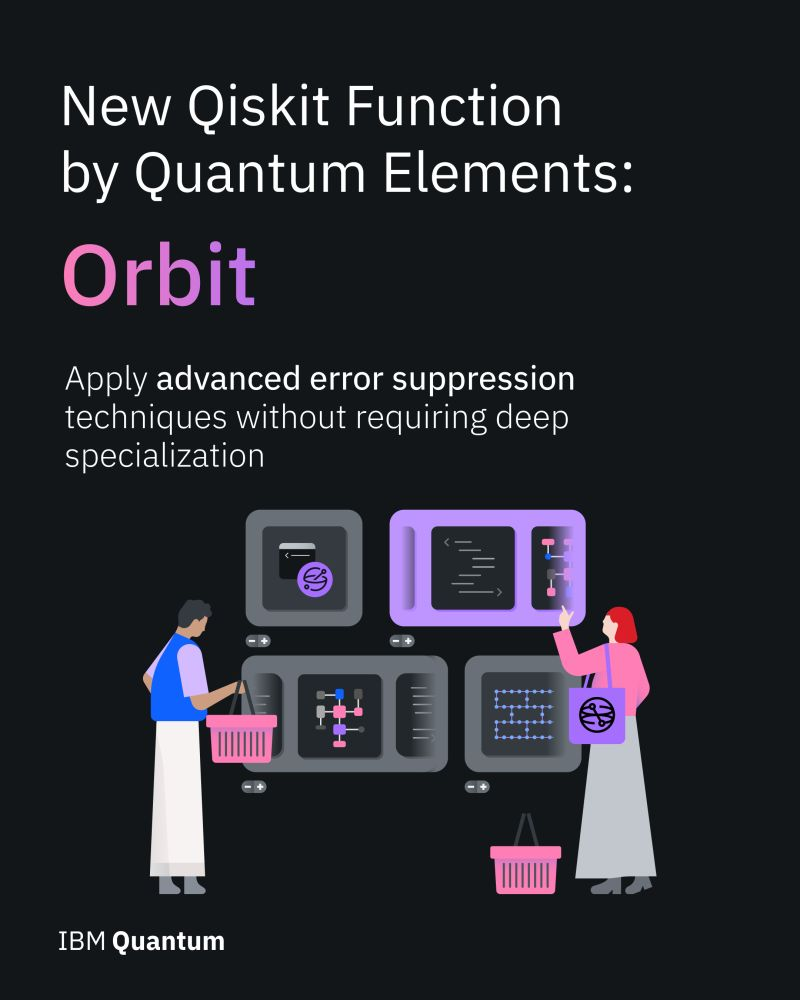
Quantum Elements released Orbit, an automated error suppression tool integrated as a Qiskit Function in the IBM Qiskit Functions Catalog, providing low-overhead circuit execution fidelity improvements for IBM Quantum Network members.[4]This is a significant step in the ecosystem development of error suppression software, embedding automated noise management into mainstream development platforms and lowering the barrier for developers.[4].

Qedma integrated its QESEM error mitigation platform with Quantinuum's ion-trap hardware, enabling a hardware-agnostic error mitigation solution to be directly applied to a high-fidelity ion-trap system for the first time.[5]This provides a paradigm for standardizing cross-platform error mitigation and also indicates that Quantinuum is expanding its application scope through the software ecosystem while maintaining its hardware advantage.[5].

Quantum machine learning

Researchers from VW and Porsche explored the "double descent" phenomenon in deeply parameterized quantum circuits, finding that the test performance of gradient-based parameterized quantum circuits may improve as model size increases, challenging the traditional expectation of overfitting in quantum machine learning.[16]If this finding can be validated on actual quantum hardware, it may provide new scaling law guidance for the design of quantum neural networks, but it is currently limited to numerical simulations.[16].

Formal verification

An AI agent completed the formal verification task for ⟦76⟧ theorems in quantum information and quantum algorithms on the Lean 4 benchmark.[17]This is the first large-scale use of AI-assisted quantum theorem proving, demonstrating the potential of automated reasoning in building the theoretical foundations of quantum computing, which may accelerate the correctness verification of quantum software.[17].

04Industry

Industry & Ecosystem

Supply Chain and Campus Construction

Zero Point Cryogenics and Ability Engineering Technology became the first supply chain tenants at IQMP, providing dilution refrigerators and precision engineering services, respectively.[8]This marks IQMP's transition from planning to physical implementation, providing critical cryogenic and manufacturing support for quantum computer operation and helping to form a regional quantum manufacturing cluster.[8].

International Cooperation and Ecosystem

IQMP signed a Memorandum of Understanding with Japan's Quantum Strategic Industry Revolution Alliance (Q-STAR), aiming to establish cross-border commercialization pathways, joint R&D, and supply chain connections.[6]This is an institutionalized attempt at US-Japan quantum industry cooperation, potentially accelerating the complementarity between the two countries in quantum microelectronics and materials.[6].

Company news

Quantum Computing Inc. appointed Susan Hunt as Chief Revenue Officer, who has sales experience in AI, cloud computing, and telecommunications, while former CRO Pouya Dianat experienced a change.[3]The personnel adjustment may reflect QCi's pursuit of broader market expansion under commercialization pressure, but the actual revenue contribution of its quantum products needs to be observed.[3].

Quantum Security Education

Bloq Quantum expanded its quantum education ecosystem through strategic partnerships in Kerala, India, co-building an undergraduate quantum computing laboratory with an engineering college.[9]This move aims to fill the quantum talent gap, especially in emerging markets, but requires supporting hardware resources and curriculum systems to have a practical impact.[9].

Post-Quantum Cryptography

Terra Quantum and Apex.AI demonstrated the integration of NIST-standardized post-quantum cryptography in an edge-to-cloud autonomous robot environment, achieving quantum-safe communication.[11]This is an early application validation of post-quantum cryptography in the mobile and robotics domains, indicating that autonomous systems are beginning to address security migration in the quantum era.[11].

Post-Quantum Security in Africa

A guest article from Africa describes the continent's race to coordinate a response to post-quantum cryptography migration, emphasizing cross-national cooperation and awareness raising.[14]This highlights that quantum security is no longer an exclusive topic for developed nations, but Africa still faces significant challenges in infrastructure and standardization follow-up.[14].
05Research

Research Frontiers

Quantum Control and Metrology

Researchers at the Southern University of Science and Technology established a universal theory for phase estimation in multi-mode bosonic interferometers based on Sp(2N,R) symmetry, proposing an Sp(2N,R) echo protocol that can reach the quantum Fisher information limit.[19]This work extends SU(1,1) interferometers to multi-mode scenarios, providing a new framework for quantum metrology and quantum control, but experimental realization still needs to overcome the preparation and maintenance of multi-mode entangled states.[19].

Quantum many-body physics

Research reveals that criticality in non-unitary chains deviates from standard entanglement scaling and is extremely sensitive to single-point energy gaps.[18]This finding deepens the understanding of entanglement structure in non-unitary quantum dynamics and may impact the evaluation of entanglement resources in measurement-based quantum computing schemes.[18].

Quantum Network Loss

A theoretical analysis of "superloss" caused by coherent spatial mode mixing in quantum correlation networks reveals that mode mixing introduces additional decoherence channels, even for squeezed light.[2]This provides a more precise model for loss budgets in quantum networks (such as photonic quantum computing and gravitational wave detection), pointing out that mode control is key to reducing network loss.[2].

Room-Temperature Spin Defects

A team at Sungkyunkwan University discovered an atomic defect in zinc oxide through computational screening that can serve as a high-fidelity spin qubit at room temperature.[10]If successfully verified experimentally, this would provide a new candidate for room-temperature solid-state qubits, but it is currently only at the computational prediction stage and still far from actual devices.[10].

06Impact

This Week's Impact

  • Neutral-Atom Approach Participants: Infleqtion's deployment plan[7]and IQMP supply chain establishment[8]increase the credibility of neutral-atom quantum computing, but the industry still needs to monitor whether its logical qubit error rate reaches the practical threshold and how the cycle speed bottleneck will be resolved.
  • Quantum Software Developers: Orbit[4]and QESEM[5]The integration of ⟦Qedma's QESEM with Quantinuum hardware⟧ lowers the barrier to using error mitigation, but developers need to assess whether the fidelity gains of these tools on actual hardware are stable and whether they introduce calibration overhead.
  • Quantum Security Industry: The validation of post-quantum cryptography in the automotive/robotics domain[11]and Coordinated Actions in Africa[14]indicates that migration demands are spreading, but standardization and performance trade-offs remain deployment obstacles.
  • Quantum Machine Learning Researchers: The double descent phenomenon in deeply parameterized quantum circuits,[16]if experimentally confirmed, could change the design paradigm for quantum neural networks, but currently, one must be wary of the differences between numerical simulations and real hardware.
07Editors

Editor's Note

The most notable signal this week is the acceleration of neutral-atom quantum computing moving from the lab to industrial deployment. Infleqtion bringing a fault-tolerant system to IQMP, coupled with the entry of supply chain companies, indicates that this roadmap is attempting to replicate the industrialization path of superconducting and ion-trap technologies. However, although neutral atoms lead in the number of logical qubits (QuEra has already achieved ⟦96⟧ logical qubits), their gate fidelity and cycle repetition rate remain scaling shortcomings. Whether the 2027 delivery target can realize true fault-tolerant computing requires close attention to its system-level metrics.

On the software ecosystem front, the standardization and platform integration of error mitigation tools are lowering the barrier to using quantum computing, but this also means that competition based on hardware differentiation will increasingly shift toward software and services. Meanwhile, the penetration of post-quantum cryptography has moved beyond traditional IT into vertical industries like automotive and robotics, making the urgency of security migration a global issue.