July 27 – August 2, 2026 · Weekly

IBM and Ecosystem Partners Achieve First Verifiable Demonstration of Logical Qubits Surpassing Classical Supercomputers

158 Reports · 17 SourcesPDFThis Issue's Summary is Free to Read
02Hardware

Hardware Frontier

Superconducting Qubits

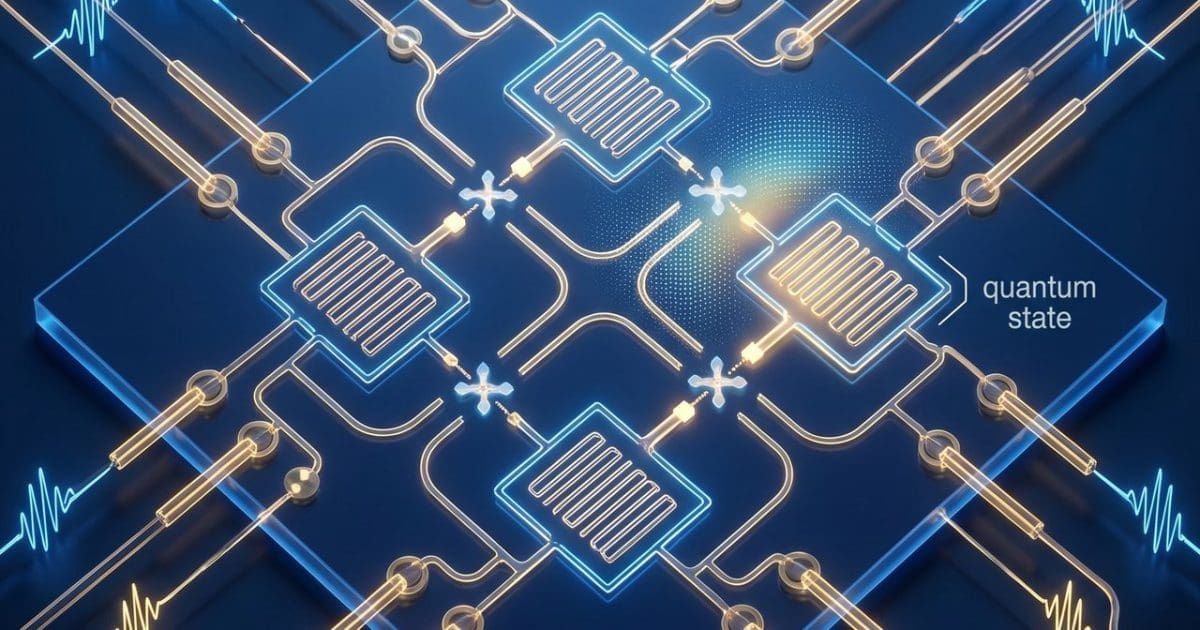
  • IBM and Qedma achieved error-mitigated quantum simulation on an IBM superconducting processor, surpassing classical benchmarks and demonstrating the potential for useful computation on noisy hardware[135]. This marks error mitigation as a key near-term pathway to quantum advantage, though the result remains tied to a specific problem, and its generality awaits verification.
  • The 54-qubit IQM Emerald processor validated the QISS optimization framework, achieving results superior to QAOA in a noisy environment[8]. This suggests that noise-resilient algorithm design may reduce requirements on hardware fidelity, but the framework is still at the proof-of-principle stage and remains distant from practical optimization problems.
  • A novel superconducting qubit suppressed odd-order harmonics by two orders of magnitude by controlling Cooper pair tunneling[15]. This helps reduce stray coupling and crosstalk in superconducting qubits, offering potential value for improving gate fidelity and scalability, though overall performance improvement has yet to be verified in an integrated device.

Silicon Spin Qubits

  • HRL Laboratories demonstrated an 18-qubit silicon spin quantum processing unit in Nature, with the chip operating autonomously without real-time control from room-temperature electronics[58][121]. This integrated architecture co-locates control circuitry with qubits in a cryogenic environment, significantly reducing wiring complexity and latency, providing a viable path for scaling silicon spin qubits, though current logical operation fidelities have not yet reached fault-tolerance thresholds.
  • A study implemented a digitally controlled quantum processing unit in silicon quantum dots, simplifying control signal requirements[52]. This helps enable integrated control of large-scale silicon qubits, but the demonstration involves only a small number of qubits and still needs further proof of fidelity and scalability.

Trapped-Ion Qubits

  • ZuriQ raised $25.5 million in seed funding to develop a quantum computer based on a two-dimensional trapped-ion architecture, and has already demonstrated a 3×3 ion array[61][153]. The 2D architecture promises higher qubit density and connectivity for trapped ions, but a significant gap remains before achieving high-fidelity gate operations and large-scale logical qubits.

Photonic Quantum Computing

  • Pusan National University and UNIST in South Korea demonstrated two-photon interference between two different quantum light sources — a cesium atomic vapor ensemble and a semiconductor quantum dot — achieving photon indistinguishability[68][134]. This is a key step toward hybrid quantum networks and distributed quantum computing, but the interference visibility still needs improvement and the network scale is limited to point-to-point connections.

Neutral-Atom Quantum Computing

  • Infleqtion and three other companies signed contracts to use ABQ-Net, the first open, entanglement-based quantum network testbed in the United States[63][154]. The platform will help validate quantum networking technologies for defense and security applications, but network performance metrics have not been disclosed and practical use remains at an early stage.

In-Depth Analysis · Premium Content

Per-Article In-Depth Analysis is Premium Content

This section contains 2 in-depth article analyses (background / key points / commentary), with source attribution and credibility assessment. The daily brief and the issue summary remain free at all times.

Access code distributed with this issue's paid subscription · Enter once for full-text access
03Algorithms

Algorithms & Software

Quantum Error Correction and Fault Tolerance

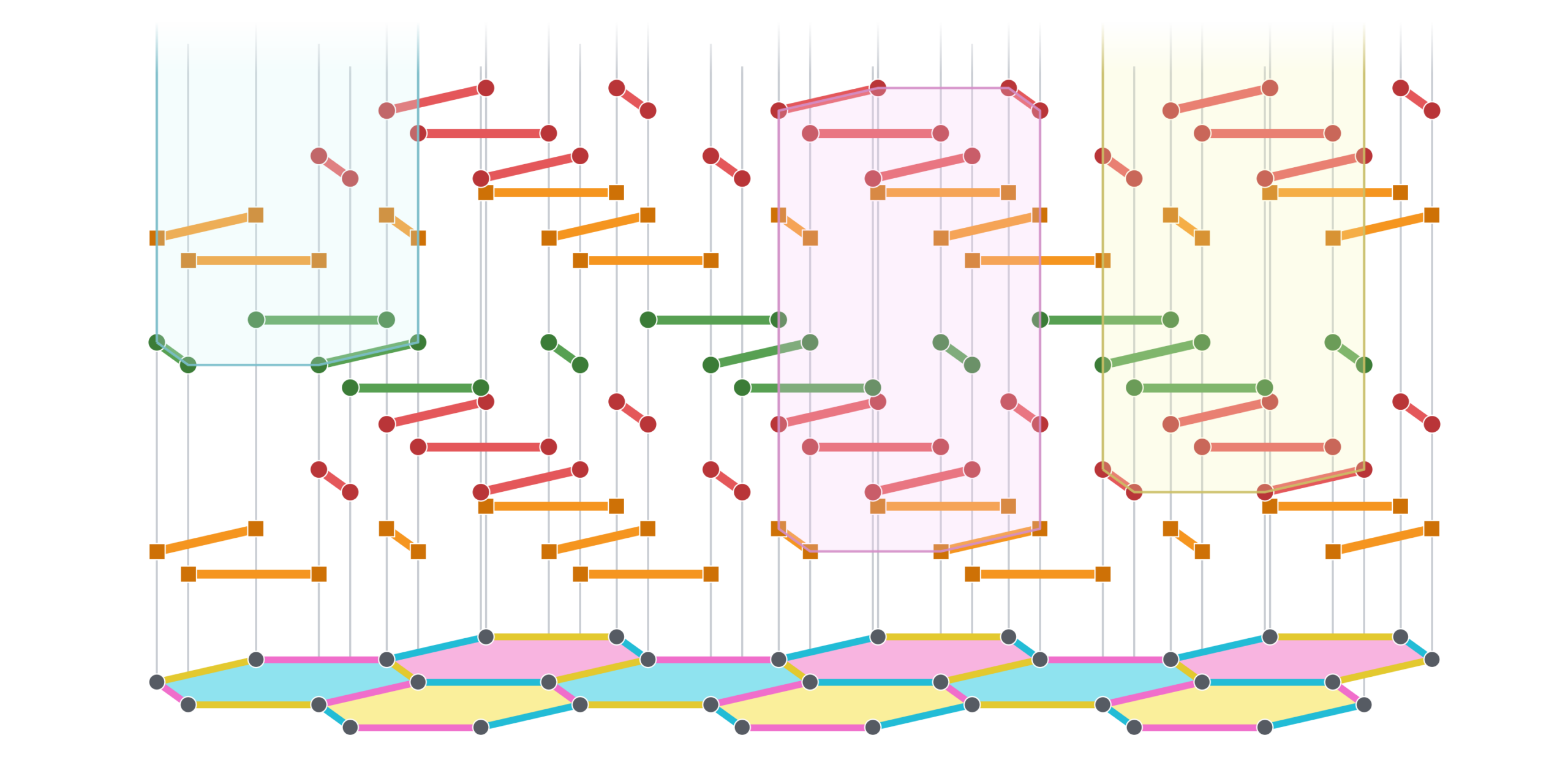
  • IBM and the University of Chicago demonstrated verifiable logical quantum computation, using 70 logical qubits to solve a classically intractable problem and surpassing classical simulation through a new error-correction method[17][148]. This is the first time a credible quantum advantage has been achieved at the logical level, indicating that quantum error correction is moving from principle demonstration toward practicality, but the logical error rate still needs further reduction to enable universal fault-tolerant computation.
  • Riverlane and the Unitary Foundation launched the Deltakit community fund to accelerate the development of open-source quantum error-correction software[64]. This will promote innovation and standardization of error-correction algorithms, but the open-source ecosystem still needs time to mature.
  • A theoretical study developed a partition-function-based framework for estimating the logical error curves of stabilizer codes[85]. The framework provides a more precise tool for evaluating the performance of different error-correcting codes, helping to guide error-correction design on real hardware.

Quantum Machine Learning

  • Cleveland Clinic and IBM developed a quantum convolutional neural network (Q-CHIPP) to predict the immunogenicity of tumor neoantigens[7][139]. The model outperformed classical methods in prediction accuracy, demonstrating the potential advantage of quantum machine learning in biomedicine, but the current demonstration is based on small-scale data and needs validation on larger datasets.
  • A study proved a general computational advantage of quantum machine learning over classical methods for supervised learning tasks[47]. This provides a theoretical foundation for quantum machine learning, but realizing the advantage on real noisy hardware remains challenging.

Optimization and Simulation

  • IQM and Deutsche Bahn demonstrated a hybrid quantum-classical optimization algorithm running on real railway operations data[2]. The application shows that quantum computing has entered the initial validation stage for industrial problems such as logistics scheduling, but the speedup is not yet pronounced and hardware improvements are still needed.
  • A superpixel-based QUBO framework achieved a 33× speedup for medical image segmentation[73]. This indicates that quantum-inspired algorithms can deliver practical acceleration on specific problems, but the speedup depends on the problem structure and generality is limited.
04Industry

Industry & Ecosystem

Quantum Advantage and Commercialization

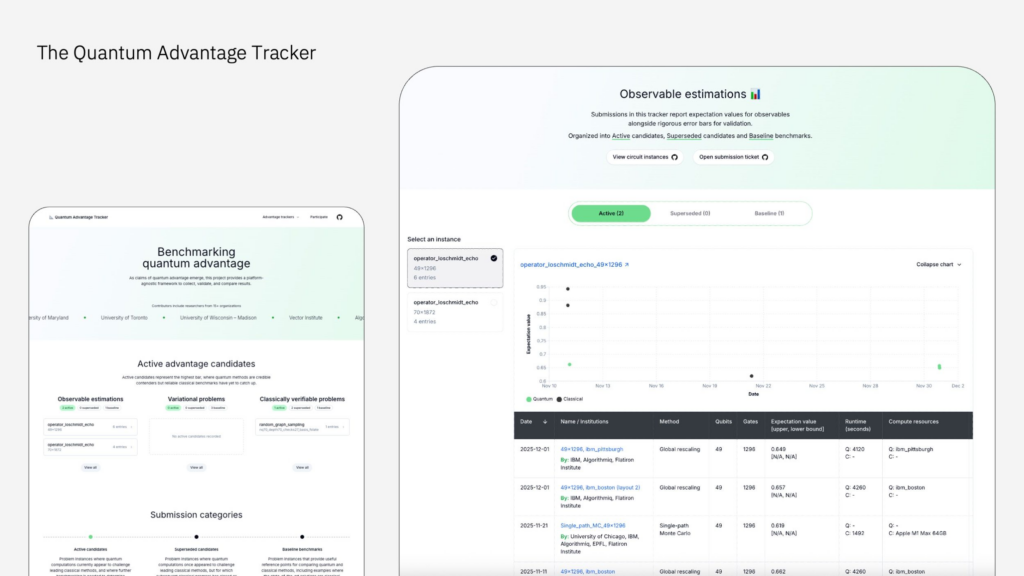
  • IBM and its ecosystem partners (University of Chicago, Qedma, Algorithmiq, RIKEN, BlueQubit) jointly released three quantum advantage demonstrations and published the circuit library on a quantum advantage tracker[65]. This signals that quantum computing companies are shifting from working in isolation to ecosystem collaboration, accelerating advantage verification and standardization, but the advantage demonstrations are still restricted to specific problems and remain some distance from general commercial value.
  • IBM’s CEO predicted that quantum computing will deliver a trillion dollars of value by the late 2030s[146]. The forecast reflects the industry’s optimistic outlook on the long-term economic impact of quantum computing, but near-term revenue contribution is still limited, and technology milestones need to be watched closely.

M&A and Vertical Integration

  • IonQ completed the acquisition of SkyWater Technology, becoming a vertically integrated quantum computing platform company[62][66][142]. The move secures IonQ’s domestic chip fabrication capability in the United States and may reshape the supply chain for trapped-ion quantum computing, but integration risks and cost control require ongoing attention.
  • SEALSQ initiated the commercial deployment of Miraex quantum photonics technology, following the earlier deployment of a $200 million quantum fund[77][141]. This marks the transition of quantum photonics from the lab to the market, but product performance and market demand still need validation.

Partnerships and Ecosystem Building

  • EY deployed an on-premises quantum computer at its Canadian innovation center to explore enterprise-grade quantum applications[3][10][123]. This shows that professional services firms are actively building quantum capabilities, paving the way for future quantum consulting and auditing businesses, but current hardware capability is still limited to exploratory projects.
  • AT&T expanded its collaboration with D-Wave to use quantum annealing for optimizing telecom network operations[57]. The partnership applies quantum annealing to a real-world network, demonstrating the potential value of quantum computing for specific optimization problems, but the speedup needs to be verified on larger-scale networks.
  • Horizon Quantum partnered with Quantum Machines to develop embedded quantum calibration technology[59][126]. This helps improve the stability and availability of quantum computers and reduces manual calibration overhead, representing a key step toward automation and scaling of quantum computing.

Policy and Standards

  • NIST finalized three post-quantum cryptography standards to defend against the future threat posed by quantum computers[83]This marks the entry of post-quantum cryptography migration into the implementation phase; governments and enterprises must accelerate deployment to safeguard data security.
  • QED-C and CQN released a quantum network application roadmap, clarifying technical requirements and milestones.[60][125]This provides a consensus framework for the development of quantum networks, helping to coordinate research and investment directions.
  • The U.S. Naval Research Laboratory (NRL) outlined its strategic priorities in quantum sensing, computing, and networking.[67][133]This reflects the defense sector's emphasis on military applications of quantum technology, potentially accelerating the development and deployment of related technologies.
05Academia

Academic Frontier

Quantum Error Correction and Fault Tolerance

  • A study demonstrated a deeply optimized embedding scheme for surface code scaling on an IBM superconducting processor, achieving sub-threshold scaling on hardware with non-matching connectivity.[49]This offers a new pathway to practical quantum error correction on existing hardware, but the logical error rate still needs to be substantially reduced.
  • Dynamical stabilizer codes were shown to work effectively under noisy readout conditions, providing flexibility for error-correction design under hardware constraints.[89]This contributes to achieving more robust quantum memories on near-term devices, but experimental verification is needed.

Quantum Algorithms and Applications

  • An interpretable quantum compressive machine learning model compressed the number of parameters to below 100 in a complex fluid flow simulation.[21]This indicates that quantum machine learning can drastically reduce model complexity, but accuracy and generalization capability require further evaluation.
  • A quantum circuit compressible flow surrogate model reduces parameters to below 100 while maintaining accuracy.[21]This provides new ideas for applying quantum machine learning in scientific computing, but implementation on actual quantum hardware still faces challenges.

Quantum Simulation and Physics

  • Time-crystalline order was observed on superconducting qubits, persisting for 120 cycles.[16]This verifies the existence of time crystals in quantum systems and provides a platform for studying non-equilibrium quantum matter, but the number of cycles is still limited, requiring extended coherence times.
  • Quantum simulators revealed topological phase transitions and mixed-state order.[46]This aids in understanding the behavior of strongly correlated quantum systems, but the simulation scale remains constrained by current hardware.

Quantum Networks and Communication

  • A bidirectional quantum analog-to-digital converter achieves conversion between photonic wavefronts and qubits.[44]This provides an interface for connecting different quantum systems, but conversion efficiency and fidelity need improvement.
  • Neural networks were used to classify multipartite continuous-variable entanglement structures, addressing the problem of insufficient training data through data augmentation.[53]This offers a new tool for quantum information processing, but classification accuracy depends on network architecture and training strategy.
06Impact

This Week's Impact

  • Increased credibility of quantum computing: IBM's demonstration of logical qubit advantage[17][65]Combining quantum error correction with practical problems may change external perceptions of quantum computing's near-term practicality, prompting more enterprises to invest in quantum application exploration.
  • Ion-trap supply chain reshaping: IonQ's acquisition of SkyWater[62][66]After the acquisition, the critical chip manufacturing segment for ion-trap quantum computing is internalized, potentially creating competitive pressure on other ion-trap companies (such as Quantinuum) that rely on external foundries; their production capacity and yield warrant attention.
  • Accelerated post-quantum cryptography migration: The finalization of NIST standards[83]Forces critical industries such as finance and government to accelerate cryptographic system upgrades, with related software and service markets poised for growth, while the quantum network roadmap[60]provides a direction for long-term secure communications.
  • Active quantum software ecosystem: The collaboration between Horizon Quantum and Quantum Machines[59]and the Deltakit community fund[64]indicate that quantum software and error-correction tools are moving toward specialization and open-source collaboration, which will lower the barrier to entry for quantum computing.
  • Increased defense quantum technology investment: NRL's strategic release[67]and ABQ-Net's defense applications[63]show that the priority of quantum sensing and networking in the military domain is rising, potentially attracting more venture capital into this market segment.
07Editor's Note

Editor's Note

The most significant development this week is that IBM and its partners achieved verifiable quantum advantage on logical qubits, marking a transition from the noisy era of physical qubits to the practical verification of logical qubits. Although this advantage remains limited to specific problems and the logical error rate has not yet met the requirements for universal fault-tolerant computing, it combines quantum error correction with beyond-classical capability for the first time, setting a new milestone for the industry. Meanwhile, the completion of IonQ's acquisition of SkyWater signals that quantum computing companies are pursuing vertical integration to control key manufacturing steps, potentially triggering supply chain competition in the ion-trap sector. Furthermore, the finalization of post-quantum cryptography standards and the release of the quantum network roadmap indicate that quantum security is shifting from a theoretical threat to practical deployment, with related industries set to enter a period of rapid growth. However, we also note that despite continuous advances in hardware and algorithms, quantum computing remains years away from solving real commercial problems; investors should guard against excessive hype and focus on substantive progress at technical milestones.