Jul 28, 2026 – Jul 29 · Daily Brief

U.S. quantum network ABQ-Net connects first commercial users

38 items · 12 sourcesPDFThis issue's roundup is free
02Hardware

Hardware Frontiers

Trapped ion

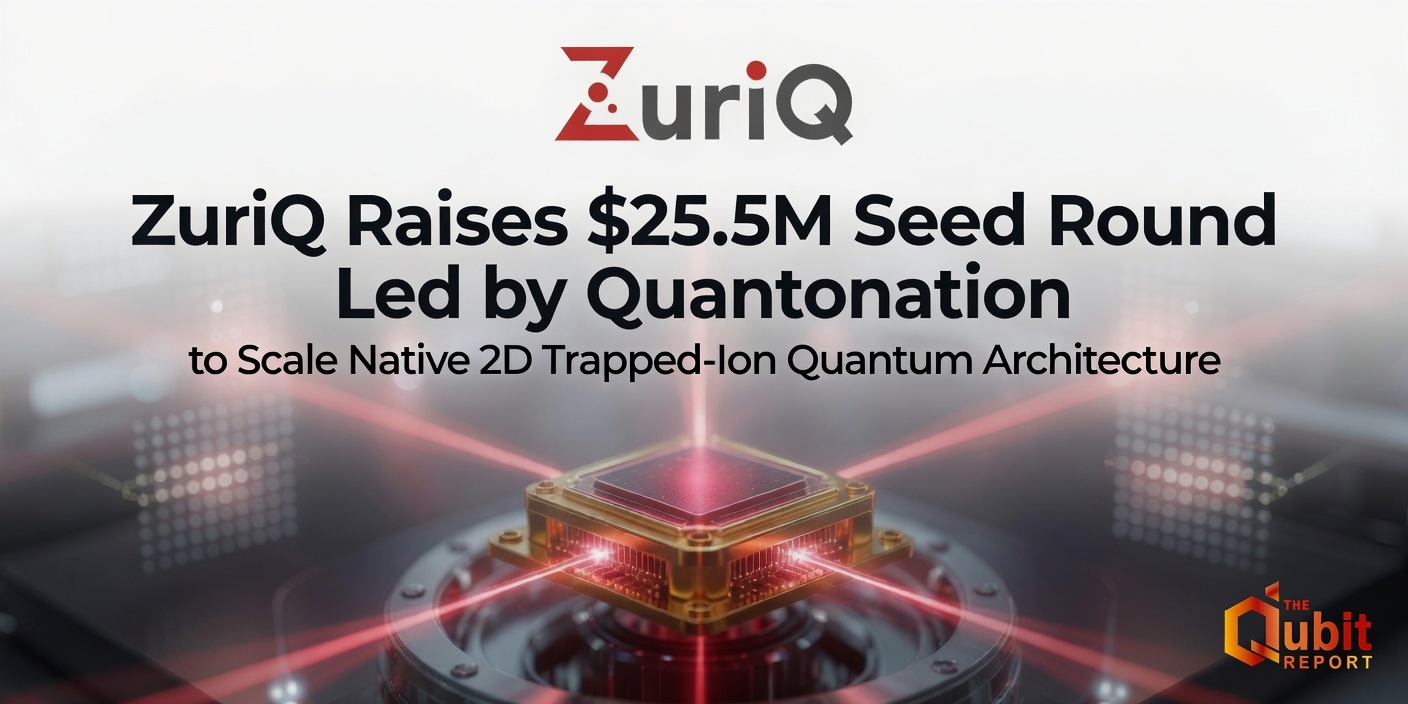
  • ZuriQ has secured $25.5 million in seed funding to scale its native 2D ion-trap architecture: the ETH Zurich spin-out has demonstrated a 3×3 ion array using Infineon-fabricated chips. The 2D layout is expected to overcome the scaling bottleneck of traditional 1D ion-trap chains, but the current scale is far smaller than Quantinuum Helios’s 98 qubits, and it remains unclear whether full connectivity is preserved[16][36].
  • Infleqtion has appointed Joseph Buck as Senior Vice President of Quantum Computing Systems to lead Sqale development: Buck previously built systems approaching 100 qubits, and his addition may accelerate the engineering of Infleqtion’s neutral-atom quantum computer, though this approach currently lags behind QuEra’s 96 logical qubits in logical qubit count[4][18].

Photonics/Quantum Networks

  • Four quantum companies join New Mexico’s ABQ-Net open quantum network: the network, built by Qunnect, is part of New Mexico’s $450 million quantum investment and represents the first enterprise-grade open-access entanglement distribution. It may accelerate quantum network application testing, but network performance metrics (such as entanglement distribution rate and fidelity) have not yet been disclosed[12][37].
  • Germany plans a nationwide fiber-optic network, the QFT-backbone, to strengthen quantum connectivity: the network aims to advance quantum technology and time/frequency metrology research and may provide a backbone for European quantum communication infrastructure, but the specific timeline and number of nodes have not been announced[13].
03Algorithms

Algorithms & Software

  • Quemix and Sumitomo Rubber propose a quantum-classical hybrid method to solve readout problems: the method enables the computational cost on a quantum computer to grow logarithmically with the number of grid points, potentially reducing the number of quantum gates, but the actual speedup depends on the specific problem and no comparison with other methods has been made[17].
  • Research reveals the role of data-induced randomness in quantum machine learning: the work indicates that randomness during the data embedding process can affect model performance, providing theoretical guidance for designing more effective quantum machine learning models, but no specific performance improvement figures are given[9].
  • Research demonstrates the relationship between quantum machine learning advantage and universal computational advantage: this theoretical work establishes stricter conditions for quantum machine learning advantage, helping to distinguish genuine quantum advantage from classical simulation, but it has not yet been experimentally verified[8].
04Industry

Industry & Ecosystem

  • Infleqtion and Quantinuum have respectively announced they will release second-quarter earnings on August 12 and August 11: the financial data of the two publicly listed companies will reflect the commercialization progress of the neutral-atom and ion-trap approaches; attention should be paid to their revenue composition and R&D investment[3][10].
  • IonQ has received regulatory approval to complete the acquisition of SkyWater Technology: this move will give IonQ its own foundry, potentially accelerating the production of its ion-trap processors, though integration risks exist[25].
  • EPFL collaborates with Quantinuum to provide cloud access to ion-trap quantum computers via the SCITAS platform: this is the first time a Swiss academic institution has embedded quantum computing into a high-performance computing environment, aiding algorithm development and talent cultivation[35].
  • Riverlane and the Unitary Foundation launch the "Deltakit Community Fund" to accelerate open-source quantum error correction: the fund will support the development of open-source error correction software tools, potentially lowering the barrier to entry for error correction research[27].
  • C12 unveils a roadmap for carbon-nanotube spin qubits, targeting practical fault-tolerant quantum computing by 2033: the roadmap includes four generations of systems, from Aïdôs in 2027 to Panopeia in 2033, but carbon-nanotube technology is still in its early stages and faces intense competition[5].
  • NVision Quantum receives €2.5 million in Horizon Europe funding for its quantum-enhanced MRI platform: the technology leverages quantum effects to improve medical imaging, but the commercialization path is long[11].
  • Other developments: QURECA partners with SciSpace to provide quantum learning resources[15]; EigenQ appoints new senior leadership[34]; Vietnam hosts an international quantum hackathon[30]; London to host the City Quantum & AI Summit[31]; Two Hands Corporation opens testing for its quantum circuit simulator[26]; NordForsk joins the G7 quantum research funding initiative[29].
05Research

Research Frontiers

  • Researchers map the dynamics of "magic" resources in random quantum states: magic is a key resource enabling quantum computation to surpass classical computation. The study uses large-q random circuits to reveal the statistical behavior of magic, potentially guiding fault-tolerant quantum circuit design, but it remains far from practical application[14].
  • A partition-function-based framework is proposed for estimating logical error curves of stabilizer codes: the method applies a statistical-mechanics mapping to decoding success probability, potentially improving the efficiency of quantum error correction performance evaluation, but it requires validation on specific codes[20].
06Impact

This Week's Impact

  • Commercialization of the neutral-atom camp accelerates: Infleqtion’s entry into the quantum network ecosystem and strengthened leadership indicate that this approach is moving from the laboratory to the market, but attention should be paid to whether its logical qubit fidelity and repetition rate can compete with ion traps[4][12][37].
  • A new idea for ion-trap scaling: if ZuriQ’s 2D architecture succeeds, it may break through the current scaling bottleneck of ion traps, but it is unlikely to shake the positions of Quantinuum and IonQ in the short term; investors should monitor subsequent array scaling and gate fidelity data[16][36].
  • Quantum networks move from concept to implementation: the signing of enterprises for ABQ-Net marks the beginning of building a commercial ecosystem for quantum networks, but network performance metrics are absent, and practical application value remains to be verified[12][37].
  • Quantum error correction ecosystem building: Riverlane’s open-source fund may accelerate innovation in error correction algorithms, but hardware improvement remains the main challenge[27].
  • Earnings season focuses on commercialization progress: the financial reports of Infleqtion and Quantinuum will reveal the revenue models and growth potential of quantum computing companies, influencing industry investment sentiment[3][10].
07Editors

Editor's Note

This week, the quantum computing industry shows a trend of multiple approaches advancing in parallel, but the focus is on early signs of quantum networks shifting from experimental demonstrations to commercial deployment. New Mexico’s ABQ-Net, despite limited details, represents a turning point where quantum communication moves from pure research to enterprise participation, and its open-access model could become a template for future quantum networks. Meanwhile, both neutral-atom and ion-trap hardware companies are strengthening their engineering capabilities, appointing senior experts and securing large-scale funding, indicating that the industry is shifting from pursuing physical qubit counts to building scalable systems. However, most progress remains at an early stage, and bottlenecks in fidelity, repetition rate, and cost still need to be resolved before practical use. It is worth noting that the construction of the quantum error correction ecosystem (open-source funds, academic collaborations) may accelerate the translation of theory into practice, while the upcoming earnings reports will test the market’s patience for the commercialization of quantum computing.