Jul 29, 2026 – Jul 30 · Daily Brief

HRL Laboratories achieves autonomous operation of silicon spin quantum processor and demonstrates error correction

51 items · 11 sourcesPDFThis issue's roundup is free
02Hardware

Hardware Frontiers

Silicon spin qubits

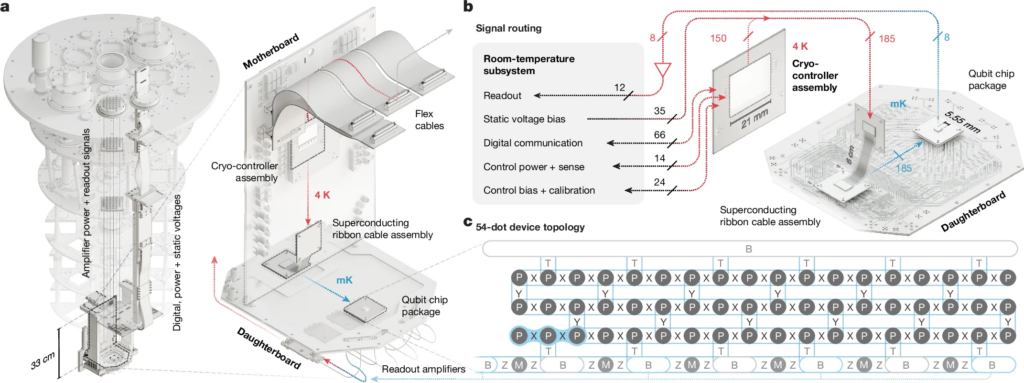
  • HRL Laboratories demonstrated an 18-qubit silicon spin quantum processor that, by integrating a custom cryogenic CMOS chip, achieves autonomous operation without real-time control from room-temperature electronics and performs error-correction operations[11]. This is the first time silicon spin qubits have achieved autonomous error correction under integrated cryogenic control; compared with previous schemes that relied on external control equipment, it drastically reduces interconnect complexity and may pave the way for scaling to thousands of qubits[11]. This result sits at the SOTA frontier of this roadmap, but reaching fault-tolerant computing still requires improvements in fidelity (current two-qubit gate fidelity undisclosed; SOTA is 99.99% [SQC]) and scale[11].
  • A University of California research team optimized the Si/SiGe heterojunction design, achieving a valley splitting of 5 meV, exceeding previously reported values[27]. Valley splitting is a key challenge for scaling silicon spin qubits; higher valley splitting facilitates consistent initialization, operation and readout, and this advance addresses that bottleneck[27].

Superconducting qubits

  • IBM demonstrated sub-threshold scaling of the surface code on a heavy-hexagonal superconducting processor, solving the problem of hardware connectivity mismatching the surface code through co-designed code embedding and control[6]. This is the first demonstration of surface-code sub-threshold scaling on superconducting hardware with non-square-lattice connectivity, implying that IBM’s fixed-coupler architecture can also support fault-tolerant computing, but practical use still requires higher fidelity and lower error rates (current Λ value undisclosed; SOTA is Google Willow’s Λ ≈ 2.1)[6].

Trapped-ion qubits

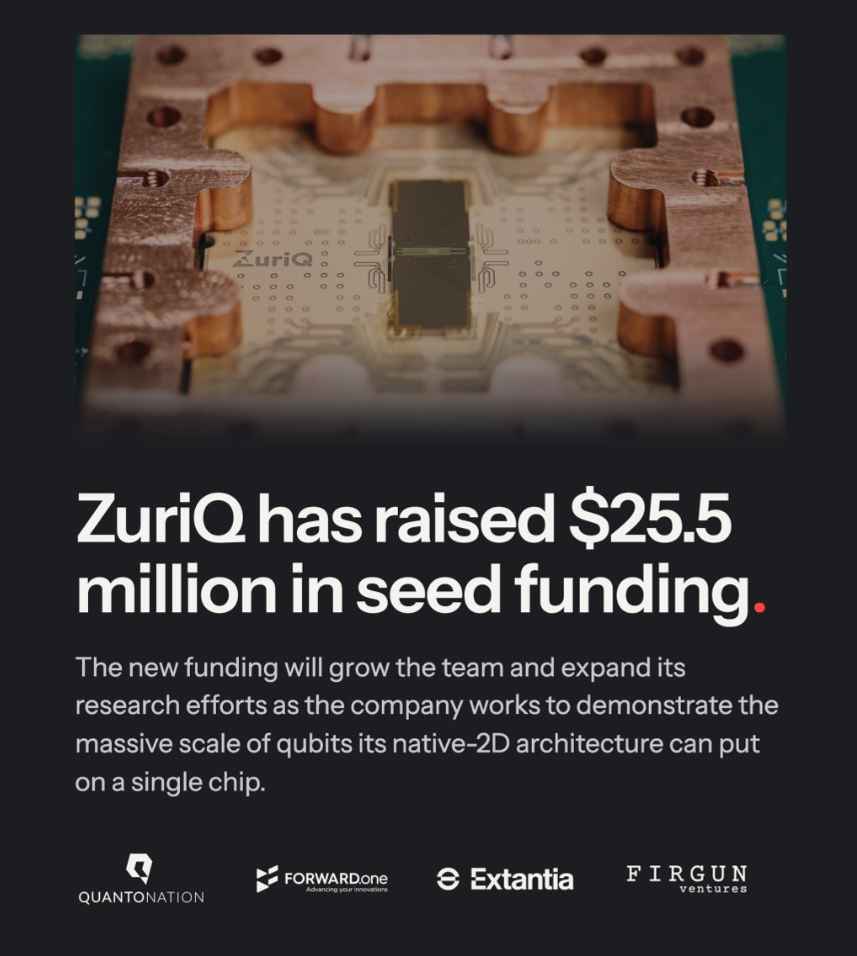
  • ZuriQ raised $25.5 million in seed funding to advance its 2D ion-trap quantum computing architecture and is partnering with Infineon for manufacturing[14]. 2D ion traps are expected to overcome the scaling bottleneck of traditional one-dimensional chains; if successful, they will improve qubit density and connectivity for ion traps, but the effort is still at an early stage and needs to verify fidelity and manufacturability[14].

Topological quantum materials

  • Researchers synthesized TaSiAs nanowires, achieving 4 to 11 times higher conductivity than the bulk material, and they remained stable under silica-shell encapsulation, exhibiting coherent electron transport[26]. This new material may be used in next-generation quantum computing, but there is still a long road to device integration[26].
03Algorithms

Algorithms & Software

  • Horizon Quantum and Quantum Machines are collaborating to develop embedded calibration technology, aiming to deploy calibration software directly in quantum hardware control systems to achieve real-time, lightweight calibration[12]. This is expected to reduce quantum computer downtime and improve availability, which is particularly important for cloud quantum service providers[12].
  • Researchers at the Indian Institute of Science proposed a noise-aware quantum resource allocation framework that reduced the number of measurements required for reliable quantum computing by 58%, lowered total error by 73%, and cut energy consumption by 62%[21]. This directly addresses the high cost of algorithm execution in the NISQ era, making more complex algorithms feasible on near-term hardware[21].
  • A University of Oxford team designed stacked linear combinations of unitaries (stacked LCUs), providing a tunable trade-off between quantum gate complexity and classical simulation cost, potentially mitigating the barren-plateau problem in variational quantum circuits[22]. This construction offers a new tool for demonstrating quantum advantage, but practical advantage still needs to be verified on concrete problems[22].
  • Researchers at the SQMS Center generalized Grover search to multi-level quantum systems (qudits), breaking through the previous restriction to power-of-two dimensions[23]. This can reduce circuit depth and resource requirements, holding significant importance for emerging qudit hardware platforms[23].
  • An IET research team developed an experimental tracking protocol for quantum software development, identifying dimensions, circuit parameters, measurement outcomes and noise signatures specific to quantum programs[24]. This helps improve the reproducibility of quantum software research and fills a gap in quantum software engineering[24].
  • Researchers developed the MPStab simulator, which combines stabilizer techniques and tensor networks to extend the range of classical simulation of quantum systems[25]. This helps delineate the boundary of quantum advantage and can be used to verify near-term quantum devices[25].
  • The open-source software atommovr was released for simulating atom rearrangement processes in neutral-atom arrays[30]. As neutral-atom processors scale up, efficient rearrangement becomes critical; this tool can help optimize experimental design[30].
  • A quantum journal paper studied the performance of dynamic codes under noisy readout and proposed design methods for dynamic codes tailored to noisy readout hardware[31]. Readout error is a key bottleneck in quantum error correction; this study provides guidance for code design on real hardware[31].
04Industry

Industry & Ecosystem

  • IonQ completed the acquisition of SkyWater Technology, gaining the largest semiconductor foundry on U.S. soil, in a transaction valued at $1.8 billion[15]. This enables IonQ to vertically integrate the manufacturing of ion-trap quantum processors, accelerate scaled production, and potentially reshape the quantum computing manufacturing landscape[15].
  • Four quantum companies (Infleqtion, Aliro Technologies, Tensora, Bandelier Technologies) joined the ABQ-Net quantum network testbed to verify defense and security technologies[16]. This marks the opening of the first open-access entangled quantum network in the U.S. to commercial users, potentially accelerating the development of quantum network applications[16].
  • Riverlane and the Unitary Foundation launched the Deltakit Community Fund to support open-source quantum error correction software development[17]. This will foster a thriving QEC software ecosystem, lower the barrier to entry, and accelerate progress in error correction technology[17].
  • QED-C and CQN jointly released a quantum network application roadmap, gathering input from over 50 experts[13]. The roadmap provides technical guidance for the development of the quantum internet and helps coordinate research directions across industry and academia[13].
  • Ernst & Young (EY) announced the deployment of an on-premises quantum computer at its facilities[43]. This reflects an early bet by professional services firms on the potential of quantum computing and may spur exploration of quantum computing applications in finance and business[43].
  • GlobalFoundries received $300 million in CHIPS Act funding for silicon photonics research[47]. Silicon photonics is a key enabling technology for optical quantum computing; this investment will strengthen U.S. competitiveness in optical quantum computing manufacturing[47].
  • Israel is promoting the establishment of a national quantum R&D center to unite industry[49]. This demonstrates Israel’s recognition of the strategic value of quantum technology and may accelerate the commercialization of quantum technology in the country[49].
  • IQM quantum computers registered 183,619 new shares from an employee stock ownership plan[44]. This reflects IQM’s talent incentives but has no direct technical impact[44].
05Research

Research Frontiers

  • Researchers at the University of Chicago defined a non-local order parameter for two-dimensional symmetry-protected topological (SPT) phases via entanglement[19]. This provides a new perspective for understanding SPT phases and may aid in developing topological quantum computing schemes[19].
  • A Peking University team studied many-body periodic orbits in periodically driven spin systems, finding that the quasi-particle band structure dominates a long-lived prethermalization regime whose lifetime can be tuned through band dispersion engineering[20]. This offers a new method for controlling thermalization in driven quantum systems, with potential applications in quantum simulation[20].
  • A quantum journal paper studied the relationship among stabilizer rank, Barnes–Wall lattices and magic-state monotones[28]. This contributes to a deeper understanding of quantum resource theory and may be used to optimize quantum circuit compilation[28].
  • Another quantum journal paper proposed modulator-assisted Zeno control for energy transport in quantum batteries[29]. This provides a new scheme for efficient charging of quantum batteries, but practical application remains distant[29].
  • A philosophy paper, *Tractatus Quanticus*, attempts to revise Wittgenstein’s worldview from the perspective of quantum mechanics[18]. This belongs to quantum foundations research and has limited impact on technology development[18].
06Impact

This Week's Impact

  • Silicon spin qubit community: HRL’s autonomously operated processor validates the cryogenic CMOS integration route and may prompt more institutions to invest in this direction, but attention must be paid to whether its fidelity can reach fault-tolerance thresholds[11].
  • Quantum error correction software developers: The launch of the Deltakit Fund will directly support open-source QEC tools; developers should watch for project calls[17].
  • Ion-trap manufacturers: IonQ’s acquisition of SkyWater may trigger a wave of manufacturing vertical integration; other ion-trap companies may need to consider similar strategies to remain competitive[15].
  • Quantum network startups: The release of the QED-C roadmap and the opening of ABQ-Net provide a technology validation platform for quantum network applications, which relevant enterprises can leverage to accelerate product development[13][16].
  • Quantum algorithm researchers: The noise-aware resource allocation framework and stacked LCUs provide new tools for NISQ algorithms; algorithm demonstrations on near-term hardware may benefit from these methods[21][22].
07Editors

Editor's Note

The most striking development this week is HRL Laboratories’ progress on silicon spin qubits, which for the first time integrates cryogenic CMOS control with silicon quantum dots to achieve autonomous quantum operation and error correction. This marks an important step for silicon-based quantum computing from laboratory demonstration toward engineering, because silicon spin qubits have always been known for compatibility with semiconductor processes, yet the complexity of control electronics has been a major obstacle to their scaling. If HRL’s scheme can prove sufficiently high fidelity, it could change the standing of the silicon spin route in the quantum computing race.

Meanwhile, industry consolidation and investment remain active: IonQ’s acquisition of SkyWater, ZuriQ’s large funding round, and GlobalFoundries’ government funding all indicate that quantum computing is shifting from pure research toward manufacturing and supply-chain construction. However, breakthroughs in hardware metrics still need to be viewed with caution — many advances are still at an early stage and remain years away from practical use.