Jul 31, 2026 – Aug 1 · Daily Brief

IBM量子计算机首次实现纠错后超越经典计算能力

43 items · 10 sourcesPDFThis issue's roundup is free
02Hardware

Hardware Frontiers

Superconducting Qubits

  • Researchers developed a hybrid superconducting qubit that suppresses odd-order harmonics by two orders of magnitude via controlled Cooper-pair tunneling. This potentially enables the suppression of harmful quasiparticle tunneling noise in superconducting qubits, offering a new pathway to improve coherence times and gate fidelities [15].
  • Time-crystalline order was observed on a superconducting qubit, persisting for 120 cycles. This is the first realization of such long-lived time-crystal behavior on a solid-state platform, validating the stability of non-equilibrium quantum phases in noisy environments, with potential implications for quantum simulation and quantum memory [16].

Photonic Quantum Computing

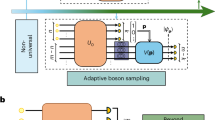
  • A theoretical study proposed a scalable, universal photonic quantum computing architecture integrating strong nonlinear resources. This offers a new solution to overcome the nonlinearity bottleneck in photonic computing and could propel the photonic route toward fault-tolerant computation [23].

Quantum Internet and Interconnects

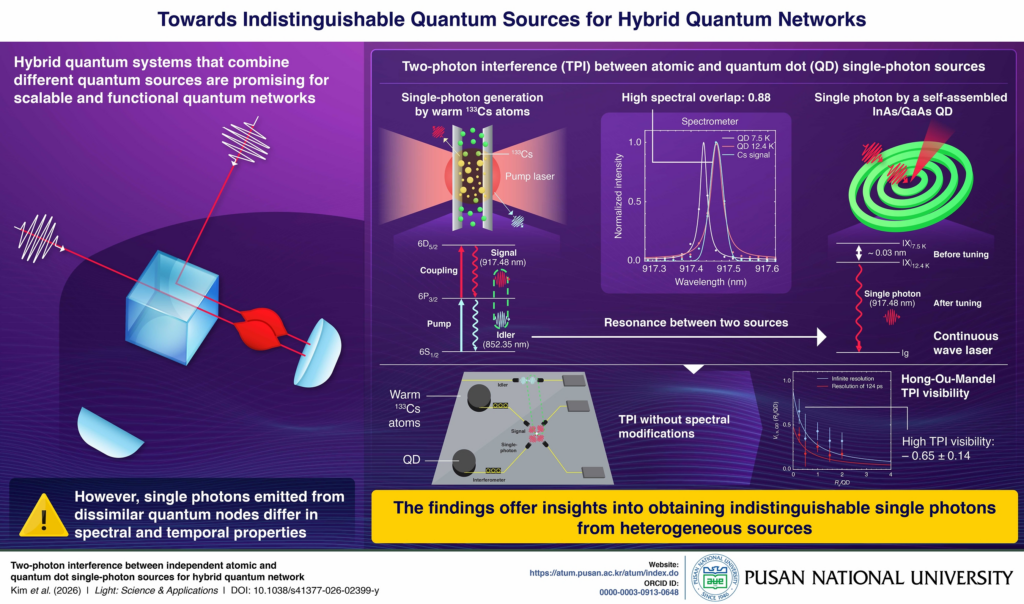
  • Researchers from Pusan National University and UNIST achieved two-photon interference between two independent, unsynchronized quantum light sources (a warm atomic ensemble and a semiconductor quantum dot), with photon indistinguishability reaching a key benchmark. This is a significant step toward building hybrid quantum networks, demonstrating for the first time the feasibility of quantum interconnects between completely different physical platforms [26].

Quantum Simulation and Optimization Hardware

  • The noise-robust optimization framework QISS was validated on a 54-qubit IQM superconducting processor, outperforming QAOA on specific problems. This indicates that carefully designed heuristic algorithms can still extract quantum computational advantages even on mid-scale noisy devices, providing a new benchmark for near-term optimization applications [8].
  • The lifetime of Rydberg quantum spin waves was extended by approximately 9 times using a new addressing scheme. This directly enhances the storage time of quantum repeaters and quantum network nodes based on Rydberg atoms, representing a step toward practical quantum memories [9].
03Algorithms

Algorithms and Software

Quantum Error Correction and Fault Tolerance

  • IBM and the University of Chicago demonstrated quantum advantage with 70 logical qubits, employing a new error correction method to complete a classically intractable computation on logical circuits. This is the first realization of credible quantum computation under error correction protection. Unlike previous logical qubit demonstrations, which were mostly limited to memory or simple gate operations, this work validates fault-tolerant capabilities on complex logical circuits. However, specific error correction code distance and logical error rates have not been disclosed, and comparison with the surface code benchmark of Λ≈2.1 still requires complete data [17][42].
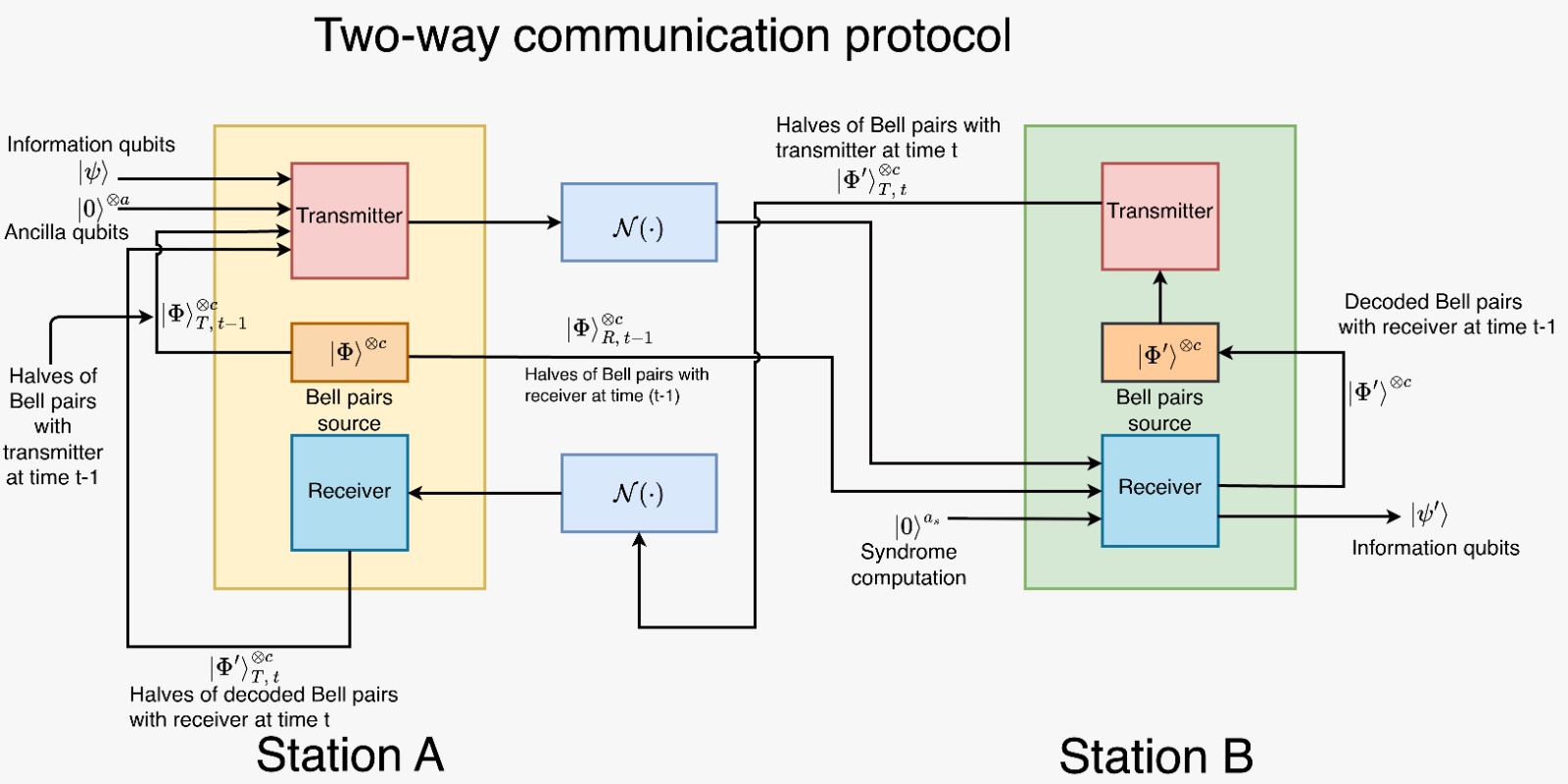
  • A study proposed a framework based on cumulant expansion to analyze the impact of correlated coherent errors on logical error rates in stabilizer codes. This provides a new tool for modeling non-standard noise in quantum error correction, aiding more accurate assessment of fault-tolerance thresholds [12].
  • Newly constructed entanglement-assisted quasi-cyclic quantum low-density parity-check codes, designed via structured permutation matrices, improve encoding rates and error correction capabilities. This provides candidate solutions for hardware-efficient implementation of quantum error-correcting codes, holding potential especially for fault-tolerant architectures requiring low overhead [27].

Quantum Machine Learning

  • Cleveland Clinic and IBM developed a quantum convolutional neural network model, Q-CHIPP, for predicting neoantigens arising from tumor gene mutations. The model shows potential superiority over classical methods in screening immunotherapy targets, marking the first practical application validation of quantum machine learning in biomedicine, though acceleration on real quantum hardware has not yet been achieved [7].

Quantum Optimization and Applications

  • IQM, in collaboration with Deutsche Bahn, ran a hybrid quantum-classical optimization algorithm on the Emerald quantum processor to solve train scheduling problems. This is the first end-to-end validation using real-world data for quantum computing in the transportation sector. However, the magnitude of improvement in optimization quality over classical heuristic algorithms has not been disclosed, warranting attention to actual business benefits [2].
  • A Kalman filter was used to stabilize magnetic field drift in real-time during ultracold atom experiments, eliminating drifts up to 70 nT/hr. This technique enhances the stability of quantum simulation and quantum sensing platforms and can be directly transferred to other precision measurement systems [13].
04Industry

Industry and Ecosystem

Corporate Strategy and Integration

  • IonQ completed the acquisition of SkyWater Technology, becoming a vertically integrated quantum platform company possessing in-house design, wafer fabrication, and packaging capabilities. This marks the first time an ion-trap quantum computing company controls a semiconductor manufacturing segment, potentially accelerating the large-scale production of ion-trap chips and reducing costs [24][36].
  • SEALSQ began the commercial deployment of Miraex's quantum photonic technology, signaling the market entry of quantum photonic sensing or communication components, a positive signal for the quantum security and quantum network industry chain [35].
  • EY deployed an on-premises quantum computer in Canada as part of its global technology strategy. This indicates that professional services firms are actively building internal quantum computing capabilities to explore applications in finance, optimization, and other areas, potentially influencing enterprise clients' adoption of quantum technology [3][10].

Policy and Funding

  • The U.S. National Science Foundation awarded $18 million to the University of California, San Diego, to establish a Quantum Materials MRSEC, as part of a $108 million national materials initiative. This will accelerate fundamental research on topological materials, superconducting quantum materials, etc., providing materials science support for next-generation quantum hardware [5].
  • The U.S. Naval Research Laboratory's Quantum Science Institute announced its strategic research priorities, coordinating Navy quantum information science and technology efforts around navigation, sensing, and secure communication, reflecting the defense sector's sustained investment and demand for practical quantum technologies [14][25].

Market and Ecosystem

  • IBM's CEO predicted that quantum computing will begin contributing revenue by the late 2020s and create a trillion-dollar value by the late 2030s. While this optimistic forecast represents an industry giant's judgment on the quantum commercialization timeline, it needs to be assessed cautiously against technical milestones; near-term revenue still relies on quantum cloud services and software tools [40].
  • Two Hands Corporation (proposing to rename to Quantum X Inc.) began external beta testing of its quantum circuit simulator, EntangleX. Although the company is a micro-cap stock, the trend of ecosystem fragmentation in quantum software tools is evident, with startups vying for simulator market share [1].
  • Vexlum established an R&D laboratory in the UK, focusing on VECSEL lasers, a key light source for ion-trap and neutral-atom quantum computers. This move could enhance Europe's autonomy in the upstream supply chain for quantum hardware [4].
05Other

Academic Frontiers

Quantum Error Correction and Fault-Tolerant Theory

  • A new paper, "Extensible universal photonic quantum computing with nonlinearity," proposed a photonic quantum computing architecture integrating nonlinear resources, solving the long-standing nonlinearity bottleneck in universal photonic computing and providing a theoretical blueprint for scalable, fault-tolerant photonic computation [23].
  • Research on entanglement-assisted quasi-cyclic quantum LDPC codes achieved efficient encoding through structured design. Such codes have potential advantages in fault-tolerance overhead and may influence future hardware choices for error-correcting codes [27].

Quantum Noise and Error Mitigation

  • The cumulant expansion framework provides a tractable expression for logical error rates under correlated coherent errors. This tool can be integrated into existing error correction simulators, enhancing the predictive capability for realistic noise [12].

Quantum Networks and Interconnects

  • The demonstration of two-photon interference between independent quantum light sources validated the core technical feasibility of hybrid quantum networks. It achieved, for the first time, a quantum interconnect between two distinct physical systems—an atomic ensemble and a quantum dot—laying a foundation for distributed quantum computing and quantum repeaters [26].

Quantum Simulation and States of Matter

  • Time-crystalline order was observed on a superconducting qubit, persisting for 120 cycles. This work validated the robustness of time crystals on a solid-state platform, providing a new experimental platform for studying non-equilibrium quantum phase transitions [16].

Quantum Algorithms and Applications

  • The Q-CHIPP model applied quantum machine learning to cancer neoantigen prediction, achieving preliminary results superior to classical models in discovering immunotherapy targets, demonstrating the potential of quantum computing in precision medicine [7].
06Impact

This Week’s Impact

  • For the Superconducting Quantum Computing Route: IBM's logical qubit quantum advantage demonstration [42] reinforces the leading position of the superconducting platform in the fault-tolerant computing race. However, specific error correction performance metrics are undisclosed. Competitors like Google Willow (surface code Λ≈2.1) still hold clear benchmarks; subsequent code distance and error rate data require attention.
  • For Ion Trap and Neutral Atom Routes: IonQ's acquisition of SkyWater [24] may accelerate ion-trap chip manufacturing, but whether vertical integration can solve the inherent shortcoming of slow qubit-number scaling in ion traps (currently max 98 qubits) remains questionable. The neutral atom route (QuEra 96 logical qubits) still leads in logical qubit count, but the issue of low cycle repetition rate is unresolved. Progress in photonic interconnects [26] may provide remote entanglement solutions for neutral atoms.
  • For the Quantum Software and Application Ecosystem: IQM's scheduling optimization with Deutsche Bahn [2] and Cleveland Clinic's quantum machine learning [7] indicate that noisy intermediate-scale quantum devices are beginning to find application entry points in specific verticals. However, a clear distance to definitive quantum advantage remains, warranting caution against over-promotion.
  • For the Quantum Security and Communication Industry: The commercialization of SEALSQ's quantum photonic technology [35] and the Navy's quantum strategy [25] suggest that the practical application of quantum communication and sensing may proceed faster than quantum computing, especially in defense and finance sectors.
  • For Investors: The contrast between IBM CEO's long-term revenue forecast [40] and the micro-cap EntangleX testing [1] reflects that the quantum computing market is still in its early stages. Investors need to distinguish between technological breakthroughs and commercial hype, focusing on hard metrics like error correction and scalability.
07Other

Editor’s Note

The most significant advancement this week is undoubtedly the demonstration of quantum advantage with 70 logical qubits by IBM and the University of Chicago. This is the first time error-corrected quantum computation has surpassed classical simulation on logical circuits, marking a transition from principle verification to credible computation in fault-tolerant computing. However, the result has not yet been published in a peer-reviewed format, and specific details like the error-correcting code distance, logical error rate, and comparison with the surface code Λ factor remain undisclosed. The choice of technical route (non-standard error-correcting codes) may spark controversy. Meanwhile, other hardware routes are also progressing: noise suppression in hybrid superconducting qubits, heterogeneous integration via photonic interconnects, and long-period observation of time crystals all point to improvements in quantum system control precision. The industry sector shows a trend of consolidation; IonQ's vertical acquisition and EY's on-premises deployment indicate that enterprises are shifting from exploration to building internal capabilities. However, caution is needed: the commercialization of quantum computing still faces an engineering gap. Near-term applications are mostly limited to specific optimization problems, and universal fault-tolerant computation still requires more experimental evidence. In the coming weeks, attention should be paid to the release of detailed data from the IBM results, responses from other error correction platforms, and the verification of ROI for quantum software in actual business scenarios.