Optical Quantum Computing
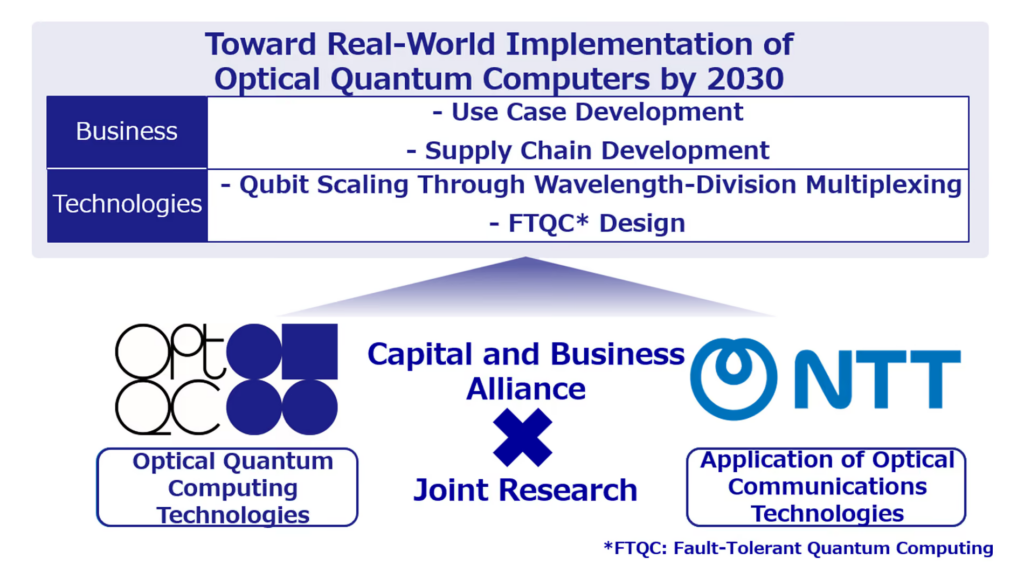
OptQC and NTT have signed a capital alliance to jointly develop a million-qubit-class fault-tolerant optical quantum computer, with NTT making a strategic equity investment [8][23]. This is the boldest volume-production timeline yet on the optical roadmap: one million physical qubits far exceeds the scale targeted by the current photonic-fusion leader PsiQuantum (whose Omega chip is only in the tens-of-qubits class), and it explicitly points to fault tolerance by 2030 [8][23]. However, the optical roadmap currently lacks an end-to-end loss budget and a demonstration of looped error correction; it remains to be seen whether NTT's engineering capabilities can fill the integration gaps [8][23].
QuiX Quantum has launched the Alquor 2.0 rack-mountable photonic processor, offering 8-, 20-, and 32-mode configurations [13][40][47]. This signals that programmable photonic processors are beginning to evolve toward standardized multi-mode platforms, but the mode count is still far below the scale required for practical fault tolerance, and no conditional fidelities or loss budgets have been published [13][40][47].
Trapped Ions
IonQ and EPB will build the Tennessee Quantum Communication Research Center in Chattanooga, deploying the first commercial quantum memory on an operational fiber network [11][43][48]. This is the first time a trapped-ion quantum memory enters a field-network environment; if it successfully validates remote entanglement distribution, it could provide a critical node for distributed quantum computing [11][43][48].
IonQ and Sandia National Laboratories have signed an MOU to accelerate quantum co-design for national security applications [48]. This move directly ties trapped-ion hardware to defense requirements and may accelerate the development of customized hardware for specific algorithms (e.g., optimization, simulation) [48].
Unitary Quantum (China's only pure-QCCD trapped-ion company) has completed a Series A funding round of several hundred million RMB, led by Shenzhen Capital Group, less than four months after its Pre-A round [45]. The speed of fundraising shows capital's confidence in the QCCD approach, but its publicly disclosed technical metrics have yet to benchmark against top players like Quantinuum and IonQ, and a gap remains to the trapped-ion state-of-the-art of 99.99% two-qubit gate fidelity [45].
Quantum Networks and Communication
Quantum Corridor, Ciena, and Toshiba have tested 1.6 Tb/s quantum-safe optical transport encryption on a live network [35]. This is a milestone for the convergence of quantum key distribution and classical high-speed optical communication; the 1.6 Tb/s rate approaches the needs of commercial backbone networks, but details on key rate and security proofs were not disclosed [35].
enQase and Light Rider are partnering to build quantum-safe communication infrastructure [34]. The collaboration combines post-quantum cryptography with quantum key distribution, aiming to provide defense-in-depth for critical infrastructure, but the specific technical approach and deployment scale were not made public [34].
Superconducting Quantum Computing
IQM has confirmed its 2026 guidance, with an order backlog exceeding €102 million [37]. As Europe's first publicly listed quantum hardware company, its order volume reflects the accelerating penetration of the superconducting route in the enterprise market, though attention should be paid to the gap between its system fidelities (median F₂Q ~99.5%) and those of IBM and Google [37].
D-Wave and Nasdaq Verafin are collaborating to develop a quantum-hybrid application for financial crime detection [7]. This is the first large-scale collaboration for quantum annealing in the financial compliance sector; if the model's performance surpasses classical methods, it could open a niche market for specialized quantum computing in regulatory technology [7].