Aug 5, 2026 – Aug 6 · Daily Brief

D-Wave Superconducting Quantum Gate Crosses Critical Error‑Correction Threshold

54 items · 11 sourcesPDFThis issue's roundup is free
02Hardware

Hardware Frontier

Superconducting Qubits

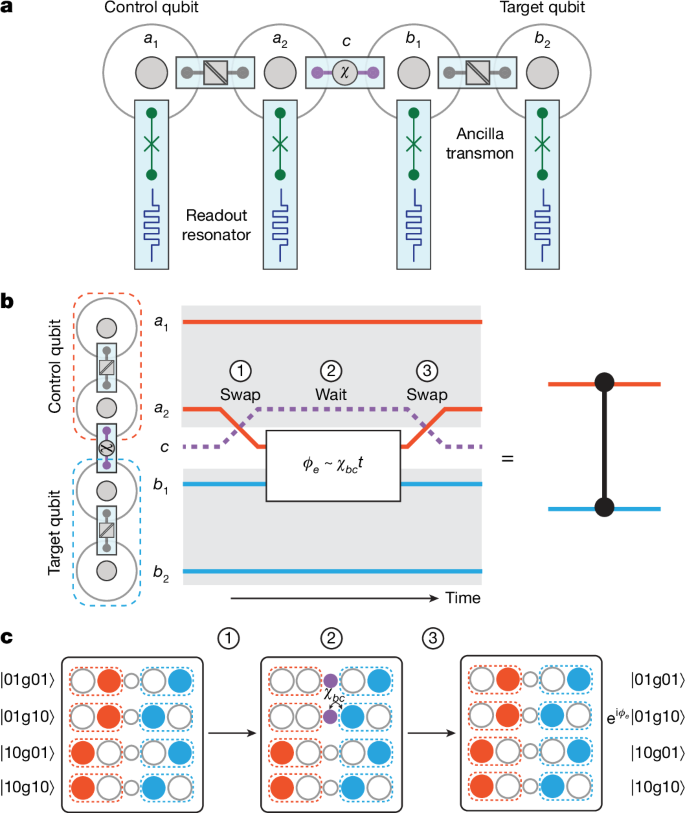
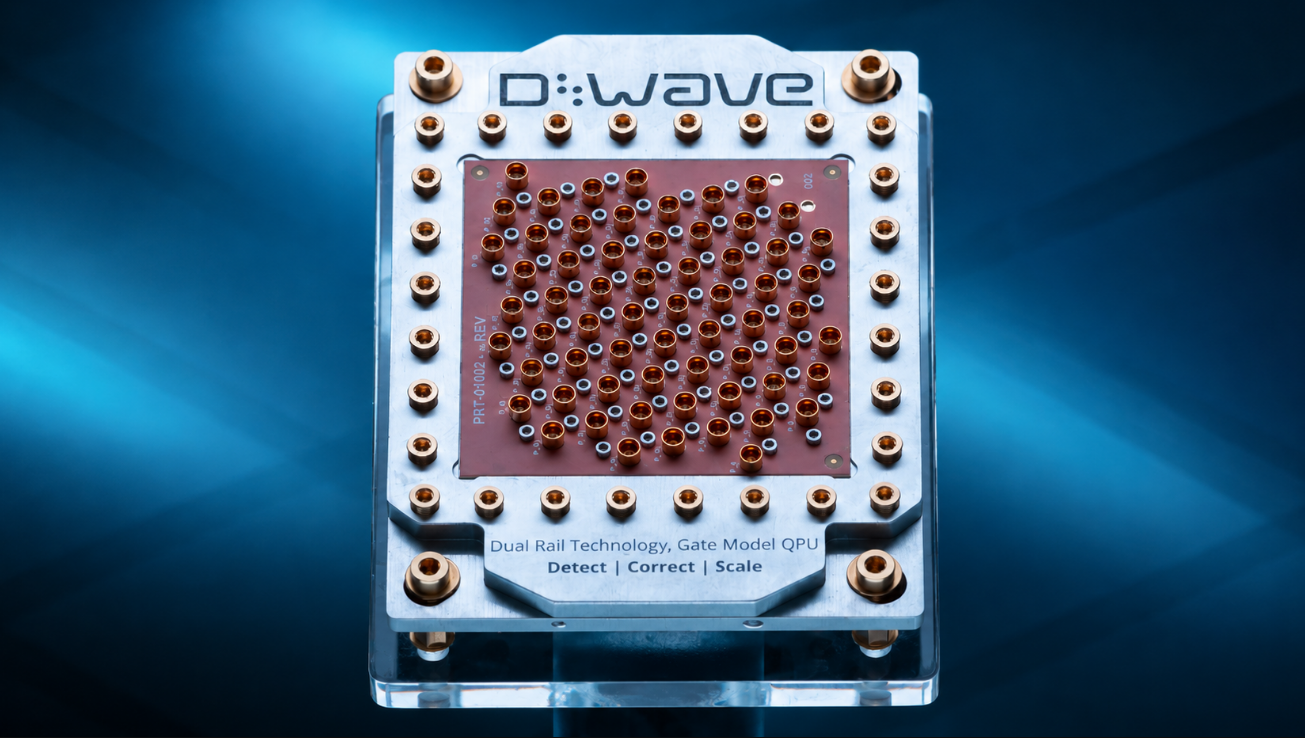
  • D-Wave’s dual-rail qubit gate achieves 99.9% fidelity with a 500-nanosecond gate time, reducing the error rate to one-tenth of previous levels[24]. Designed for error correction, this gate is the first high-fidelity entangling gate using dual-rail encoding on a superconducting platform, suggesting the superconducting approach is approaching trapped-ion levels in error-correction capability. However, a gap remains compared to Quantinuum Helios’s 99.921% all-to-all pair fidelity, and validation in larger-scale arrays is still needed[7][24].
  • Researchers have achieved wafer-scale preparation of air-stable, ultra-thin superconductors, overcoming scalability barriers for such materials in quantum devices[6]. If applied to superconducting qubits, this could improve coherence times and device uniformity, but the current superconducting state-of-the-art T1 already reaches the 100-microsecond level, requiring further verification of material performance[6].
  • Engineers have revealed the correlation between fluxonium qubit gate speed and qubit-pad geometry, providing guidance for optimizing the performance of 2D fluxonium processors[27]. This finding helps improve gate fidelity, but the coherence times and gate errors of fluxonium qubits still need to catch up with the state-of-the-art levels of transmons[27].
  • Tantalum-silicon co-design has enhanced superconducting qubit coherence, yielding results from interdisciplinary collaboration[44]. Specific metrics were not disclosed; if coherence times are significantly extended, this could alleviate TLS fluctuation issues in superconducting qubits, but independent verification is required[44].

Photonic Quantum Computing

  • QuiX Quantum has launched the Alquor 2.0 programmable photonic processor platform, offering 8-, 20-, and 32-mode configurations based on silicon nitride photonic integrated circuits[11][52]. As a universal linear optical interferometer, this platform can accelerate photonic quantum computing prototype validation, but the end-to-end loss budget and conditional fidelity issues of the photonic approach remain key bottlenecks for practical use[11].

Trapped-Ion Quantum Computing

  • IonQ has signed a Memorandum of Understanding with Sandia National Laboratories to co-design trapped-ion quantum technology for national security applications[10][28][48]. The collaboration will leverage Sandia’s ion-trap fabrication capabilities, potentially accelerating improvements in IonQ hardware fidelity and scale, but qubit count and transport overhead remain scaling challenges for trapped ions[10].
03Algorithms

Algorithms & Software

Quantum Error Correction & Encoding

  • A novel dual-rail erasure qubit entangling gate scheme has been released, designed specifically for quantum error correction to reduce error rates[7]. This scheme achieves high-fidelity gates through encoding, potentially enhancing the error-correction capability of superconducting systems, but logical error rate comparisons with existing surface code schemes are needed[7].
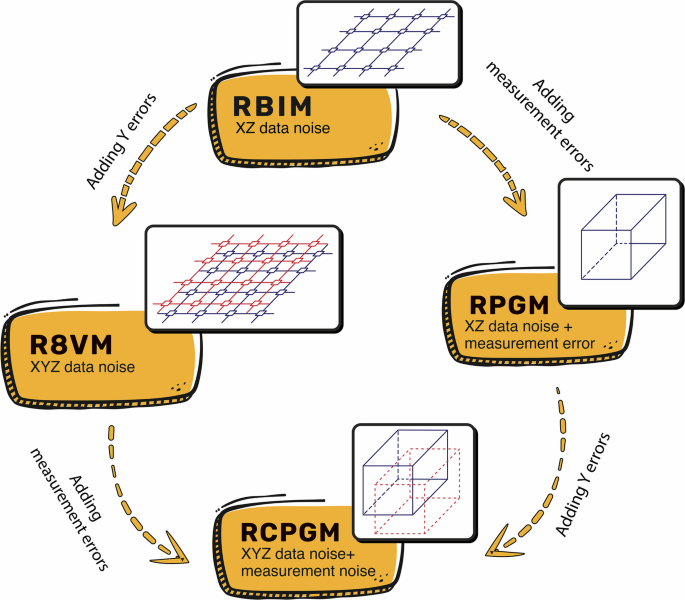
  • A random-bond surface lattice model has been introduced to optimize surface code decoding under circuit-level noise, improving the handling of Y errors[8]. This model may improve the surface code threshold, but experimental validation of its decoding efficiency is required[8].

Quantum Optimization & Machine Learning

  • Quantinuum’s Pauli-correlation encoding framework has solved binary optimization problems with up to 1,000 variables using an efficient simulable implementation requiring fewer qubits[19]. This progress demonstrates the potential of heuristic quantum algorithms on intermediate-scale problems, but actual speedup still needs comparison against classical solvers[19].
  • A four-qubit kernel method preserved geometric structure with 98.9% fidelity on IBM hardware, achieved through dynamical decoupling and gate twirling[26]. This result validates the feasibility of quantum kernel methods on noisy hardware, but more qubits and lower noise are still needed for practical use[26].
  • UT Austin’s QC-PHAST framework achieved a 2.71x speedup in rare-event searches, combining quantum-classical computation[25]. While limited, this speedup demonstrates the advantage of quantum computing in specific sampling tasks, requiring comparison with other heuristic algorithms[25].

Quantum Cryptography & Security

  • Researchers have proposed an uncopyable quantum encryption method leveraging the no-cloning property of quantum states[41]. This scheme may enhance quantum communication security, but experimental verification of its resilience to noise and loss is needed[41].
04Industry

Industry & Ecosystem

Financing & Corporate Updates

  • China’s Yao Zheng Quantum has completed a Series A funding round of several hundred million RMB, led by Shenzhen Capital Group, for the R&D of QCCD trapped-ion systems[50]. This financing will accelerate China’s catch-up in the trapped-ion approach, but attention is needed on whether its fidelity and scale can reach international top-tier levels[50].
  • Quanome Technologies has rebranded to focus on quantum computing, changing its Nasdaq ticker to "QNME"[21]. This move may reflect a strategic focus, but its technological progress needs observation[21].
  • Venture capital investment in quantum chemistry and life sciences is accelerating into 2025-2026[4]. Capital enthusiasm may drive the exploration of quantum computing applications in pharmaceuticals, materials, and other fields, but bubble risks must be monitored[4].

Policy & Government Programs

  • Israel has launched a national quantum computer tender, "Project Nexus," as part of its AI sovereignty strategy[47][49]. This platform will support domestic quantum technology development, potentially accelerating Israel’s positioning in quantum computing[47].
  • UCLA has received a $4 million NSF grant to design a 60-qubit fault-tolerant computer[18]. This project will advance academic quantum hardware R&D, but the 60-qubit scale remains far below the current state-of-the-art of hundreds of physical qubits[18].
  • Thailand has established the Quantum Club Thailand platform to support quantum technology development[45]. This initiative aids quantum ecosystem building in Southeast Asia, but technological accumulation will take time[45].

Collaborations & Deployments

  • AWS is collaborating with JPMorgan Chase to advance quantum computing research on financial optimization problems[1]. This partnership will explore practical applications of quantum algorithms in finance, but current hardware levels do not yet support practical speedups[1].
  • NIST has transmitted entangled photons over 62 kilometers between Gaithersburg and the University of Maryland, validating the survivability of quantum states in existing fiber-optic networks[22]. This milestone provides confidence for quantum network construction, but key technologies for practical quantum repeaters are still needed[22].
  • Quantum Corridor, Ciena, and Toshiba have validated 1.6 Tb/s quantum-safe encryption over commercial fiber between Chicago and Hammond[13]. This trial demonstrates the feasibility of high-speed quantum-safe communication, but attention is needed on the standardization of encryption schemes[13].
  • Thales has released the Luna 8 Hardware Security Module, supporting post-quantum cryptography to counter quantum decryption threats[12]. This product will help enterprises protect data during the transition period, but the long-term security of post-quantum algorithms still requires validation[12].
  • Atomionics has opened a quantum sensing center in Singapore to advance marine gravity surveys[51]. This facility will accelerate the commercialization of quantum gravimeters, but their performance in complex marine environments needs to be proven[51].
05Other

Academic Frontier

Quantum Information Theory

  • New research has completely mapped the acceptance probability curve for the product overlap of many-body quantum states, revealing the criteria for determining fully unentangled states[14]. This theoretical work provides more precise tools for entanglement verification, but experimental implementation requires high-fidelity measurements[14].
  • Klein tunneling through asymmetric potential barriers has been found to exhibit symmetric transmission, even when spatially asymmetric[15]. This discovery may simplify the design of certain quantum transport devices, but other non-ideal factors must be considered in actual devices[15].

Quantum Simulation & Few-Body Physics

  • The transition of pairing correlations from the surface to the bulk state in few-body fermionic systems has been observed with single-atom resolution[17]. This experiment provides a new perspective for understanding strongly correlated quantum systems, but the system size is limited and needs scaling to more particles[17].

Quantum Randomness & Fundamental Physics

  • On-chip quantum randomness has been confirmed with 10-sigma confidence, realizing a semi-device-independent random number generator[20]. This progress offers a high-security scheme for quantum random number generation, but the generation rate needs improvement for practical applications[20].
06Impact

This Week's Impact

  • Superconducting Hardware Vendors: D-Wave’s dual-rail qubit gate fidelity breakthrough injects confidence into the superconducting approach, but attention is needed on its performance in large-scale arrays and with logical qubits, potentially influencing the error-correction strategies of competitors like IBM and Google[7][24].
  • Trapped-Ion Competitors: IonQ’s collaboration with Sandia will accelerate the deployment of quantum technology in national security, but IonQ’s revenue growth and the acquisition of SkyWater may reshape the competitive landscape[10][39].
  • Quantum Algorithm Researchers: Quantinuum’s optimization algorithm progress indicates that heuristic methods can achieve scale advantages on near-term hardware, potentially driving more investment toward quantum-classical hybrid algorithms[19].
  • Cybersecurity Industry: The field validation of quantum-safe encryption and the launch of hardware security modules will push enterprises to accelerate post-quantum cryptography migration; related standard-setting and productization are worth watching[13][12].
  • Asian Quantum Ecosystem: The financing of China’s Yao Zheng Quantum and Israel’s national quantum computer tender show intensifying competition among Asian nations in quantum computing, potentially leading to more regional cooperation and rivalry in the future[50][47].
07Other

Editor's Note

This week in quantum computing presents a landscape of "error-correction first, application trials underway." D-Wave’s dual-rail qubit gate fidelity breakthrough marks significant progress in error-correction-specific hardware for the superconducting approach, but a substantial gap remains before building logical qubits. Meanwhile, Quantinuum’s demonstration of an optimization algorithm at the thousand-variable scale suggests that heuristic quantum algorithms may find utility on near-term hardware, though actual speedup and problem applicability still require rigorous validation. On the industry side, IonQ’s revenue growth and deepening collaborations, along with large financing rounds for Chinese quantum startups, reflect sustained capital bets on the commercialization prospects of quantum computing. However, this week’s progress also serves as a reminder: most results remain at the laboratory or prototype stage, and the leap for quantum computing from "advantage demonstration" to "practical tool" still requires fundamental breakthroughs in error rates, scale, and algorithm design.