Aug 6, 2026 – Aug 7 · Daily Brief

Amazon Quantum Algorithm Threatens Post-Quantum Cryptography Standards

42 items · 8 sourcesPDFThis issue's roundup is free
02Hardware

Hardware Frontiers

Superconducting

No relevant progress.

Ion Trap

No relevant progress.

Photonic

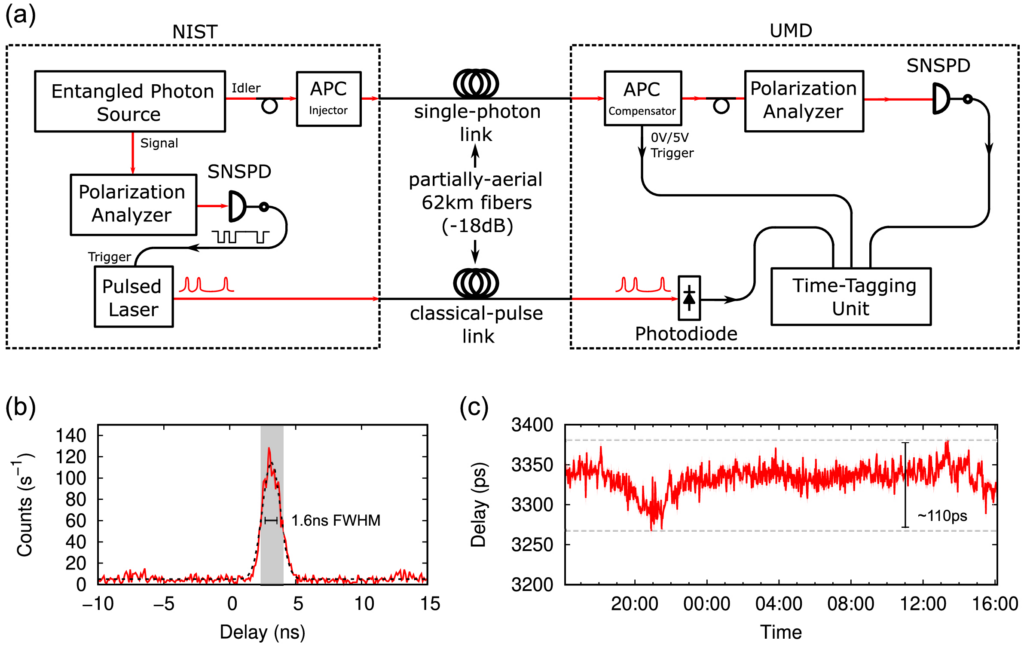
  • Following previous reports, NIST, the University of Maryland, and Qunnect demonstrated polarization-entangled photon distribution over 62 km of deployed metropolitan aerial fiber, further validating the feasibility of deploying quantum communication in real-world fiber networks [8]. This marks a critical step toward practical quantum networks, providing an important reference for metropolitan quantum key distribution and entanglement distribution networks.

Neutral Atom

No relevant progress.

Other Platforms

  • Researchers achieved room-temperature ferroelectric switchable quantum geometry in few-layer WTe₂, providing a new physical basis for complementary in-memory computing [4]. This work combines quantum geometry with ferroelectric switching for the first time, potentially opening new avenues for low-power, high-density quantum information processing.
  • A study established a framework separating geometric decoherence from environmental decoherence in split matter-wave systems, enabling the extraction of source-independent Bell correlation decay [12]. This provides a new diagnostic tool for precision quantum interferometry and decoherence control.
03Algorithms

Algorithms and Software

  • An Amazon researcher claims their quantum algorithm can break lattice-based cryptography, which would disrupt the existing PQC framework if proven true [35]. Details of the algorithm have not yet been made public, but it has drawn significant attention from the cryptography community; its importance lies in bringing the quantum vulnerability of lattice-based cryptography to the forefront for the first time.
  • A study links denoising models to nuclear quantum effects, achieving accurate results using only classical data plus analytical components [17]. This may offer an efficient method for simulating nuclear quantum effects, reducing the demand for quantum computing resources.
  • Researchers proved the global well-posedness of the nonlocal Fokas-Lenells equation under weighted Sobolev initial data, resolving singular behavior via the inverse scattering transform and Riemann-Hilbert problem [22]. This provides a rigorous foundation for the mathematical analysis of related integrable systems.
  • Tulane University researchers achieved a two-fold enhancement of superoscillation frequency using only two harmonics, matching the effect of a four-harmonic approach [23]. This simplifies the generation scheme for superoscillations, potentially advancing their application in super-resolution imaging and quantum sensing.
  • Analysis of the Schwinger model in AdS₂ space reveals a quantum screening effect, where dynamical fermions lead to a finite static potential, contrasting with confinement in flat space [24]. This provides new insights for understanding quantum field theory effects in curved spacetime.
  • Horizon Quantum released an early access version of Beryllium and expanded its European quantum hardware testbed [6]. Beryllium, as a quantum programming language, aims to simplify algorithm development; early access may accelerate the construction of the quantum application ecosystem.
  • Qoro Quantum's CTO introduced its Divi SDK in a podcast, which can automatically select among 12 simulation methods and dispatch to QPUs [11]. This middleware abstracts hardware differences, helping lower the barrier to quantum computing application development.
04Industry

Industry and Ecosystem

  • Xanadu announced its Q2 2026 financial results, with cash reserves of $312.8 million, $67.2 million raised through its ATM facility, and an expansion of its Albany operations [5]. This indicates that the photonic-roadmap company is well-funded and accelerating its US market presence.
  • IQM released its first post-IPO financial report, with H1 2026 revenue growth, record backlog, and full-year guidance provided [7]. As the first pure-play European quantum computing company listed on Nasdaq, its performance serves as a bellwether for the industry.
  • Pasqal's Form F-4 was declared effective by the SEC, advancing its SPAC merger with Bleichroeder [38]. This clears a key obstacle for Pasqal's listing and may accelerate the commercialization of its neutral-atom quantum computing.
  • IonQ received a $28 million contract extension from DARPA for atomic clocks and an award for NRO radar satellites [9]. This consolidates IonQ's position in the defense quantum sensing sector and extends its reach into space intelligence.
  • enQase partnered with Light Rider to integrate hardware, software, and key distribution capabilities, offering a quantum-safe communication architecture [10]. This may provide a one-stop quantum security solution for governments and critical infrastructure.
  • D-Wave reported a surge in bookings, with quarterly revenue remaining stable [39]. This indicates sustained growth in commercial appeal for quantum annealing in optimization problems.
  • Multibeam appointed David J. Lam as interim CFO, following the achievement of a $200 million financing milestone [36]. This shows the company's expansion momentum in the electron-beam lithography sector.
  • Daon developed a quantum-ready digital identity architecture encompassing five patents [40]. This provides a forward-looking solution for identity authentication security in the post-quantum era.
  • Quantum Optics Jena's ELVIS system passed independent security testing, validating its quantum communication security [41]. This enhances the credibility of the device in high-security sectors like defense and finance.
  • DARPA is focusing on quantum manufacturing, aiming to address scalability bottlenecks [42]. This reflects the critical need for quantum computing to transition from lab to fab, with manufacturing capability potentially becoming the next competitive focus.
  • Florida Atlantic University launched a Quantum Computing Business Strategy Certificate [37]. This helps cultivate quantum business talent, bridging the gap between technology and application.
  • Innovate UK reported a quantum computing project funding success rate of about 30%, with companies able to apply for up to £13 million [20]. This provides significant financial support for UK quantum software startups.
  • A guide to quantum computing companies in Slovakia was released, outlining the country's quantum ecosystem [25]. This helps international investors and partners understand the Eastern European quantum market.
  • Venture capital firms Quantonation, DCVC, and Lux Capital invested in quantum finance [2]. This shows that the application prospects of quantum technology in the financial sector are attracting capital interest.
05Other

Academic Frontiers

  • Researchers explored toroidal multipole transitions in hydrogen and alkali atoms, going beyond traditional electric and magnetic multipoles [13]. This opens new research directions for atomic spectroscopy and quantum optics.
  • Nagoya University studied the entanglement properties of analogue Hawking radiation generated by a moving mirror, revealing negative energy flux as an information return channel [14]. This provides new insights for the black hole information paradox and quantum gravity simulations.
  • Wang Li and Ye Yunjie defined a two-dimensional superlubricity criterion using graphene, based on a thermodynamic phase definition at the zero-temperature limit [15]. This clarifies the nature of superlubricity and holds significance for nanotribology.
  • An analytical inversion method extracts quasiparticle band gaps and screening lengths from the optical exciton spectra of monolayer materials [16]. This provides a convenient pathway for characterizing two-dimensional semiconductor materials.
  • Sunlight was used to generate quantum entanglement in a laboratory [19]. This addresses the need for sustainable energy sources in quantum technology and may promote the development of green quantum networks.
  • Coupling phase effects were modeled in a multi-mode cavity magnonic system [26]. This provides more precise control methods for hybrid quantum systems and information processing.
06Impact

This Week's Impact

  • The cryptography community is shaken: If the quantum algorithm claimed by an Amazon researcher is confirmed, NIST PQC standards may need revision, and all deployed or deploying quantum-resistant cryptographic systems face reassessment [35].
  • Quantum communication network deployment accelerates: The 62 km metropolitan entanglement distribution experiment by NIST and collaborators provides a blueprint for city-level quantum networks, with telecom operators and network service providers able to learn from its aerial fiber solution [8].
  • The defense quantum sensing market expands: IonQ's receipt of DARPA and NRO contracts indicates clear demand for quantum clocks and sensing in military and space domains, potentially encouraging other ion-trap and atomic clock companies to follow suit [9].
  • Quantum finance investment heats up: Increased VC attention on quantum finance suggests algorithmic trading, risk modeling, and cryptography applications will attract more funding, driving deep integration between quantum software and the financial industry [2].
  • Quantum manufacturing becomes a new focal point: DARPA's emphasis on quantum manufacturing signals that hardware scalability and production capacity will be key to the next stage of competition, potentially creating opportunities for materials and equipment suppliers [42].
07Other

Editor's Note

The most striking development this week comes from an Amazon researcher's potential quantum attack on lattice-based cryptography, reminding us that the threat of quantum computing to cryptography may be closer than anticipated. Although details remain undisclosed, this statement alone is enough to put the cryptographic community on alert, highlighting the urgency of quantum-safe migration. Meanwhile, the experimental success of quantum communication on a metropolitan scale demonstrates the practical prospects of quantum key distribution and entanglement networks, laying the groundwork for a quantum internet. On the industry side, financial reports from several quantum computing companies show revenue growth and ample funding, but commercial implementation remains concentrated in niche areas like annealing and sensing; universal fault-tolerant quantum computing still requires long-term investment. DARPA's focus on quantum manufacturing points to the bottleneck in hardware scaling, and manufacturing capability may become a key differentiator among leaders in the coming years.