Aug 10, 2026 – Aug 11 · Daily Brief

Pasqal traps neutral atoms using photonic integrated circuits for the first time

39 items · 12 sourcesPDFThis issue's roundup is free
02Hardware

Hardware Frontier

Neutral Atoms

Pasqal traps neutral-atom qubits via photonic integrated circuits for the first time

  • Facts: Pasqal, in collaboration with its subsidiary Aeponyx, used laser light generated by photonic integrated circuits (PICs) to trap single neutral atoms, replacing conventional free-space optical platforms [10].
  • Technical implications: This marks the first on-chip trapping for neutral-atom quantum computing, miniaturizing large optical tables onto solid-state chips and potentially reducing system size and complexity significantly. However, the demonstration involves trapping only; no gate operations or fidelity data were reported, leaving a substantial gap to practical utility. The source also provides no fidelity comparison with other neutral-atom platforms, so whether on-chip trapping affects gate fidelity remains unknown.
  • Landscape impact: If the technology can be extended to gate operations while maintaining fidelity, it could alter the engineering path for neutral-atom quantum computers, lowering manufacturing cost and footprint. Near-term (1–2 years) industry impact is limited, but it may threaten existing free-space optical approaches in the long run.

Q-CTRL runs 100-qubit quantum algorithm on IBM hardware

  • Facts: Q-CTRL executed a 100-qubit quantum Fourier transform (QFT) on IBM quantum hardware, claiming it to be the largest QFT demonstration to date [15].
  • Technical implications: The 100-qubit QFT demonstration shows the possibility of running practical algorithms on noisy intermediate-scale quantum (NISQ) devices, though QFT itself is not an algorithm expected to deliver near-term quantum advantage. The source states only that it is the largest QFT demonstration to date, without disclosing success rate or fidelity of the algorithm execution, nor providing comparative data against other hardware platforms.
  • Landscape impact: The result reinforces the value of error-suppression software in the NISQ era. As a quantum software company, Q-CTRL’s technology can empower multiple hardware platforms, potentially attracting more enterprises to adopt its error-mitigation solutions.

Photonics

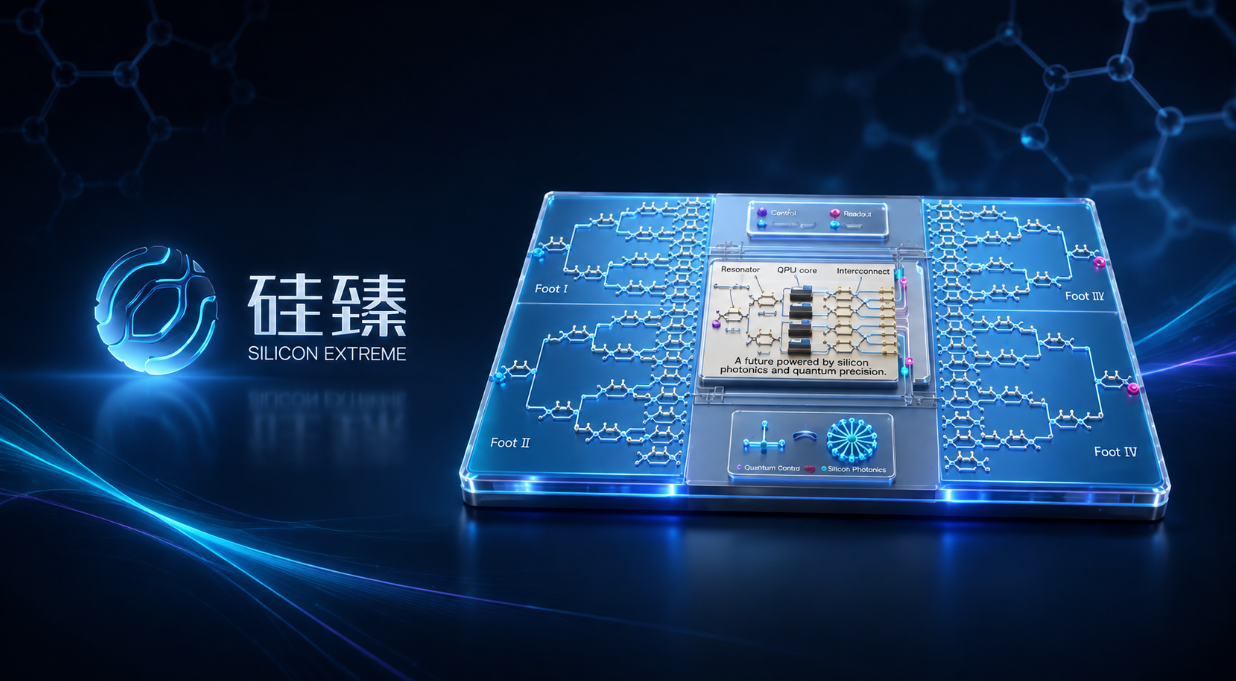
Sizhen and USTC team demonstrate multi-qubit quantum states on silicon photonic chip

  • Facts: Hefei Sizhen Chip Technology and the research group of Prof. Xifeng Ren from the CAS Key Laboratory of Quantum Information at USTC jointly reported multi-qubit photonic quantum states on a silicon photonic chip [33].
  • Technical implications: Progress has been made in integrating photonic quantum computing, but the report provides no specific metrics such as fidelity or qubit count, and the source gives no comparable industry baseline data. The demonstration remains at an early stage, far from practical utility.
  • Landscape impact: Silicon photonics is a potential path combining quantum computing with classical semiconductor processes, but this result is insufficient to affect the global competitive landscape.
03Algorithms

Algorithms & Software

Classiq proposes logarithmic growth in circuit width for spatial search

  • Facts: Classiq proposed a quantum circuit for d-dimensional spatial search based on discrete-time quantum walks, whose width grows logarithmically with grid size; in the examined range, the depth in three dimensions empirically obeys a certain dependence, the specific expression of which is not given in the source [21].
  • Technical implications: The design significantly reduces the circuit width for spatial search algorithms, potentially enabling large-scale search problems to be realized on limited qubits sooner. However, the specific scaling form of the depth is undisclosed, and no performance comparison with classical algorithms is provided.
  • Landscape impact: If validated on near-term quantum hardware, the algorithm could influence quantum application development in areas such as logistics and route optimization, but on a timescale of 3–5+ years.

Quantum journal compares quantum resources of two surface-code lattice-surgery methods

  • Facts: A study published in the journal Quantum compares the resource requirements of two leading surface-code lattice-surgery methods for Hamiltonian simulation, providing end-to-end resource estimates [22].
  • Technical implications: The study offers a quantitative comparison framework for the practical resource needs of fault-tolerant quantum computing. The source abstract stops at describing the surface-code compilation assumption (circuit serialization via Clifford-gate elimination); specific differences in logical qubit counts and operation counts between the two methods are not given in the abstract and require consulting the full paper.
  • Landscape impact: For quantum hardware developers, the study clarifies the resource overhead of different error-correction schemes, which may influence future hardware architecture design, but will not change industrial roadmaps in the short term.

Perturbation spectral norm of the Szegedy quantum walk transfer matrix is 1/N

  • Facts: An analysis proves that removing a single edge from a complete graph perturbs the transfer matrix of the Szegedy quantum walk with a spectral norm of 1/N [16].
  • Technical implications: The result quantifies the robustness of quantum walks to changes in graph structure, providing theoretical guidance for quantum-walk-based algorithm design.
  • Landscape impact: Purely theoretical result; no near-term industrial impact.

Upper and lower bounds on simulation cost for classically simulable measurements (CSM) derived

  • Facts: A study derives lower and upper bounds on the simulation cost required to enhance the discriminatory power of classically simulable measurements (CSM), and relates this cost to magic resources [20].
  • Technical implications: The work provides finer theoretical tools for verifying quantum advantage, helping to delineate the boundary where quantum computing surpasses classical simulation.
  • Landscape impact: Theoretical progress that may influence the design of future quantum advantage experiments, but has no direct commercial impact.
04Industry

Industry & Ecosystem

Intel announces proposed $15 billion common stock offering

  • Facts: Intel announced a proposed $15 billion underwritten public offering of common stock; pricing and closing have not been completed. The company states that customers continue to send strong and sustainable demand signals, driven by unprecedented investment in AI compute, and that progress in emerging areas such as physical AI, custom silicon, advanced packaging, and external foundry is also a reason [5].
  • Business implications: The source attributes the offering to capturing AI compute demand and investment opportunities in emerging areas, with no mention of financial stress; the large offering will dilute existing shareholders.
  • Landscape impact: The source makes no mention of Intel’s quantum computing division or silicon spin qubit roadmap; the impact of this proposed offering on its quantum R&D spending has not been disclosed. Investors may monitor Intel’s subsequent disclosures for changes in quantum division investment.

Cloudflare obtains FedRAMP High authorization, extends quantum-safe government platform

  • Facts: Cloudflare announced that its government security platform has received FedRAMP High authorization, extending post-quantum cryptography protection capabilities to U.S. federal government workloads at the highest security level [35].
  • Business implications: FedRAMP High is a necessary authorization for serving the U.S. government’s most sensitive data. Note that the source is a company press release stating only that Cloudflare for Government has obtained this authorization; the source provides no basis for Cloudflare’s relative position in quantum-safe cloud services or any claimed first-mover advantage.
  • Landscape impact: The federal government’s accelerated migration to post-quantum cryptography will spur other cloud service providers to follow suit and stimulate growth in the quantum-safe encryption market. In the near term (1–2 years), Cloudflare competitors such as AWS and Azure may accelerate similar certifications.

U.S. lawmakers push to increase quantum defense spending

  • Facts: U.S. lawmakers are reportedly pushing to increase quantum technology spending in the defense budget to address competition with China in the quantum domain [37].
  • Business implications: Increased defense funding will flow directly to R&D and procurement in quantum computing, quantum sensing, and quantum communications, benefiting defense contractors and quantum startups.
  • Landscape impact: Geopolitical competition in quantum technology intensifies, potentially accelerating military applications of quantum technology in the U.S. and prompting synchronized investment by allies. Investors should watch the flow of defense-related quantum contracts.

Infleqtion partners with Eaton to advance quantum computing for U.S. grid resilience

  • Facts: Following prior reporting, this release specifies that the collaboration is a multi-year, multi-million-dollar project, with Eaton selecting Infleqtion to support research aimed at using quantum computing to enhance U.S. grid resilience and reduce economic losses from power outages [2].
  • Business implications: The collaboration is an early case of quantum computing in the energy sector, but it remains at the research-support stage; the source announces no results, and the value of quantum optimization in grid management has yet to be validated.
  • Landscape impact: If successful, the project could attract more utility companies to invest in quantum solutions, but practical deployment is likely 5+ years away.

Qunnect and Monarch Quantum partner to commercialize quantum networking technology

  • Facts: Qunnect and Monarch Quantum are collaborating to accelerate the commercialization, miniaturization, and scaled manufacturing of entangled quantum network hardware using advanced manufacturing techniques [7].
  • Business implications: The partnership combines Qunnect’s entanglement distribution technology with Monarch Quantum’s photonic system engineering capabilities, aiming to reduce the cost of quantum network hardware.
  • Landscape impact: Quantum networks are the foundation of the quantum internet; this partnership may advance early deployment of quantum-secure communication networks, but large-scale commercialization remains years away.

Quantum Optics Jena’s ELVIS QKD system completes ISO/IEC 23837 security evaluation

  • Facts: Germany’s Quantum Optics Jena has completed an independent security evaluation of its ELVIS quantum key distribution (QKD) system against the ISO/IEC 23837 standard, conducted by TÜVIT over three months of testing [8].
  • Business implications: Completing an independent security evaluation under an international standard is a key threshold for QKD products entering government and financial markets; the ELVIS system may thereby gain more commercial orders. The source does not state a pass or conformance conclusion for the evaluation.
  • Landscape impact: Standardization and certification of QKD systems will accelerate their adoption in critical infrastructure, though the QKD market remains constrained by fiber distance and cost.

BTQ and ITRI validate QCIM core chip for NIST post-quantum standards

  • Facts: BTQ Technologies and Taiwan’s ITRI have completed a key milestone for the QCIM chip, which uses 28-nanometer process technology and supports NIST post-quantum cryptography standards; test chips are expected to be delivered to customers by year-end [38].
  • Business implications: The QCIM chip is designed to protect digital systems from quantum computer attacks; its hardware implementation may offer higher security and efficiency than purely software-based solutions.
  • Landscape impact: As NIST post-quantum standards are promoted, the hardware security module market may grow; the BTQ-ITRI collaboration targets quantum-safe needs for IoT and edge devices.

Quantum Domain Dynamics project coordinated by Infosim launched, with FAU RRZE participation

  • Facts: The Regional Computing Center Erlangen (RRZE) of FAU is participating in the QDD project coordinated by Infosim, which has received €3.26 million in funding from BMFTR with a total budget of €3.84 million, aiming to develop cross-domain automated hybrid QKD and post-quantum cryptography management through 2029 [39].
  • Business implications: The project explores hybrid deployment of QKD and post-quantum cryptography, providing a transitional solution for future cybersecurity architectures.
  • Landscape impact: Continued European investment in quantum communication infrastructure will strengthen its leading position in the field, but the project timeline is long, limiting near-term commercial impact.

Utah Governor signs executive order launching statewide quantum initiative

  • Facts: Utah Governor Spencer Cox signed an executive order launching the Utah Quantum Initiative, aiming to position the state as a regional hub for quantum research, manufacturing, and commercialization [9].
  • Business implications: State-level quantum initiatives may attract quantum startups and drive local employment and investment.
  • Landscape impact: The quantum race among U.S. states intensifies, but Utah must compete with states like Colorado and Maryland that already have established quantum ecosystems.

Quantum Computing Inc. Q2 revenue surges to $5.6M, Fab 2 launched

  • Facts: Quantum Computing Inc. (QCi) reported Q2 2026 revenue of $5.6 million and announced the launch of its Fab 2 manufacturing facility through the acquisition of NHanced [11].
  • Business implications: QCi’s revenue growth is accelerating; the source abstract does not disclose net income or profit/loss figures. The launch of Fab 2 may boost its photonic chip manufacturing capacity, but the impact of capital expenditures on cash flow warrants attention.
  • Landscape impact: As an integrated photonic quantum computing company, QCi’s manufacturing expansion may accelerate the photonics roadmap, but market competition is intense.
05Other

Academic Frontier

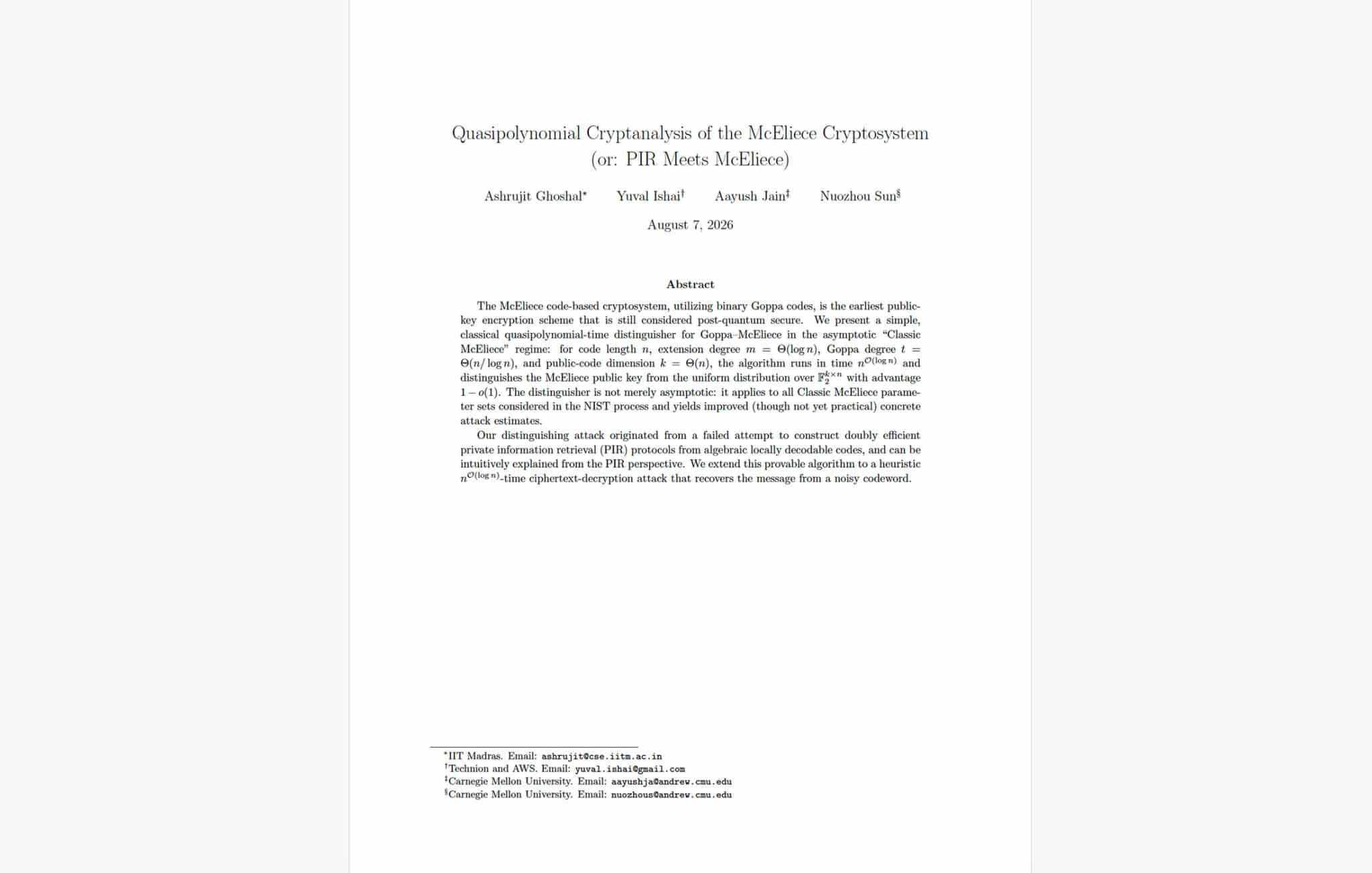
New distinguisher for Classic McEliece weakens generic decoding advantage, but is not a break

  • Facts: A new study has discovered a new distinguisher for the Classic McEliece cryptosystem, with an attack cost lower than generic decoding, affecting the security arguments for all NIST parameter sets [6].
  • Technical implications: The distinguisher does not break McEliece, but it shakes the quantitative argument that structural attacks were negligible, implying that McEliece’s security margins need re-evaluation.
  • Landscape impact: McEliece is one of the candidate schemes in the NIST post-quantum cryptography standardization process; this finding may affect its standardization progress and deployment confidence, but will not lead to practical attacks in the near term.

University of Vienna uses tensor networks to obtain sharper spectral gap bounds

  • Facts: Researchers at the University of Vienna improved the method of Fannes, Nachtergaele, and Werner, using tensor networks to obtain sharper bounds on the spectral gap of quantum systems [18].
  • Technical implications: This theoretical advance helps describe the energy gap of quantum many-body systems more precisely, with implications for the study of quantum phase transitions and topological order.
  • Landscape impact: Basic research with no direct near-term application, but may influence future development of quantum materials and quantum simulation.

Dissipation can serve as an entanglement tool

  • Facts: According to an institutional press release, researchers have shown how dissipation — typically viewed as noise — can be used to generate entanglement [36].
  • Technical implications: The source is a press release; no journal or peer-review information is provided. Entanglement preparation via dissipation engineering has been studied for years; this work further demonstrates that dissipation can, under specific conditions, serve as a resource for quantum information processing rather than merely a detrimental factor.
  • Landscape impact: In the long term, it may influence the design philosophy of quantum error correction and quantum computing hardware, but will not change mainstream approaches in the short term.

Tracking control theoretically yields sublinear optical response from a single hydrogen atom

  • Facts: Researchers propose that in a hydrogen atom, tracking control — where the driving field is self-consistently determined by the evolving quantum state — can theoretically construct a sublinear optical response, meaning the emitted field scales as a fractional power of the driving field [17].
  • Technical implications: The work goes beyond the perturbative regime of traditional nonlinear optics, offering a new method for extreme nonlinear optics; the source describes it as a theoretical and numerical scheme, with no experimental demonstration reported.
  • Landscape impact: Pure basic research, with potential long-term implications for future quantum light sources and quantum sensing.
06Impact

Today’s Impact

  1. Intel investors: The proposed $15 billion common stock offering will dilute existing shareholders, potentially pressuring the stock in the short term; the source does not address the quantum division, and subsequent changes in investment must be based on company disclosures [5].
  2. Quantum-safe industry: Cloudflare’s FedRAMP High authorization may trigger a chain reaction, pushing AWS, Azure, and others to accelerate quantum-safe certifications, benefiting post-quantum cryptography software and hardware vendors [35].
  3. Neutral-atom quantum computing roadmap: If Pasqal’s on-chip trapping is successfully extended to gate operations, it could reduce system costs, but will not change the lead of QuEra and Atom Computing in logical qubit numbers in the near term [10].
  4. Defense quantum technology investment: U.S. lawmakers’ push to increase quantum defense spending may preferentially benefit quantum sensing and quantum communication companies; the source does not name specific firms [37].
  5. Post-quantum cryptography standardization: The discovery of a new distinguisher for McEliece may affect its standardization progress and deployment confidence, but according to the source it does not constitute a break [6].
07Other

Editorial Comment

Today’s quantum industry dynamics highlight the tension between capital rhythms and technological breakthroughs. Intel’s proposed $15 billion offering is externally justified by capturing AI compute demand and investing in emerging areas, not financial tightening; yet it reminds us that when large tech companies reshuffle capital allocation, the priority of long-horizon investments like quantum can likewise be re-examined by the outside world. Meanwhile, Pasqal’s on-chip neutral-atom trapping demonstrates engineering progress in quantum hardware but does not touch the core metric of fidelity — the industry should be wary of "demonstration inflation," where novelty substitutes for performance. In the quantum-safe domain, Cloudflare’s FedRAMP authorization marks the shift of post-quantum cryptography from standard-setting to actual deployment; the government market may open faster than expected. Investors should distinguish between near-term commercial opportunities (such as quantum-safe encryption) and long-term technology bets (such as fault-tolerant quantum computing), and closely monitor the flow of defense funding, as geopolitics is becoming a key accelerator for quantum technology.