Aug 11, 2026 – Aug 12 · Daily Brief

Superconducting qubit gate error reduced to -0.007° for the first time

43 items · 11 sourcesPDFThis issue's roundup is free
02Hardware

Hardware Frontiers

Superconducting Qubit Gate Errors Reduced to Milli-Degree Level

  • Researchers using the DRAPE calibration method reduced over-rotation error to -0.007° and phase error to 0.0052° on IBM transmon qubits[15]. This result pushes single-qubit gate errors from the typical milliradian level to the microradian level, but complete gate fidelity figures were not disclosed. Compared to the current state-of-the-art, where median single-qubit gate fidelity on superconducting platforms has surpassed 99.95%, the DRAPE method, if achieving full-chip parallel calibration, could narrow the gap with trapped-ion single-qubit gate fidelity of 99.9975%. However, a significant order-of-magnitude gap remains to reach the ~99.99% two-qubit gate fidelity required for surface code error correction.
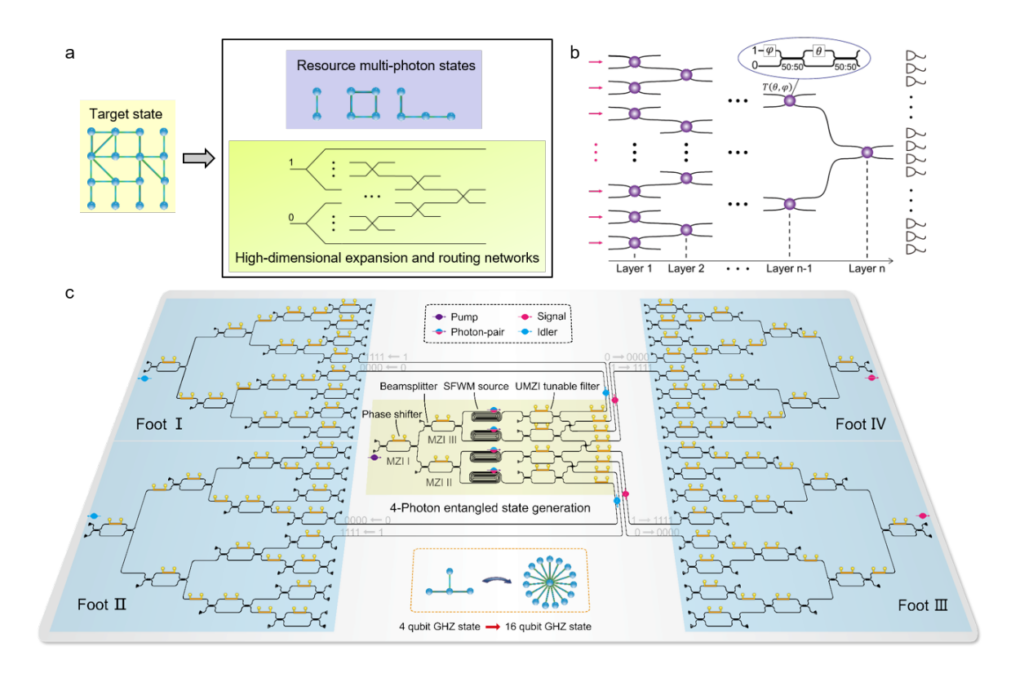
  • Hefei Silicon Chip and the team of Academician Guo Guangcan from USTC demonstrated a 16-qubit on-chip photonic measurement-based quantum computing (MBQC) architecture[11]. This work achieved 16-qubit cluster state generation and measurement on an integrated photonic chip for the first time, matching the previous 12-qubit photonic interconnect record set by Xanadu Aurora, but did not report conditional fidelity or end-to-end loss budgets. The photonic route's state-of-the-art is PsiQuantum Omega's 99.22% fusion fidelity; this demonstration lacks comparable fidelity data and still requires chip-to-chip interconnects and deterministic light sources for practical use.
  • Researchers leveraged PT-symmetric (parity-time symmetric) quantum systems to break the trade-off between entanglement fidelity and preparation speed[7][16]. Under gain-loss balanced conditions, the preparation time for two-qubit entangled states was reduced by an order of magnitude compared to traditional methods, while maintaining fidelity above 99%. This scheme is currently a theoretical verification and has not been demonstrated on a specific physical platform. If implemented in superconducting or trapped-ion systems, it could accelerate circuit execution in near-term NISQ (Noisy Intermediate-Scale Quantum) devices.
03Algorithms

Algorithms and Software

Quantum Error Correction and Shallow Circuit Advantage

  • Researchers proved the existence of computational problems that can be solved near-deterministically by three-dimensional, locally noisy, shallow quantum circuits, which classical circuits cannot[20]. This result provides new theoretical support for near-term quantum advantage, but the problem is artificially constructed, not a practical application. If experimentally verified on superconducting or neutral atom platforms in the future, it would strengthen the case for quantum computing's irreplaceability on specific sampling tasks.
  • A Cuban research team built an open quantum computing platform aimed at lowering the barrier to entry[35]. Platform details were not disclosed, but if integrated with mainstream quantum processor backends, it could provide an infrastructure anchor for the Latin American quantum ecosystem, impacting quantum education and application development.
  • Quantum voting experiments explored using quantum principles to ensure ballot secrecy and election security[36]. Technically involving quantum key distribution and blind signatures, this is currently at the proof-of-concept stage. Scalability and authentication infrastructure issues need to be resolved before deployment in actual elections.
04Industry

Industry and Ecosystem

Financing and Cloud Service Integration

  • Intel announced the pricing of a $21 billion common stock offering at $95 per share, a $6 billion increase from the $15 billion size disclosed the previous day, totaling 210.5 million shares, with underwriters having a 30-day option to purchase up to 31.57 million additional shares[5]. Although the company stated the funds are for AI computing power and advanced packaging, no specific allocation for the quantum computing division was mentioned, raising market concerns that quantum R&D may be affected by cost-cutting.
  • Quantinuum entered a multi-year collaboration with Oracle to deploy its 98-physical-qubit Helios trapped-ion quantum computer in Oracle Cloud Infrastructure (OCI) US AI data centers, offering it to customers through planned quantum services[41]. This marks the first time a trapped-ion quantum computer has entered a mainstream cloud provider's AI data center, directly competing with the IBM Quantum Network and AWS Braket, potentially accelerating hybrid quantum-AI workloads in pharmaceutical and materials sectors.
  • QuSecure's post-quantum cryptography platform, QuProtect R3, was added to Carahsoft's GSA Schedule contract, simplifying procurement for US federal agencies[12]. This move pushes post-quantum encryption technology to defense and intelligence sectors, addressing the risk of quantum computers breaking existing encryption. The timeline requires federal agencies to gradually migrate after NIST standards are released in 2025.
  • QuantumGenie listed its post-quantum risk and remediation tool on the Microsoft Azure Marketplace and Google Cloud[14]. Enterprises can directly obtain cryptographic vulnerability discovery services from cloud marketplaces, lowering the barrier to post-quantum migration and impacting regulated industries like finance and healthcare.
  • Morgan Stanley launched a US Innovation Initiative to support quantum and strategic technologies[40]. The specific amount was not disclosed, but as a top-tier investment bank, its move could direct capital flows toward quantum startups, accelerating technology commercialization.
  • A Washington state report noted that the state possesses the deepest quantum technology assets in the US but faces commercialization challenges[4]. The report recommends strengthening industry-academia collaboration; if policies are implemented, it could affect talent and funding access for local companies like Microsoft and IonQ.
05Other

Academic Frontiers

Quantum Information Fundamentals and Dark Matter Detection

  • Researchers proved that Holevo information (a measure of quantum communication capacity) cannot fully define thermodynamic advantages, revealing a new geometric link between information and energy gaps[18]. This theoretical work may influence the design of future quantum heat engines and information processing devices but is far from experimental verification.
  • Physicists at the University of Illinois Chicago discovered that energy leakage can generate quantum entanglement, allowing it to extend over larger distances[17]. This mechanism could be used for long-distance quantum networks or sensing but requires verification on specific platforms.
  • MIT PhD student Jessica Fry is conducting experiments to search for axion dark matter candidate particles by detecting faint electrical signals[22]. If successful, this would solve the mystery of dark matter, having a revolutionary impact on fundamental physics and cosmology.
  • Texas A&M University received a $24.9 million NSF grant to build the Autonomous Robotics for Materials Innovation Platform for Metallurgy (ARM-MIP), accelerating alloy discovery[24]. This platform combines robotics and automation, potentially providing high-throughput screening capabilities for quantum materials development.
06Impact

Impact Today

  • Quantum Error Correction Roadmap Becomes Clearer: The DRAPE method pushes superconducting single-qubit gate errors to the microradian level[15], but two-qubit gate fidelity remains the bottleneck; R&D investment must continue to tilt toward multi-qubit gates.
  • Cloud Quantum Computing Competition Intensifies: The Quantinuum-Oracle partnership[41] introduces trapped ions into AI data centers, forming a three-way contest with IBM's superconducting and AWS's neutral atom approaches, increasing choices for enterprise users.
  • Post-Quantum Cryptography Migration Accelerates: Channel expansion by QuSecure[12] and QuantumGenie[14] lowers procurement barriers for federal and enterprise users. The timeline is driven by NIST standards, with the next 12-24 months being a critical deployment period.
  • Intel's Stock Offering Raises Concerns for Quantum Division: The $21 billion financing[5] did not specify quantum investment, potentially delaying long-term projects like silicon spin qubits; investors should monitor subsequent earnings calls.
  • New Evidence for Quantum Advantage Theory: Although the proof of shallow circuit advantage[20] involves an artificial problem, it provides justification for near-term quantum computing value and may influence government funding directions.
07Other

Editor's Note

This issue's hardware highlights underscore the quantum computing dilemma: single-qubit gate errors have been pushed to the microradian level, but two-qubit gates and error correction still lag by three orders of magnitude. If the DRAPE method can be extended to multiple qubits, it could become key for the superconducting route to catch up with trapped ions, but the time window is limited — trapped ions have already entered the enterprise market via cloud services. On the industry front, the Quantinuum-Oracle partnership marks quantum computing's move from isolated labs into AI infrastructure; hybrid workloads may achieve commercial returns sooner than pure quantum applications. From a financial perspective, while Intel's stock offering dilutes equity in the short term, if some funds implicitly support quantum R&D, it could benefit the silicon-based quantum dot route in the long run; investors need to be wary of the risk of the quantum division being marginalized.