Aug 15, 2026 – Aug 16 · Daily Brief

Superconducting-chain logical qubit lifetime extended by a factor of two

19 items · 6 sourcesPDFThis issue's roundup is free
02Hardware

Hardware Frontier

Superconducting Qubits

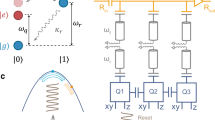
  • Noise-protected logical qubits realized in open-chain superconducting qubits: Researchers reduced the logical qubit relaxation rate by 50% in open-chain superconducting qubits with ultrastrong interactions[1][12]. This result demonstrates noise-protected logical qubits in an open-chain architecture; the source did not disclose a quantitative comparison with schemes such as the surface code. This advance provides a new encoding scheme for fault-tolerant quantum computing on the superconducting route and may influence the technical roadmaps of superconducting quantum computing companies such as IBM and Google, with further validation expected within the next 1–2 years.
  • Fast unconditional reset and leakage reduction for fixed-frequency transmon qubits: A new method achieves fast unconditional reset of fixed-frequency transmon qubits while reducing leakage[2]. This technique addresses both reset speed and leakage in a fixed-frequency architecture; the source did not disclose specific reset-time values or a quantitative comparison with existing reset schemes. This will increase the cycle rate of superconducting quantum processors and lower error rates, with direct engineering value for companies using fixed-frequency transmons such as IBM and Rigetti, and is expected to be integrated into next-generation chips.
  • Superconducting switch for qubit readout handles 100 picowatts of power: A new superconducting switch design can handle readout power exceeding 100 picowatts[16]. The switch can process more than 100 picowatts of readout power, providing a key component for scaling superconducting quantum systems. This addresses the readout-signal routing bottleneck in large-scale quantum systems and may accelerate the scaling of superconducting quantum computers, with direct impact on companies such as IBM and Google, and is expected to become practical within 2–3 years.

Other Platforms

  • WSe2 bilayer reveals quantum photocurrent correlated with individual dopants: Researchers measured quantum photocurrent correlated with individual dopants in a WSe2 bilayer, revealing how local fields affect charge separation[9]. This work directly links individual dopants to quantum photocurrent in a two-dimensional material, providing a new characterization tool for quantum optoelectronic devices. The finding may advance the development of quantum sensors and optoelectronic devices based on two-dimensional materials, affecting the materials and device research community, with applications expected to take more than 5 years.
  • e/3 charge detected in graphene quantum Hall states: Scientists detected e/3 charge in the fractional quantum Hall effect in graphene, using "antidots" to measure quasiparticle charge via conductance[14]. This work provides e/3 quasiparticle charge from conductance measurements in a graphene system; the source did not address non-Abelian statistics. The result offers material-platform evidence for topological quantum computing and may influence topological quantum computing research at Microsoft, Delft University of Technology, and others, but practical application remains more than 10 years away.
03Algorithms

Algorithms and Software

Quantum Algorithms and Benchmarking

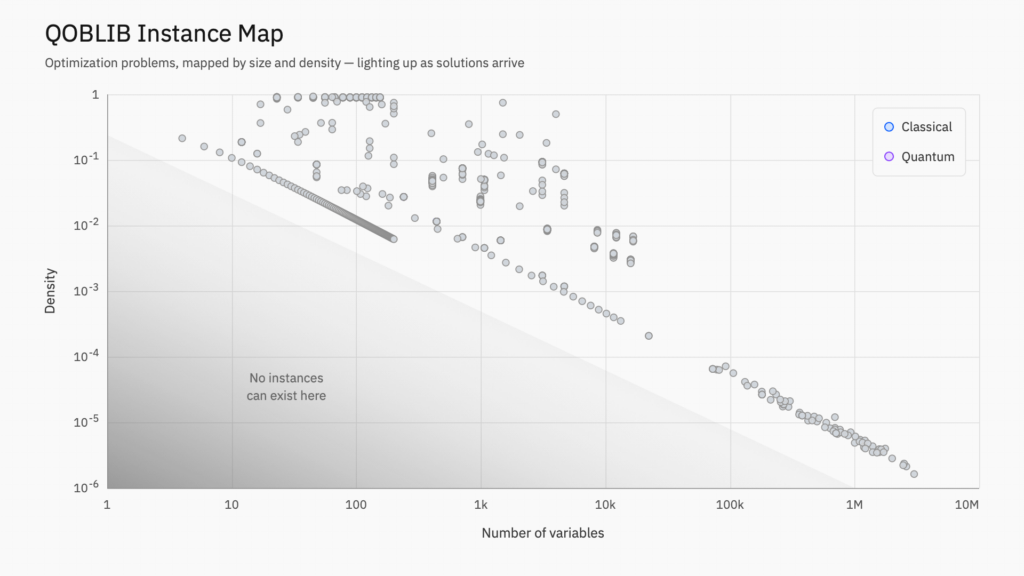
  • Global consortium launches Quantum Optimization Benchmarking Library (QOBLIB): An international research consortium led by IBM Quantum, Zuse Institute Berlin, Technische Universität Berlin, and Purdue University published the Quantum Optimization Benchmarking Library (QOBLIB) in Nature Computational Science[7]. This is a standardized, model-agnostic, open-source benchmarking framework for quantum optimization, providing a tool for tracking quantum advantage. The library will help researchers and enterprises fairly compare quantum optimization algorithms and may accelerate the application of quantum optimization in logistics, finance, and other fields, with the potential to become an industry standard within 1–2 years.
  • Fraunhofer IAF pushes more robust quantum algorithm benchmarking: A Fraunhofer IAF publication details tools for evaluating quantum advantage, focusing on realistic assessment of quantum chemistry and quantum algorithm scaling[13]. This work is oriented toward quantum chemistry applications and surveys methods and tools for robustly evaluating quantum advantage. It will influence quantum chemistry algorithm research and make quantum computing application assessments in the pharmaceutical and materials industries more reliable, with broad adoption expected within 2–3 years.
  • Hirata and Tsukada build a quantum control channel language: According to source[8] (auto-summarized), researchers Kengo Hirata and Takeshi Tsukada are designing a quantum language for programming quantum channel control, with the attributed NASA institutional affiliation still to be verified against the original paper. The language may simplify programming for quantum networks and distributed quantum computing. This work has foundational significance for quantum network and quantum communication protocol research, affecting relevant research institutions, and is expected to take more than 5 years to mature.
04Industry

Industry and Ecosystem

Company Developments and Personnel

  • PsiQuantum appoints Niklas Zennström to board: PsiQuantum appointed Atomico founder and CEO and Skype co-founder Niklas Zennström to its board on August 11, succeeding Siraj Khaliq as Atomico's board representative[6]. Zennström's addition brings top-tier venture capital and technology entrepreneurship experience to PsiQuantum, signaling that photonic quantum computing companies are attracting mainstream technology investors. The appointment may accelerate PsiQuantum's commercialization and fundraising, with a positive impact on the photonic quantum computing route, and further capital activity is expected within the next year.
  • BTQ Technologies advances four quantum business lines toward commercialization: Following its Q2 2026 acquisition of QPerfect, BTQ Technologies is advancing four quantum business lines toward commercial use, expanding its capabilities in quantum software and financial infrastructure[17]. Relative to earlier reporting on the acquisition, the incremental development is that four business lines are being pushed toward commercial use; the acquisition is an important move by BTQ Technologies in the quantum software space, strengthening its application capabilities in fintech. This progress indicates that quantum financial infrastructure is moving from proof-of-concept toward commercialization; the company says the relevant business lines are being "pushed toward commercial use" but has not disclosed actual deployment status. It may influence quantum technology adoption in the financial industry, with revenue expected within 1–2 years.
  • Canada, G7, and Nordic countries seek quantum research projects: International teams from Canada, G7, and Nordic countries can now submit collaborative research proposals in quantum science and technology[10]. The call is open to international teams from Canada, G7, and Nordic countries, aiming to promote transnational research. This initiative will advance international cooperation and resource sharing in quantum technology and may accelerate the development of quantum computing, communication, and sensing, with joint research results expected within the next 2–3 years.

Market and Investment

  • Commercial QPU market audit: only six companies sell quantum processors: An audit of the commercial QPU market shows that, after stripping away cloud access and turnkey machines, the number of companies actually selling quantum processors for third-party integration drops to six, with pricing, specifications, and gaps provided[4]. According to this analysis (an industry analysis article, not peer-reviewed), the commercial QPU supply chain is highly concentrated. This information is of significant reference value to quantum computing hardware purchasers and investors, may influence the competitive landscape of the quantum computing industry, and is expected to guide procurement decisions in the near term.
  • Dorit Dor (QBeat Ventures): what the rise of cybersecurity means for quantum market strategy: Dorit Dor discusses in an interview how the rise of the cybersecurity industry can inform go-to-market strategies for quantum technology[19]. According to the interviewee, the evolution of the cybersecurity industry can serve as a reference for the commercialization path of quantum technology, and she outlines strategies quantum companies should consider (interview views, not peer-reviewed). This has guiding significance for the market positioning and product strategy of quantum startups, may influence investment decisions, and is expected to affect strategic adjustments at some companies within the next 1–2 years.
05Other

Academic Frontier

Key Papers

  • Noise-protected logical qubits in open chains of superconducting qubits: Research published in npj Quantum Information demonstrates noise-protected logical qubits in open chains of superconducting qubits with ultrastrong interactions, with a 50% reduction in relaxation rate[1]. This work demonstrates noise protection of logical qubits in an open-chain architecture, providing a new fault-tolerant encoding scheme for superconducting quantum computing. The result may influence the research direction of superconducting quantum computing and has reference value for companies using the superconducting route such as IBM and Google, with follow-up experimental validation expected within the next 1–2 years.
  • Fast unconditional reset and leakage reduction for fixed-frequency transmon qubits: Research published in npj Quantum Information proposes a fast unconditional reset method that also reduces leakage in fixed-frequency transmon qubits[2]. This technique simultaneously achieves fast reset and leakage suppression in a fixed-frequency architecture; the source did not disclose specific reset-time values. This has a direct impact on the error rate and cycle rate of superconducting quantum processors and may be adopted by companies such as IBM and Rigetti, with integration into next-generation chips expected within 1–2 years.
  • Quantum Optimization Benchmarking Library (QOBLIB): A paper published in Nature Computational Science introduces QOBLIB, an open-source quantum optimization benchmarking library launched by an international consortium led by IBM Quantum and others[7]. The library provides standardized, model-agnostic benchmarking tools for quantum optimization algorithms, addressing the problem of inconsistent evaluation. This will promote fair comparison and progress in quantum optimization algorithms, with impact on both academic research and industrial applications, and is expected to become the standard in the field within 1–2 years.
  • Quantum photocurrent correlated with individual dopants in WSe2 bilayers: Researchers measured quantum photocurrent correlated with individual dopants in a WSe2 bilayer, revealing the influence of local fields on charge separation[9]. This work directly links individual dopants to quantum photocurrent in a two-dimensional material, providing a new characterization method for quantum optoelectronic devices. The finding may advance the development of quantum sensors based on two-dimensional materials, affecting materials science and optoelectronics, with applications expected to take more than 5 years.
  • Detection of e/3 charge in graphene quantum Hall states: Scientists detected e/3 charge in the fractional quantum Hall effect in graphene, using antidots to measure quasiparticle charge via conductance[14]. This work provides e/3 quasiparticle charge from conductance measurements in a graphene system; the source did not address non-Abelian statistics. The result offers material-platform evidence for topological quantum computing and may influence topological quantum computing research, but practical application remains more than 10 years away.

Other Academic Advances

  • SwissFEL achieves X-ray scattering measurements at 35 millikelvin: At PSI's X-ray laser SwissFEL, scientists achieved measurements at 35 millikelvin, the coldest temperature ever recorded using X-ray scattering[15]. This is the first time X-ray scattering has been performed at the ultralow temperature of 35 millikelvin, providing a new tool for studying the behavior of quantum materials near absolute zero. The advance may promote research on quantum materials and superconductors, with important implications for fundamental physics and materials science, and is expected to yield new discoveries in the coming years.
  • Columbia University quantum industry and investor workshop: Columbia University held its first quantum industry and investor workshop on August 10, connecting industry with quantum faculty and exploring emerging quantum research[11]. This is the first time Columbia University has held such a workshop, showcasing its expertise in quantum technology; relative to earlier reporting, the incremental development is that the workshop discussed application scenarios for quantum technology and noted the need to integrate research and innovation resources to unlock next-generation quantum applications[11]. The event may promote the commercialization of academic results and has a positive impact on the New York-area quantum ecosystem, with collaborative projects expected to launch within the next year.
06Impact

Impact Today

  • Superconducting quantum computing companies: The 50% reduction in logical qubit relaxation rate[1][12] provides a new scheme for fault-tolerant quantum computing on the superconducting route and may influence the technical roadmaps of companies such as IBM and Google; the next step is to watch for validation of this scheme in larger-scale systems.
  • Photonic quantum computing company PsiQuantum: Zennström's appointment to the board[6] strengthens the company's capital and strategic resources and may accelerate its commercialization; investors should watch for subsequent fundraising and product launches.
  • Quantum optimization algorithm researchers: The release of QOBLIB[7] provides standardized benchmarking tools that will promote fair comparison of algorithms; researchers can begin adopting the library for experiments.
  • Quantum financial infrastructure: BTQ Technologies' push toward commercialization after acquiring QPerfect[17] indicates that quantum software applications in finance are accelerating; financial institutions can watch for product deployment.
  • Quantum hardware purchasers: The commercial QPU market audit[4] reveals that only six companies sell quantum processors; purchasers can adjust supply-chain strategies accordingly, and investors can watch for opportunities arising from market concentration.
07Other

Editor's Note

Today's quantum computing landscape shows simultaneous technological breakthroughs and commercial positioning. The result of doubling the logical qubit lifetime in superconducting chains, while still far from practical application, opens new possibilities for fault-tolerant quantum computing on the superconducting route — particularly the demonstration of noise protection in an open-chain architecture, which may be a useful complement to existing surface-code schemes. At the same time, the board change at PsiQuantum and BTQ Technologies' acquisition progress reflect that the quantum computing industry is attracting more mainstream capital and accelerating commercialization. The launch of the Quantum Optimization Benchmarking Library QOBLIB marks a move toward standardization in quantum algorithm evaluation, which is crucial for curbing hype in the industry and promoting fair competition. Overall, quantum computing is gradually moving from laboratory demonstrations toward engineering and commercialization, but there is still a long way to go before true quantum advantage.