Aug 21, 2026 – Aug 22 · Daily Brief

Optimizing neutral-atom spacing to suppress correlated noise after error correction

38 items · 8 sourcesPDFThis issue's roundup is free
02Hardware

Hardware Frontier

Neutral Atoms

Multi-site atom arrays coupled into fiber microcavity An experiment precisely places rubidium atoms in the optical-field confinement of a fiber microcavity, achieving coupling between a multi-site atom tweezer array and a high-cooperativity cavity[13] (the source headline says 5 atom sites coupled, while the abstract says 12 rubidium atoms; the discrepancy between site count and atom count needs verification against the original paper). Technical significance: previous demonstrations of this kind were limited to 1–2 trapped atoms; this extension to multi-site arrays paves the way for programmable interactions and distributed quantum-network nodes. Landscape impact: the neutral-atom route is moving toward cavity-QED integration, affecting quantum-networking and distributed-computing architectures, on a timescale of roughly 3–5 years.

Neutral-atom spacing optimization suppresses correlated noise Research shows that even when minimum qubit spacing rules are satisfied, residual van der Waals interactions still introduce noise; treating the spacing of entanglement regions as a tunable variable can suppress correlated errors that remain visible after quantum error correction[12]. Technical significance: quantifies the relationship between spacing and correlated noise in neutral-atom arrays; combined with recompilation, this can improve performance within existing hardware constraints and provides a basis for layout optimization. Landscape impact: affects chip design across all neutral-atom vendors (QuEra, Pasqal, Atom Computing), with near-term error-correction performance gains possible.

Levitated Electrons

FAMU-FSU designs levitated-electron qubit The FAMU-FSU College of Engineering has designed a quantum-computing architecture in which electrons levitate above a neon chip, addressing qubit instability caused by surface defects[17]. Technical significance: uses levitated electrons to reduce surface-defect effects; a novel solid-state qubit architecture distinct from the superconducting route, currently at the design stage. Landscape impact: if experimentally validated, could open a new branch of solid-state qubits, but engineering realization is at least 5 years away.

Photonics

Optalysys demonstrates programmable photonic computing Optalysys has demonstrated programmable photonic hardware that performs tens of GFLOPs of computation on data links, enabling "compute-in-transit"[15]. Technical significance: places computation in the data-flow path, eliminating the need to wait for data to reach a processor. Landscape impact: offers a new option for low-latency computing in data centers, affecting traditional optical-interconnect and edge-computing landscapes, with commercialization expected in about 2–3 years.

Other Hardware

Paderborn University builds bright squeezed-light source A Paderborn University team has built a bright squeezed-light source, with simulations predicting squeezing approaching 20 dB and precise beam control[9]. Technical significance: provides a key component for hybrid continuous-variable and discrete-variable quantum systems, though the current theoretical description assumes idealized conditions. Landscape impact: if experiments meet expectations, will improve sensitivity in quantum sensing and communication; experimental verification still needed.

Berkeley Lab and Ideon develop transportable muon imager A project by Berkeley Lab and Ideon Technologies has received U.S. Department of Energy funding to develop a transportable muon imager[29]. Technical significance: muon imaging exploits the penetrating power of cosmic-ray muons to image the interiors of large structures; the source did not disclose specific application scenarios. Landscape impact: expands the application boundaries of quantum sensing in detection and imaging; the source gave no prototype timeline.

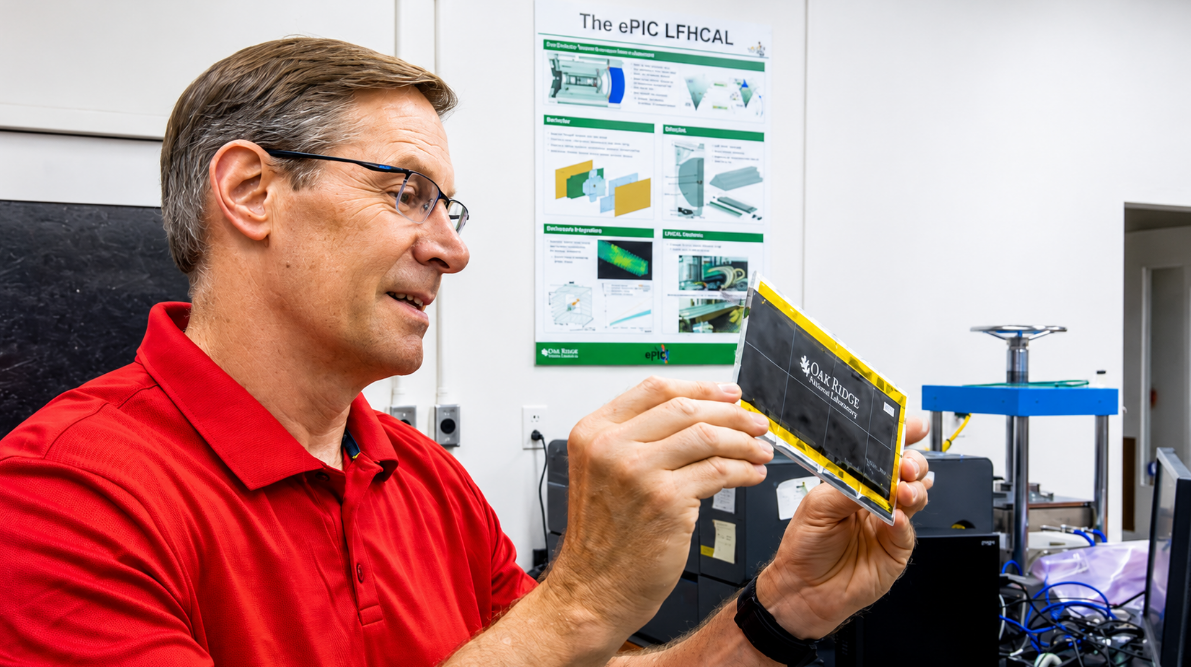
ORNL researcher advances EIC particle detection ORNL researcher John Lajoie has made progress on particle-detection technology for the Electron-Ion Collider (EIC)[30]. Technical significance: improves particle-identification precision in high-energy nuclear physics experiments. Landscape impact: supports long-term U.S. nuclear-physics facility construction and indirectly benefits quantum chromodynamics research.


03Algorithms

Algorithms & Software

Quantum X Labs claims decoding performance surpasses PyMatching Quantum X Labs (Nasdaq: QXL) announced that its AI-driven error-correction decoder exceeds matching-family baselines such as PyMatching in decoding accuracy on Google's public surface-code datasets, accelerated with NVIDIA CUDA-Q[4]. Technical significance: company-reported results not yet independently verified; if confirmed, would demonstrate the advantage of data-driven methods over commonly used decoders. Landscape impact: a new competitor emerges in the quantum error-correction decoding software market, potentially reshaping the landscape of hardware-vendor in-house decoders; commercial partnerships possible within 12 months.

Sequential preparation and measurement of multiple qubits via a single channel A new paper demonstrates a method for sequentially preparing and measuring multiple qubits through a single channel[2]. Technical significance: simplifies qubit control wiring and reduces hardware overhead, with reference value for scalable architectures. Landscape impact: influences control-electronics design for quantum processors, with long-term benefits for chip integration density.

Quantum algorithm for linear matrix equations A new paper proposes a quantum algorithm for solving linear matrix equations[3]. Technical significance: offers potential acceleration for matrix equations in scientific computing; algorithmic complexity remains to be compared with classical methods. Landscape impact: if exponential speedup is proven, would affect computational chemistry, optimization, and other fields; currently at the theoretical stage.

Reinforcement learning auto-designs quantum sensors A new framework, AutoQSense, uses reinforcement learning to automatically design quantum-sensor circuits; learned circuits outperform existing designs while requiring fewer qubit connections[14]. Technical significance: a new framework applying reinforcement learning to parameter-estimation circuit design for quantum sensors; can automatically discover better architectures and shows resilience to decoherence noise. Landscape impact: accelerates quantum-sensing design iteration, lowers the expertise barrier, and may spawn new sensor products.

Virtual rotations prepare states for PDE solving A new method uses virtual rotations to prepare quantum states for solving partial differential equations, achieving 0.9611 fidelity at 12 qubits with a more compact circuit[16]. Technical significance: achieves the same target fidelity with a leaner circuit without increasing physical circuit complexity, and clearly outperforms more complex methods under realistic conditions. Landscape impact: provides a practical tool for implementing quantum algorithms on near-term hardware, affecting the quantum-computing software stack.

04Industry

Industry & Ecosystem

Dirac Labs raises $1.8M to advance quantum navigation Dirac Labs has secured $1.8 million in funding to advance its quantum universal positioning system, providing navigation independent of GPS[10]. Commercial significance: this report is a follow-up on the same funding round; the source did not disclose investors; reflects capital interest in quantum-sensing alternatives to GPS. Landscape impact: a quantum-navigation startup receives early-stage funding, but commercial products remain years away; watch for subsequent prototype testing.

Q2B Copenhagen 2026 focuses on quantum commercial adoption The Q2B Copenhagen 2026 conference will focus on quantum technology and commercial adoption, bringing together industry leaders[31]. Commercial significance: the conference platform facilitates connections between quantum enterprises and traditional industries, accelerating commercialization. Landscape impact: Europe's quantum ecosystem activity increases, strengthening Denmark's position as a quantum-technology hub.

Study identifies 11 quantum-computing user types A study has identified 11 user types for quantum computing, providing a framework for market segmentation[32]. Commercial significance: helps quantum companies precisely target customer segments and optimize product strategy. Landscape impact: the quantum-computing market is shifting from technology-driven to user-driven, influencing startup business-model design.

ORNL Quantum Computing User Forum highlights quantum-HPC research ORNL held a Quantum Computing User Forum, focusing on quantum–high-performance computing (HPC) integration research[33]. Commercial significance: national laboratories are promoting the convergence of quantum and classical supercomputing, providing hybrid computing resources for research users. Landscape impact: accelerates practical application of quantum computing in scientific computing, driving demand for related software and middleware.

NSF funds UCLA for unified supercomputing access The NSF has awarded UCLA $9 million to unify access to multiple NSF-supported computing-center resources[19]. Commercial significance: lowers the barrier for researchers to use national supercomputing resources and promotes cross-disciplinary quantum-classical computing research. Landscape impact: facilitates validation of quantum algorithms on supercomputers, indirectly advancing the quantum-computing ecosystem.

05Other

Academic Frontier

Quantum droplet prediction challenges conventional understanding Two different types of quantum particles may form stable droplets, challenging decades of conventional wisdom; the prediction could be experimentally verified soon[20]. Technical significance: if confirmed, would reveal a new quantum phase and expand many-body physics research. Landscape impact: may influence cold-atom experimental directions and provide a new platform for quantum simulation.

Google Quantum AI discovers half-fractal states Google Quantum AI has found power-law tails in quantum-particle behavior on Cayley trees, indicating "half-fractal" states with broadly extended wavefunctions[11]. Technical significance: following earlier reports in recent days, further reveals a new phase between quantum chaos and localization. Landscape impact: deepens understanding of quantum many-body systems and may influence quantum-algorithm design.

MIT and KAUST build quantum-materials analysis foundry MIT and KAUST are collaborating to build a CMOS foundry for characterizing novel quantum materials[6]. Technical significance: provides a standardized fabrication and testing platform for quantum-materials research. Landscape impact: accelerates the translation of quantum materials from laboratory to devices, influencing hardware-route development.

51-qubit ion-trap quantum simulation provides error bounds Researchers at the Technical University of Munich have quantified the uncertainty of quantum simulations on a 51-qubit ion-trap computer, obtaining results with explicit error bounds[18] (the source link points to Innsbruck; the attribution of the experimental setup needs verification against the original paper). Technical significance: provides quantifiable error ranges for quantum simulations on ion-trap platforms, increasing result credibility. Landscape impact: lays a foundation for practical application of quantum simulation in scientific computing and influences application expansion of the ion-trap route.

Entanglement-swapping fidelity reaches 94% Researchers have achieved 94% fidelity in entanglement swapping, paving the way for practical quantum networks, though the current system relies on laboratory conditions[7]. Technical significance: achieves high fidelity in entanglement swapping, a key operation for quantum networks, but a gap remains before practical deployment. Landscape impact: quantum-network research advances, but large-scale deployment still requires solving stability issues.

Quantum method efficiently simulates complex systems A new algorithm changes query complexity from multiplicative to additive, achieving computational cost of O(αT + log(1/ε)), outperforming previous methods[8]. Technical significance: precision dependence shifts from multiplicative to logarithmic-additive; simulation time no longer grows proportionally with target precision, with major implications for long-time simulations in materials science and other fields. Landscape impact: provides a new tool for quantum-simulation algorithms and may accelerate the emergence of quantum advantage in scientific computing.

06Impact

Today's Impact

  1. Neutral-atom error-correction route gains empirical support: the spacing-optimization study[12] directly guides chip layout for QuEra, Pasqal, and other vendors; design iterations are expected within 6 months, and investors should watch for error-correction performance announcements.
  2. Competition in quantum error-correction decoding software intensifies: Quantum X Labs' self-reported results[4] may attract more startups into the decoder market; traditional hardware vendors may accelerate in-house development or seek partnerships; M&A activity possible within 12 months.
  3. Quantum-navigation funding signal is clear: Dirac Labs' funding[10] indicates sustained capital interest in GPS alternatives, but technical maturity remains low; watch for its prototype-testing timeline.
  4. Quantum-computing user profiles become clearer: the 11-user-type study[32] provides quantum companies with a market-segmentation tool; sales strategies will become more precise and may improve commercial conversion rates.
  5. Academic results accelerate translation: fundamental discoveries such as quantum droplets[20] and half-fractal states[11] have no direct near-term commercial impact, but open new directions for quantum simulation and materials research, potentially spawning new technologies in the long term.
07Other

Editor's Note

Today's news reveals two distinct trends: first, the neutral-atom route continues to make breakthroughs in error correction and integration, from multi-atom cavity coupling to spacing optimization, showing that this route is moving from physics demonstrations toward engineering optimization, with its lead in "verified logical qubit count" likely to be further consolidated; second, the quantum error-correction software ecosystem is beginning to differentiate, with independent decoder companies claiming—based on data-driven methods—to surpass traditional tools on public benchmarks, potentially reshaping the value distribution between hardware and software. At the same time, funding and project developments in quantum sensing for navigation and imaging indicate that quantum-technology commercialization is no longer confined to computing; sensing is becoming a track that delivers value earlier. Going forward, close attention should be paid to whether neutral-atom error-correction optimization at the array-layout level continues to deliver, and to how the competitive landscape of the decoder market evolves.