Aug 22, 2026 – Aug 23 · Daily Brief

Google estimates that a minimum of 1,200 logical qubits could break Bitcoin.

23 items · 7 sourcesPDFThis issue's roundup is free
02Hardware

Hardware Frontier

Ion-Trap Quantum Simulation

Researchers performed quantum quenches starting from the critical point and verified theoretical predictions in an ion-trap quantum simulator [1]. The paper includes both the theory of critical-point quenches and experimental verification on an ion-trap quantum simulator; the source provides only the title and DOI, with no further details disclosed. The ion-trap route maintains a high-fidelity advantage in quantum simulation, but still needs to overcome the qubit-count scaling bottleneck before reaching universal fault-tolerant computation.

Bosonic Quantum State Preparation

A new scheme uses parity measurements to prepare squeezed states, cat states, and GKP states [2]. The scheme uses parity measurement as a tool to prepare the three types of bosonic quantum states listed above; the source discloses no further technical details, offering a possible path for continuous-variable quantum error correction. Both photonic and superconducting routes can benefit, but the scheme imposes extremely high requirements on measurement fidelity and remains some distance from practical use.

Free-Space Quantum Network

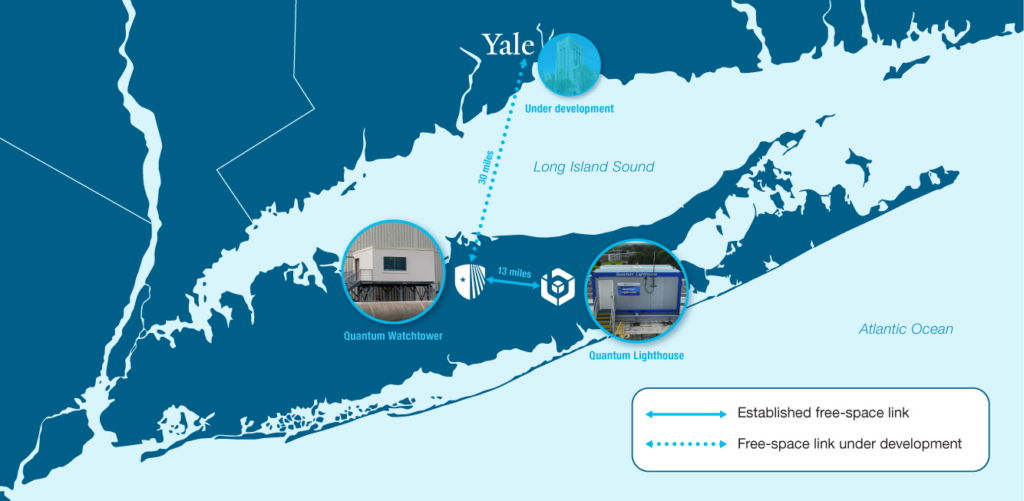
Brookhaven National Laboratory and Stony Brook University demonstrated the first permanent free-space optical quantum link in the United States, spanning 13 miles [4]. The source states that facilities at Brookhaven, Stony Brook, and Yale together constitute the free-space optical link; the specific link topology and how it corresponds to the 13-mile span are not disclosed. Free-space quantum networks can bypass fiber loss limits, but atmospheric turbulence and weather effects are long-term challenges.

Enhanced Optoacoustic Interaction

Freezing a liquid core inside an optical fiber increases the strength of light-sound interaction by more than 1000 times and was used to fabricate an optoacoustic memory [20]. The result is three orders of magnitude stronger optoacoustic coupling than in ordinary optical fibers, providing a new platform for low-energy photonic computing and quantum interfaces. The technology is still at the laboratory stage, with integration and stability yet to be verified.

03Algorithms

Algorithms and Software

Quantum Error Correction Compilation Speedup

The ONEX framework reformulates quantum error correction compilation tasks as a one-dimensional problem, raising the clock rate to up to 42.1 times that of existing methods, with simulation verification on systems exceeding 2000 qubits [13]. The framework reduces complex compilation tasks to a one-dimensional problem solvable within practical time scales; the source points to qLDPC codes and neutral-atom platforms, directly alleviating the software bottleneck in scaling that route. If independently verified, it will accelerate large-scale quantum error correction deployment.

Topological Decoder via Integer Programming

A University of Chicago team developed a topological code decoder based on integer linear programming that outperforms multiple existing methods on several test models [17]. The decoder exploits global constraints from anyon encoding, but requires formulating error correction as an integer programming problem with a large number of constraints and variables, so scalability may be limited. Note that the anyons and topological codes here refer to excitations in error-correcting codes, not the same concept as topological qubit hardware routes.

Noise-Induced Equalization Improves Learning Accuracy

Research shows that noise-induced equalization can improve the accuracy of quantum learning models, involving teams from the University of Basel and the University of Pavia [6]. The work examines the positive effects of noise in quantum learning, offering a new perspective for algorithm design in the NISQ era. In the short term it can improve the performance of variational quantum algorithms; in the long term it must be combined with error correction.

Quantum Dynamics Enhanced Graph Learning

The QDAGer Transformer network injects time-resolved quantum signals into the attention mechanism and outperforms traditional methods on multiple graph learning tasks [10]. The model leverages quantum evolution simulation data and exhibits stronger inductive bias than existing methods; ablation experiments confirm that the improvement stems from dynamical information rather than merely increased compute. It opens a new path for combining quantum machine learning with classical graph neural networks.

Real-Time Data Simulates Imaginary-Time Evolution

A new method proposed by the Dakota team derives imaginary-time evolution from standard measurement data of real-time evolution, requiring no additional qubits [11]. The scheme establishes a pathway between real-time and imaginary-time dynamics, simplifying quantum state preparation workflows. It has practical value for quantum chemistry and optimization problems, but measurement overhead and accuracy require further verification.

Simulation Error Converted into a Resource

Policy-trained quantum simulations can generalize to entirely new initial conditions and scale to systems ten times larger than those used in training [12]. The work is the first to treat simulation approximation error as a correctable resource rather than an irreducible defect. It offers new ideas for long-time quantum simulation, but generalization bounds and error models still need theoretical support.

Block Encoding Reduces T-Gate Count

A new method reduces the T-gate count of unitary operations through block encoding, but requires the error tolerance to tighten as system size grows [14]. The technique achieves T-gate count compression for the first time under specific conditions, but applicability is limited by error requirements and may fail in complex computational scenarios. It has reference value for resource optimization in fault-tolerant quantum computing.

Monitored Circuits Simulate Two-Dimensional Quantum States

Scientists used monitored circuits to simulate two-dimensional quantum states, with qualitative agreement with DMRG methods on the J1-J2 model [16]. The work is currently a proof of concept, constrained by finite bond dimension, and quantitative accuracy remains insufficient. It provides an alternative path for simulating strongly correlated materials on quantum computers.

04Industry

Industry and Ecosystem

Personnel Changes

D-Wave appointed Kevan P. Krysler to its board of directors and audit committee; Krysler is currently CFO of Carbon Robotics [3]. He has more than twenty years of financial leadership experience and previously served as CFO of Everpure, among other roles. D-Wave is strengthening financial governance, possibly paving the way for subsequent commercialization and capital operations.

Bitcoin Quantum Attack Timeline

New estimates from Google's Quantum AI team indicate that a quantum computer needs a minimum of 1200 logical qubits to break Bitcoin cryptography [7]. The figure is significantly lower than previous estimates, substantially advancing the quantum threat timeline. The Bitcoin and cryptocurrency ecosystem faces pressure to upgrade security, and the need for post-quantum cryptography migration is urgent.

Pure-Play Quantum Security

SEALSQ Corp (NASDAQ: LAES) is one of the few publicly listed companies built entirely around the threat posed by quantum computers [19]. Its business history reveals the early shape and evolutionary logic of the quantum security market. Investors can use it as an observation sample for the quantum security sector.

Quantum Consciousness Advocacy

Lionel Martellini of the EDHEC Quantum Institute argues that business leaders need quantum consciousness rather than quantum washing [23]. The viewpoint emphasizes distinguishing genuine quantum capability from marketing rhetoric, carrying cautionary significance for healthy industry development. Enterprise quantum strategy formulation requires establishing a technical assessment framework.

05Other

Academic Frontier

Quantum Quench Theory Verified

npj Quantum Information published a paper on the theory of quantum quenches from the critical point and experimental verification in an ion trap [1]. The source provides only the paper title and DOI; quantitative experimental conclusions are not disclosed, offering a reference direction for quantum many-body physics.

Parity Measurement Prepares Bosonic States

npj Quantum Information published a scheme using parity measurements to prepare squeezed states, cat states, and GKP states [2]. The theoretical scheme uses parity measurement to prepare three types of bosonic quantum states, providing a new tool for continuous-variable quantum computing.

Noise Effects in Quantum Learning

Quantum Science and Technology published research on noise-induced equalization, involving teams from the University of Basel and the University of Pavia [6]. The paper examines the impact of noise-induced equalization on the accuracy of quantum learning models, offering a new perspective for algorithm design.

Universality of Quantum Theory

An Oxford team confirmed universal properties of quantum theory based on consistency constraints on dynamical evolution [9]. The work continues Heisenberg's approach to quantizing the electromagnetic field, ruling out classical-quantum hybrid descriptions from the perspective of algebraic consistency. It has theoretical significance for quantum foundations research.

Highly Entangled GHZ State Simulation

Northwestern University and other institutions used Bethe-Heitler processes to simulate more than 900 highly entangled GHZ states [15]. The work demonstrates for the first time in simulation the potential of simple interactions to generate complex entanglement, offering new ideas for quantum information encoding.

06Impact

Today's Impact

  1. Bitcoin security timeline tightens: Google's new estimate lowers the logical qubits required for a quantum attack to a minimum of 1200, and the cryptocurrency community needs to accelerate post-quantum cryptography migration; related standards and hardware deployment may be brought forward [7].
  2. Quantum error correction software stack matures: The ONEX framework's up to 42.1x speedup brings thousand-qubit-scale error correction compilation into practical time scales; large-scale error correction experiments on qLDPC codes and neutral-atom platforms will benefit, potentially accelerating logical qubit demonstrations [13].
  3. New path for topological decoders: The integer programming decoder outperforms multiple existing methods on several models; if verified on real hardware, it will improve decoding efficiency for topological error-correcting codes and has direct significance for related error correction schemes [17].
  4. Free-space quantum network lands: The first permanent free-space quantum link in the United States has been established, offering a new option for intercity quantum communication, but weather and stability issues must be addressed [4].
  5. Quantum security investment targets become clearer: The business history of pure quantum security companies such as SEALSQ provides a sample for observing the early shape of this market; the source does not address valuation or investment merit, and quantum security market education is accelerating [19].
07Other

Editorial Commentary

The most noteworthy item in this issue is Google's new estimate of the logical qubits required for a quantum attack on Bitcoin: a minimum of 1200 logical qubits. The source states that this means quantum attacks are closer than previously thought, and the quantum threat is no longer a distant future. However, one must remain clear-headed: the source does not provide a comparison between the current logical qubit scale and error rates of quantum computers, and how far the 1200 threshold remains from existing demonstrations still requires public data to support. Beyond growth in quantity, reduction in error rates is equally a prerequisite. The market may overestimate short-term risk but underestimate long-term certainty.

Another trend is the rapid maturation of the quantum error correction software stack. The ONEX framework's 42x speedup, the integer programming decoder, and noise-induced equalization all indicate that software optimization is becoming a second scaling path alongside hardware. Against the backdrop of slowing improvements in physical qubit fidelity, gains in compilation and decoding efficiency may yield order-of-magnitude practical benefits. Investors should pay attention to companies that can optimize both hardware and software simultaneously.