Aug 23, 2026 – Aug 24 · Daily Brief

Continuous-variable QKD hybrid link achieves a key rate of up to 0.93 Mbit/s

18 items · 3 sourcesPDFThis issue's roundup is free
02Hardware

Hardware Frontier

Quantum Communication

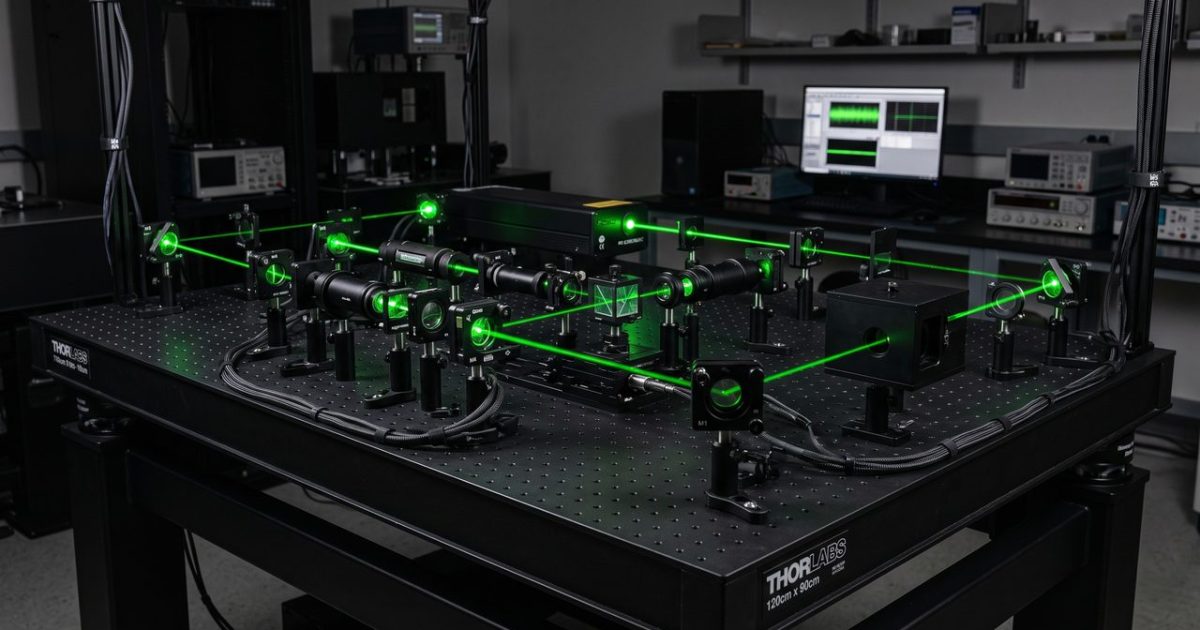
  • A research team used squeezed states to implement continuous-variable QKD, achieving a key rate of up to 0.93 Mbit/s over a hybrid link of 2 km optical fiber and 620 m free space, with post-processing recovering an additional 19% of keys [3]. Technical implications: raising the continuous-variable QKD key rate to up to 0.93 Mbit/s over a hybrid-medium link; the source does not provide a quantitative comparison with prior work; the result shifts channel adaptation to post-processing, requiring no complex optical adjustments. Strategic impact: directly promotes deployment of quantum secure communication networks; existing fiber infrastructure can be reused; affects QKD equipment vendors and operators; pilots expected within 1–3 years.

Quantum Sensing

  • A Michigan team used electromagnetic and acoustic Fano interference in surface acoustic wave resonators to shape the resonance spectrum, enhancing frequency-shift detection capability [2]. Technical implications: first engineering of device response through interference effects rather than design optimization or electrical signals, improving sensitivity to small environmental changes. Strategic impact: potential value for sensing-sensitivity improvements from materials science to quantum technology; affects sensor manufacturers; timescale 2–5 years.
  • Researchers proposed a new protocol for distributed quantum sensing networks that balances accuracy and privacy [8]. Technical implications: achieving a trade-off between high precision and individual data privacy in multi-party quantum sensing. Strategic impact: paves the way for quantum sensing networks in sensitive-data scenarios such as healthcare and finance; affects relevant standards development; timescale 3–5 years.

Quantum Computing Hardware

  • Diraq fabricates spin qubits in silicon, using the same type of manufacturing methods as those for conventional computer chips [10]. Technical implications: if validated, would significantly reduce quantum chip production costs, but the source does not disclose specific technical metrics such as fidelity, so caution is warranted. Strategic impact: strategic significance for semiconductor foundries and quantum computing startups; may accelerate quantum processor mass production, but remains multiple orders of magnitude away from fault-tolerant computing (coherence time, qubit count, etc.).
03Algorithms

Algorithms and Software

Quantum Communication Theory

  • A team from an ETRI-affiliated institute proved the optimality of Gaussian encoding for transmitting information over power-constrained quantum channels [4]. Technical implications: resolves a long-standing problem in quantum communication capacity optimization, providing a theoretical optimality proof for Gaussian-state encoding. Strategic impact: influences quantum communication protocol design and standardization; provides guidance for QKD and quantum network capacity analysis; immediate academic impact, with industrial application requiring further engineering.

Quantum Foundations

  • A research team extended the interpretation of Bell experiment results to probabilistic scenarios, using "frame-indexed causal models" to handle consistency for relatively moving observers [5]. Technical implications: extends the argument against combining quantum mechanics with classical locality to genuinely probabilistic scenarios, broadening the applicability of Bell's theorem. Strategic impact: profound implications for quantum foundations research and quantum information theory; may affect security proofs of quantum cryptography, but no direct near-term industrial impact.

Quantum Computing Applications

  • Researchers from UPV/EHU, Harvard, and TECNALIA used quantum computers to classify neutrino telescope events [12]. Technical implications: applies quantum computing to neutrino event classification, demonstrating the potential of quantum machine learning in particle-physics data processing. Strategic impact: provides an application case for quantum computing in scientific computing such as high-energy physics; affects relevant research institutions, but current quantum hardware scale is limited and practical advantage remains to be verified.
  • University of Leeds researchers reconsidered quantum repeaters, balancing scalability with long-distance high-speed data transmission [6]. Technical implications: seeks a balance between scalability and long-distance transmission rate; the source does not disclose specific design details. Strategic impact: potential impact on quantum internet backbone construction; involves repeater hardware vendors and network operators; timescale 5–10 years.

Classical Computing Related

  • NVIDIA researchers proposed a Hybrid Domain Knowledge Fusion (HDKF) framework for portrait relighting; the distilled model runs in real time at 512x512 resolution, 11.89 ms on RTX 2060 and 1.82 ms on RTX 4090 [7]. Technical implications: advances portrait relighting from offline processing to real time, with a speedup of about 6.5x (4090 vs 2060), but this work belongs to classical computer vision, not quantum computing. Strategic impact: affects real-time video processing, augmented reality, and other applications, but has no direct relevance to the quantum industry and is mentioned only as technical background.
04Industry

Industry and Ecosystem

Financing and Investment

  • The London Quantum Cluster provides seed funding for quantum health applications, with applications closing at 16:00 on August 24; funding size undisclosed [9]. Business implications: quantum technology is penetrating the healthcare sector; early-stage projects receive support from local innovation clusters, reflecting the trend of diversified quantum applications. Strategic impact: attracts more health-tech startups into the quantum track; may spawn cross-disciplinary projects such as quantum diagnostics and drug discovery; timescale 1–2 years.

Company Developments

  • Infleqtion (NYSE: INFQ), a neutral-atom quantum computing and sensing company, listed on the NYSE in February 2026; its Sqale roadmap and financial disclosures show the company's development trajectory [11]. Business implications: a neutral-atom-route company has entered the public market, providing investors with a direct vehicle, but its technical progress needs continuous tracking against the Sqale roadmap and filings. Strategic impact: the number of listed quantum computing companies increases, attracting more capital attention, but the match between valuation and fundamentals warrants caution.
  • Diraq fabricates spin qubits in silicon, using the same type of manufacturing methods as conventional computer chips [10]. Business implications: lowers quantum chip production costs and may attract cooperation or investment from semiconductor giants, but technological maturity remains low. Strategic impact: if mass production proves feasible, it will change the quantum computing supply-chain landscape and affect the strategic positioning of foundries such as TSMC and Samsung; timescale 5+ years.
05Other

Academic Frontier

Geometry of Open Quantum Systems

  • Researchers defined a geometric landscape for open quantum systems, providing an alternative to traditional approaches that rely on strict symmetry conditions [1]. Technical implications: introduces a geometric description into open quantum system dynamics, potentially simplifying analysis of complex systems, but full compatibility is guaranteed only under specific parameter settings. Strategic impact: inspires theoretical research in quantum control and quantum thermodynamics; no direct near-term application.

Quantum Foundations and Causal Models

  • A research team extended Bell experiment interpretation to probabilistic scenarios, adopting frame-indexed causal models [5]. Technical implications: handles causal models within a relativistic framework, revealing the difficulty of combining quantum mechanics with locality. Strategic impact: deepens understanding of quantum foundations; may affect security proofs of quantum information protocols.

Quantum Communication Capacity

  • An ETRI-affiliated institute proved the optimality of Gaussian encoding over power-constrained quantum channels [4]. Technical implications: provides a rigorous proof for quantum communication capacity, resolving this long-standing problem; the analysis deliberately avoids multi-particle entanglement scenarios and makes no broad assertions about one-to-two-particle arrangements. Strategic impact: provides a theoretical benchmark for quantum communication system design and influences future standards development.

Quantum Repeater Design

  • University of Leeds researchers proposed a quantum repeater scheme balancing scalability and rate [6]. Technical implications: optimizes repeater architecture at the system level rather than for a single metric. Strategic impact: offers new ideas for quantum network construction, but remains far from practical deployment.

Quantum Machine Learning Applications

  • UPV/EHU and other institutions used quantum computers to classify neutrino events [12]. Technical implications: demonstrates the feasibility of quantum computing in high-energy physics data processing, but current quantum hardware scale is limited. Strategic impact: provides a validation case for quantum computing in scientific computing and promotes interdisciplinary collaboration.

Distributed Quantum Sensing

  • A new protocol balances accuracy and privacy in quantum sensing networks [8]. Technical implications: introduces privacy-preserving mechanisms into multi-party quantum sensing, expanding application scenarios. Strategic impact: provides theoretical support for deploying quantum sensing networks in sensitive-data environments.

Classical Computer Vision

  • NVIDIA's HDKF framework achieves real-time portrait relighting, 1.82 ms on RTX 4090 [7]. Technical implications: classical deep-learning optimization, unrelated to quantum computing. Strategic impact: affects the real-time video processing industry, but is not within the key focus of the quantum daily brief.
06Impact

Today's Impact

  • Quantum communication industry: continuous-variable QKD key rate reaches up to 0.93 Mbit/s and can reuse existing infrastructure, potentially accelerating deployment of quantum secure communication over existing fiber networks; affects QKD equipment vendors such as ID Quantique and Toshiba; next watch field trials and standardization progress [3].
  • Quantum computing investors: Infleqtion's post-listing performance and Diraq's silicon-route progress provide capital markets with vehicles across different technology routes; investors should focus on publicly disclosed technical metrics and avoid hype [10][11].
  • Quantum sensing R&D: surface acoustic wave resonator sensitivity improvements and distributed sensing privacy protocols provide new tools for IoT, medical monitoring, and other scenarios; related startups may secure more funding [2][8].
  • Quantum foundations research: new Bell experiment interpretations and open-system geometric methods provide new perspectives on quantum theory; may affect security assumptions in quantum information processing and could spawn new protocols in the long term [1][5].
  • Cross-disciplinary applications: quantum computing applied to neutrino classification demonstrates the potential of quantum machine learning in scientific computing; may drive broader adoption of quantum computing in high-energy physics and astronomy [12].
07Other

Editor's Note

This issue focuses on the practicalization of quantum communication: the continuous-variable QKD key rate reaches up to 0.93 Mbit/s and can operate over hybrid fiber–free-space links, further strengthening the feasibility of moving quantum secure communication from the laboratory to metropolitan-area networks. Compared with discrete-variable QKD, continuous-variable schemes are easier to integrate with existing optical communication equipment, but have previously been constrained by key rate and distance; this advance shifts channel adaptation to post-processing, clearing a key obstacle for deployment. However, the result is still based on a single experimental setup; loss, noise, and stability in real networks remain to be verified, and large-scale commercial deployment is still several years away.

On the other hand, the quantum computing industry is diversifying: Diraq adopts the same type of silicon manufacturing as conventional chips, attempting to bring quantum chips into the existing semiconductor manufacturing system; Infleqtion, as a neutral-atom company, has gone public, offering investors a new vehicle. But caution is warranted: in this issue's sources, neither route discloses key technical metrics such as fidelity or qubit count, and the public information is insufficient to support horizontal comparison. Amid capital enthusiasm, the gap between technical validation and commercial deployment remains significant.