Aug 24, 2026 – Aug 25 · Daily Brief

U.S. Treasury takes the lead in fitting the financial system with quantum-resistant locks

45 items · 13 sourcesPDFThis issue's roundup is free
02Hardware

Hardware Frontier

Neutral Atoms

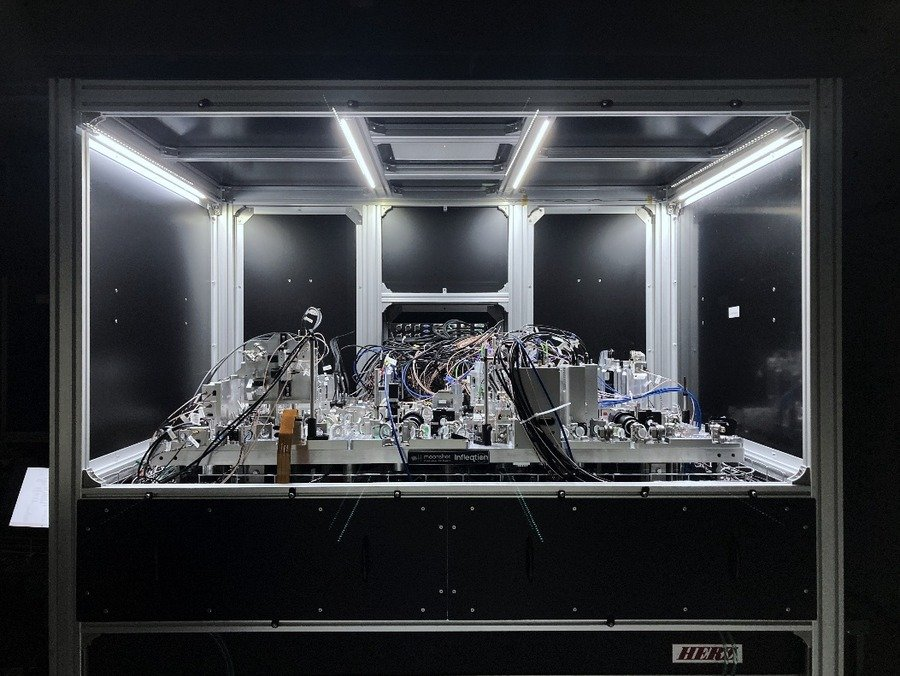
The neutral-atom quantum computer "Shunkai," developed through a collaboration between Infleqtion and Japan's Moonshot program, has officially entered operation[3]. This collaboration was previously reported; the incremental development here is that this computer becomes Japan's first operational full-stack neutral-atom quantum computer, with the processor unit already deployed. Technical implications: the neutral-atom route lands its first operational full-stack system in Japan; against the baseline, the state-of-the-art two-qubit gate fidelity for neutral atoms is 99.5% (Harvard 2023), and Infleqtion has not disclosed specific fidelity figures, so it cannot be determined whether parity has been reached. Landscape impact: Japan's quantum computing supply chain gains localized hardware support, and Infleqtion (NYSE: INFQ) accelerates its commercialization pace in Asia-Pacific, with a timeline of the next 12 months.

Trapped Ions

IonQ subsidiary Skyloom has deployed dozens more optical communication terminals to low Earth orbit this time, bringing the total number of in-orbit terminals to 84, supporting the U.S. Space Development Agency (SDA) constellation[11]. Technical implications: cumulative in-orbit optical inter-satellite link terminals reach 84, improving constellation communication capacity; however, this is optical communication rather than quantum computing hardware, with no direct technical connection to the trapped-ion route. Landscape impact: IonQ diversifies its revenue streams, with space optical communications becoming a cash flow supplement, with a timeline of 2026–2027.

Photonics

NIST researchers developed superconducting nanowire detectors with photon capture efficiency of 98%[26][40]. Technical implications: the detector can capture 98% of incident photons, substantially reducing missed detection of weak optical signals; against the baseline, the photonic route's SPAM fidelity of 99.98% depends on high detection efficiency, and the 98% detector provides a superior component for system integration. Landscape impact: weak-light detection applications such as deep-space communication and biomedical imaging benefit, and quantum communication receiver sensitivity improves, with a timeline of 2–3 years.

Superconducting

Researchers used optical signals to control superconducting qubits, achieving single-qubit gate fidelity of 99.915±0.005% and two-qubit CZ gate fidelity on the order of 99% (the source value is truncated here; full digits not disclosed)[20]. Technical implications: the single-qubit fidelity of optically controlled superconducting qubits approaches the upper bound of the production-system baseline F₂Q of 99.5%–99.9%; the exact level of the two-qubit CZ gate awaits verification against the original text; optical interconnects provide a new path for scaling superconducting qubits. Landscape impact: room-temperature control electronics for superconducting quantum computers may be replaced by photonic links, reducing wiring complexity in dilution refrigerators, with a timeline of 3–5 years.

Spin Qubits

Researchers controlled hundreds of nuclear spins in diamond with significantly reduced energy consumption and expanded the carbon-13 register as long-term quantum storage[16]. Technical implications: diamond nuclear spin control shifts from high energy consumption to low power, while increasing the number of available quantum storage qubits; it should be noted that this work belongs to the diamond color-center platform, not the same technical route as silicon spin qubits, and the source does not provide directly comparable gate fidelity figures—progress is concentrated at the level of control energy consumption and storage registers. Landscape impact: the practicality of solid-state quantum storage improves, influencing quantum repeater and quantum network node design, with a timeline of 5+ years.

Topological/Other

Harvard University achieved isolation fidelity exceeding 99% for individual NaCs molecular pairs, with optical array site filling rates exceeding 95%[17]. Technical implications: previously, ground-state molecular loading filling rates were only 20–50%; this work uses static and microwave electric fields to create "collision shielding" that prevents molecular loss, raising the filling rate above 95% and paving the way for molecular qubit arrays. Landscape impact: molecular quantum computing as an emerging route gains critical preparation capability, attracting more research groups to enter, with a timeline of 5–10 years.

Researchers used nanoscale lens structures to improve single-atom detection sensitivity by a factor of 4[21]. Technical implications: through near-field light-scattering focusing, atomic fluorescence collection efficiency improves by a factor of 4, providing a new tool for atom array readout. Landscape impact: readout speed and fidelity for neutral-atom and trapped-ion platforms may benefit, with a timeline of 2–3 years.

03Algorithms

Algorithms and Software

Quantum Error Correction and Error Mitigation

Researchers used Google Willow processor data to optimize measurement timing, reducing the logical error rate that causes computational failure by up to 40%[13]. Technical implications: by adjusting measurement timing rather than modifying hardware, error rate reduction is achieved on existing error-correcting codes, representing software-level error correction optimization; against the baseline, Willow's error suppression factor Λ≈2.1, and this work does not provide Λ changes, but a 40% error rate reduction is equivalent to effectively improving Λ. Landscape impact: quantum error correction decoding and timing optimization become low-cost paths to improving fault-tolerant performance, affecting all hardware vendors using surface codes, with a timeline of 1–2 years.

Researchers used error mitigation techniques such as Qedma QESEM to reduce error rates by a factor of 4.7 on the IBM Pittsburgh processor, reaching 0.0188[14]. Technical implications: error mitigation (rather than correction) pushes the effective error rate of noisy intermediate-scale quantum devices below 2%; the source does not compare this value with logical error rates of error-correcting codes. Landscape impact: the practical window for NISQ devices is extended, and hardware vendors such as IBM can offer higher-fidelity cloud services, with a timeline of 6–12 months.

Quantum Simulation and Chemistry

A Soongsil University team used a sample-based quantum diagonalization method to estimate ground-state energies of HeH⁺, ArH⁺, and H₂O on IBM quantum hardware, with a deviation of 0.00 mHa[15]. Technical implications: zero deviation compared with CCSD calculations (within reported precision) indicates that quantum hardware combined with classical post-processing can achieve chemical accuracy. Landscape impact: near-term applications of quantum computing in molecular simulation are validated, and chemical and pharmaceutical companies can begin pilot programs, with a timeline of 1–3 years.

Microsoft Research released Skala 1.1, increasing training data volume by a factor of 2.5, with significantly improved accuracy in thermochemistry, reaction kinetics, and molecular structure prediction[18]. Technical implications: the accuracy of machine-learning surrogate models for density functional theory (DFT) improves, already integrated into CP2K and being integrated into Psi4, FHI-aims, ORCA, and VASP. Landscape impact: the classical computational chemistry software ecosystem is penetrated by machine-learning models, reducing computational costs for materials science and drug discovery, with immediate effect.

Quantum Advantage and Communication

Nagoya University demonstrated quantum advantage over classical computers under limited communication exchanges, achieving a power separation of 3/2 − 1/(4t), with the four-round protocol at t=1 showing improved performance on at least one total function[23]. Technical implications: first demonstration of quantum advantage under few-round communication, stronger than previous separations requiring more computational steps. Landscape impact: quantum communication protocol design gains theoretical support, and distributed quantum computing architectures benefit, with a timeline of 3–5 years.

Researchers proved that the "hidden conjecture" for Gaussian boson sampling (GBS) holds for any number of squeezed input modes[24]. Technical implications: this key property no longer depends on restrictive assumptions about the number of input modes, thereby strengthening the argument for the classical simulation hardness of GBS. Landscape impact: quantum advantage claims based on GBS become more robust, and the photonic route's position on sampling tasks is reinforced, with immediate effect.

Researchers optimized methods for dynamically preparing quantum spin liquids, simulating and optimizing the preparation of spin-liquid correlations in systems with up to 384 atoms[25]. Technical implications: even when the ground-state phase diagram lacks a topological phase, states with quantum spin-liquid correlations can be dynamically prepared, providing a new avenue for topological matter research. Landscape impact: applications of quantum simulators in condensed matter physics expand, influencing fundamental research and future topological quantum computing, with a timeline of 5+ years.

04Industry

Industry and Ecosystem

Finance and Policy

The U.S. Treasury announced the establishment of a Quantum Readiness Working Group to coordinate the federal financial system's migration to quantum-safe cryptography[34]. Technical implications: the working group is established pursuant to Executive Order 14412, with the goal of strengthening cryptographic protection; the source does not disclose a migration roadmap or timeline. Landscape impact: the federal financial system's post-quantum cryptography migration moves from statements to coordinated execution; the source does not propose mandatory standards or completion deadlines.

The Responsible Finance & Investment Institute (RFI) and Safeheron launched a cross-border post-quantum cryptography (PQC) pilot to evaluate quantum-resilient digital asset transaction infrastructure[10]. Technical implications: the pilot involves international commercial banks and financial regulators across multiple jurisdictions, testing post-quantum wallet generation and transactions. Landscape impact: quantum security standards for digital assets (cryptocurrencies, stablecoins) begin to take shape, affecting exchanges and custodians, with a timeline of 1–2 years.

Investment and Regional Deployment

Pasqal signed an agreement with Eleven Ventures to establish a joint venture, Pasqal Arabia, to deploy neutral-atom quantum processors in the Middle East and North Africa[12]. Technical implications: Pasqal's hardware and software stack will enter the Saudi and surrounding markets, potentially including local data centers and R&D centers. Landscape impact: quantum computing becomes part of Saudi Arabia's "Vision 2030," and the Middle East becomes a new battleground for quantum technology, with a timeline of 2–5 years.

EuroHPC opened a €119 million call for quantum technology funding[35]. Technical implications: funding covers quantum computing, quantum simulation, quantum communication, and other directions, open to EU member states and associated countries. Landscape impact: European quantum startups and research institutions gain a new funding pool, accelerating technology transfer, with a timeline of 2026–2027.

Sweden set a 2036 deadline for its national quantum technology strategy[38]. Technical implications: the Swedish government has defined quantum technology development goals, potentially including quantum computing, quantum sensing, and quantum communication. Landscape impact: the Nordic quantum ecosystem gains policy certainty, attracting investment and talent, with a timeline of 10 years.

New Mexico invested $3 million in the University of New Mexico's quantum institute[39]. Technical implications: state-level funding supports quantum research and education, potentially used for laboratory equipment and graduate fellowships. Landscape impact: the geographic distribution of U.S. quantum research expands, and New Mexico becomes a quantum talent base, with a timeline of 3–5 years.

Company Developments

ColibriTD raised €4 million in funding to expand its multiphysics quantum simulation platform[22]. Technical implications: following a previous €1 million investment, this round funds platform development and commercialization. Landscape impact: quantum simulation software adoption in industrial design (aerospace, automotive) accelerates, with a timeline of 1–2 years.

GSA updated identity and access programs to migrate to post-quantum cryptography[6]. Technical implications: the U.S. General Services Administration updated federal identity architecture and physical access testing, transitioning to quantum-safe cryptography. Landscape impact: identity management vendors in the federal government supply chain must upgrade products, with a timeline of 2–3 years.

05Other

Academic Frontier

Quantum Information Theory

An IQIM collaborative team performed the first experiments on two different conformal field theories on a quantum simulator, directly measuring energy levels[2]. Technical implications: using new quantum simulator techniques, conformal field theory energy levels are directly measured for the first time, validating theoretical predictions. Landscape impact: quantum simulators become a new tool for studying quantum field theory, influencing high-energy physics and condensed matter theory, with a timeline of 5+ years.

Researchers studied micromechanical qubits based on quantized oscillations in superfluid helium[7]. Technical implications: a micromechanical qubit scheme based on quantized oscillations in superfluid helium is proposed, potentially featuring long coherence times. Landscape impact: exploration of novel qubit platforms; if successful, could scale to large systems, with a timeline of 10+ years.

Researchers characterized the steerability of rank-2 two-qubit entangled states[8]. Technical implications: quantum steerability conditions for rank-2 two-qubit entangled states are determined, providing resource certification for quantum information tasks. Landscape impact: entanglement verification in quantum key distribution and quantum networks benefits, with a timeline of 3–5 years.

Quantum Materials and Simulation

Caltech and Yale University precisely quantified the Kondo effect[27]. Technical implications: accurate quantification of the Kondo effect, a key phenomenon for understanding electron behavior in real materials. Landscape impact: quantum simulation of strongly correlated electron systems becomes more precise, influencing high-temperature superconductivity and heavy-fermion materials research, with a timeline of 5+ years.

The QAL Quantum Algorithms Laboratory is developing visual interactive tools for teaching and researching quantum algorithms, linear algebra, and group theory[9]. Technical implications: interactive tools help understand quantum algorithms and mathematical foundations, potentially containing patentable novel designs, currently under construction. Landscape impact: the quantum education tools market expands, cultivating more quantum talent, with a timeline of 1–2 years.

06Impact

Today's Impact

  1. Quantum security for the financial system accelerates: The U.S. Treasury working group and cross-border PQC pilot[34][10] push cryptographic migration onto the agenda for banks, payment companies, and digital asset platforms; the source does not provide completion deadlines or compliance requirements. Next to watch: whether the working group releases a specific migration roadmap and timeline.
  2. Quantum computing enters the Middle East: Pasqal Arabia, established through the Pasqal–Eleven Ventures agreement[12], brings neutral-atom quantum computers to Saudi Arabia and the MENA region, potentially triggering a regional technology race. Next to watch: whether Saudi sovereign funds make additional investments, and the progress of local data center construction.
  3. Software-level error reduction becomes a competitive focus: The 40% logical error rate reduction from error-correction measurement timing optimization and the 4.7× error improvement from error mitigation[13][14] show that performance can be improved without hardware changes; hardware vendors and software startups will compete on timing optimization and error mitigation. Next to watch: whether these methods are reproduced on more hardware platforms.
  4. Photon detection efficiency improves: NIST's 98% photon capture efficiency[26][40] will improve receiver sensitivity for quantum communication and deep-space communication. Next to watch: end-to-end performance testing of this detector in quantum key distribution systems.
  5. Molecular simulation accuracy improves: The quantum diagonalization method reaches chemical accuracy[15], and Skala 1.1 substantially improves DFT accuracy[18]; pharmaceutical and materials companies can begin piloting quantum-computing-assisted design. Next to watch: simulation results for actual drug molecules or material systems.
07Other

Editor's Commentary

The most noteworthy development in this issue is that quantum security for the financial system has moved from discussion to execution. The establishment of the U.S. Treasury working group and the launch of the cross-border PQC pilot signal that regulators are no longer waiting for quantum computers to mature but are proactively driving cryptographic migration. This contrasts with the "quantum threat is still distant" narrative of past years. Financial practitioners should recognize that quantum security is no longer optional but an engineering task that needs to be scheduled in advance.

On the technical side, software-level error reduction has become a new hotspot. The 40% logical error rate reduction from error-correction measurement timing optimization and the 4.7× error improvement from error mitigation demonstrate that software-level improvements can rapidly boost performance without waiting for hardware breakthroughs. This creates opportunities for differentiation among quantum computing companies: whoever can provide better error mitigation and timing optimization will win customers in the NISQ era. Meanwhile, the expansion of the neutral-atom route in Asia and the Middle East indicates that geopolitical technology competition is extending from the U.S. and Europe to the entire globe.