Quantum Key Distribution
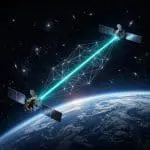
Eavesdropping detection with 15% qubit probability Experimental QKD detects eavesdropping on 15% of shared qubits without discarding any key material; traditional methods require revealing and sacrificing key bits to verify security [5]. This is a new direction in QKD security verification, embedding cryptographic operations into photonic quantum switches and achieving covert eavesdropping detection through controlled qubits. The impact on QKD practicality is direct: key-rate loss drops from a significant fraction in conventional schemes to zero; if independently verified, this will change the security-margin design of QKD systems.
Photon shape encoding pushes key rate to 0.9 Kb/s A new QKD protocol encodes data using spatial modes of photons, achieving a key rate of 0.9 Kb/s [18]. This represents an expansion of QKD encoding dimensions, adding a degree of freedom compared to traditional polarization or phase encoding. For quantum-secure network deployers, 0.9 Kb/s remains far below classical communication, but it has entered the acceptable range for scenarios such as low-speed IoT.
Superconducting Qubits
NIST and University of Maryland propose experimental scheme for quantum autonomous gates Researchers have proposed an experimental implementation of quantum autonomous gates, published in Quantum Science and Technology on August 28, 2026 [6]. Autonomous gates execute quantum operations without external classical control, representing one path toward reducing control-electronics overhead. This has potential value for superconducting-route scalability, but it remains at the experimental-proposal stage with no fidelity data reported, so it cannot be benchmarked against the current superconducting two-qubit gate SOTA (99.5%–99.9%).
Trapped-Ion Qubits
Geometric phase gates push entanglement fidelity above 0.99 Researchers achieved Bell-state fidelity exceeding 0.99 on trapped-ion qubits, even with motional excitation of up to 10 phonons [10]. This result matches the top tier of the trapped-ion route (Quantinuum Helios all-pair F2Q 99.921%, IonQ EQC prototype single-pair 99.99%), but the report does not specify whether it is a single-pair or system-wide metric; if single-pair with no parallel data, it still lags commercial all-pair SOTA by an order of magnitude. Distance to fault tolerance still lacks system-wide parallel gate fidelity and scalable-architecture validation.
Spin Qubits
Frozen impurities extend spin-qubit coherence time to 0.2 seconds Nuclear spins in solids are leading candidates for quantum networks and quantum repeaters; direct all-optical initialization, coherent control, and readout of individual nuclear-spin qubits have long been a challenge. By freezing paramagnetic impurities, coherence time exceeds 0.2 seconds with single-shot readout fidelity of 91(2)% [16]. For individual nuclear-spin qubits with all-optical initialization, coherent control, and readout, a coherence time exceeding 0.2 seconds is significant progress. However, readout fidelity of 91% remains below the fault-tolerance threshold (typically above 99%), and scalability is not addressed; if independently reproduced, this result would substantially improve quantum-repeater feasibility.
Topological and Quantum Materials
PTB and Würzburg explore magnetic-field-free quantum resistance standard Dr. Kajetan Fijalkowski and PTB are using the quantum anomalous Hall effect to develop a new resistance standard that achieves high precision without an external magnetic field [12]. This is a metrology application; the quantum anomalous Hall effect provides topologically protected quantized resistance. It has long-term implications for precision measurement and standards development, but the commercial timeline is measured in years.