M&A: Quantum eMotion to Acquire Plurilock in CAD 33.8 Million Deal
Canadian publicly traded quantum technology company Quantum eMotion has announced a definitive agreement to acquire 100% of cybersecurity service provider Plurilock Security Inc. for an aggregate consideration of CAD 33.8 million (approximately USD 23.8 million), with the transaction expected to close before the end of 2026 [10].
In terms of commercial and technical implications, each share of Plurilock will be exchanged for CAD 0.084 in cash and 0.0763 shares of Quantum eMotion stock. This acquisition sets a precedent for a pure-play quantum hardware security company acquiring an established IT endpoint security provider, directly injecting Quantum eMotion's patented quantum random number generator (QRNG) hardware IP into Plurilock's behavioral adaptive authentication and identity management software, which already serves dozens of government and enterprise clients.
Regarding landscape impact, affected stakeholders include North American traditional cybersecurity and Zero Trust architecture vendors. The merged entity plans to launch a next-generation endpoint protection platform with hardware-level post-quantum credentials within 1 year, accelerating the commercialization of post-quantum security products from lab hardware concepts into enterprise subscription-based cash flows.
Capital Movements: CDT Equity Discloses 22.7% Stake in Sarborg
CDT Equity has disclosed that it holds 1,290 shares in quantum technology firm Sarborg Limited, representing 22.7% of its total issued share capital. Sarborg's latest financing round priced shares at $125,000 each, implying a fully diluted post-money company valuation of approximately $709 million (roughly RMB 5.04 billion) [21].
In terms of commercial implications, against a backdrop of increasing capital market caution toward deep-tech investments, Sarborg's single-round valuation of $709 million places it firmly in the top tier of global private quantum hardware unicorns. This demonstrates that full-stack hardware teams possessing proprietary physical qubit fabrication and comprehensive measurement and control capabilities can still command substantial valuation premiums in primary markets.
Regarding landscape impact, this pricing sets a benchmark anchor for subsequent financing rounds across the global full-stack quantum hardware sector, directly bolstering private equity fundraising confidence for system developers and accelerating timelines for leading hardware companies eyeing public capital markets in the 2027–2028 window.
Regional Manufacturing: Quandela Establishes Asian Manufacturing and R&D Hub in South Korea
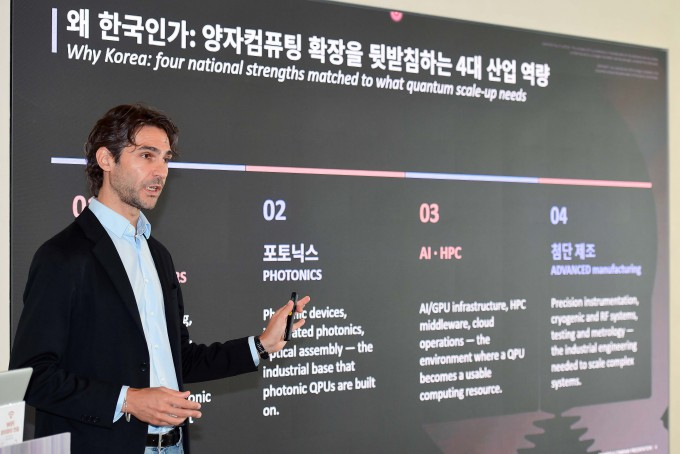
Building on its ongoing Asia-Pacific expansion, French photonic quantum computing company Quandela has officially designated South Korea as its Asian hub for QPU manufacturing and hardware R&D ecosystems. It plans to pursue foundry partnerships with South Korean semiconductor fabs and optoelectronic integrators, while collaborating with the Korea Advanced Institute of Science and Technology (KAIST) to develop electronic control units [7].
In terms of commercial and technical implications, the clear incremental significance of this development is that Quandela is no longer confined to commercial sales branch operations; instead, it is establishing the volume production of core photonic quantum control chips, photonic integrated circuit (PIC) packaging, and cryogenic hybrid optoelectronic testing lines directly within South Korea's semiconductor manufacturing supply chain.
Regarding landscape impact, this move breaks the capacity ceiling that European photonic quantum firms faced by relying solely on domestic pilot lines. Leveraging South Korean wafer foundries and high-density optoelectronic packaging capacity, Quandela expects to shorten volume tape-out delivery cycles for photonic quantum computing chips by over 40% within the next 2 years.
Infrastructure: Cloudflare Announces Launch of Quantum-Resistant Public CA Service
Global cloud connectivity and edge security provider Cloudflare (NYSE: NET) has officially announced its plans to become a global public Certificate Authority (CA), issuing next-generation digital security certificates that support both traditional public-key cryptography and native integration of PQC (post-quantum cryptography) standards to websites worldwide [36].
In terms of technical implications, as an edge infrastructure provider handling nearly 20% of global internet traffic, Cloudflare's entry into the public CA arena means quantum-safe certificates will transform from internal testbeds at select financial institutions into a standard, one-click internet security protocol available to any general website and end user.
Regarding landscape impact, affected entities include commercial digital certificate authorities such as DigiCert and Sectigo. Leveraging Cloudflare's globally distributed edge network, global distribution and OCSP (Online Certificate Status Protocol) verification latencies for post-quantum security certificates will be virtually eliminated, driving a multi-fold increase in web-wide PQC-compatible site penetration over the next 2 years.
Asset Security: Project Eleven Acquires Riva Labs to Expand Post-Quantum Cryptographic Infrastructure
Project Eleven, a startup dedicated to post-quantum security infrastructure for digital assets, has completed the acquisition of Riva Labs, fully absorbing its core technology and intellectual property across post-quantum multi-party computation (MPC), post-quantum digital signatures, quantum-resistant crypto wallets, and Ethereum account abstraction [37].
In terms of commercial and technical implications, this acquisition integrates Riva Labs' expertise in post-quantum signature algorithms for Ethereum EIP standards and smart contract account abstraction into Project Eleven's underlying custody architecture, creating a post-quantum security shield spanning the entire lifecycle of blockchain digital assets.
Regarding landscape impact, this development directly impacts crypto exchanges, institutional custodians, and Web3 application developers, pushing digital asset infrastructure into a production-grade private key migration and hardware key management upgrade cycle following the official finalization of NIST PQC standards.
Sensor Manufacturing: QSENSATO Secures €1 Million Investment to Build Quantum Sensor Facility
Italian quantum sensing startup QSENSATO has announced €1 million in funding via a SAFE (Simple Agreement for Future Equity) instrument. Led by European quantum investment fund Quantonation with participation from Deep Ocean Capital and others, the capital will be fully dedicated to constructing an in-house atomic vapor cell manufacturing facility [12][44].
In terms of technical implications, integrated atomic vapor cells serve as core sensing elements for next-generation quantum sensors, including quantum magnetometers, atomic clocks, and quantum gravimeters. By establishing an in-house wafer-scale vapor cell packaging line, QSENSATO addresses key engineering hurdles in alkali metal filling and long-term hermeticity retention during the mass packaging of high-vacuum miniature vapor cells.
Regarding landscape impact, affected domains include GPS-denied navigation for autonomous vehicles, medical magnetoencephalography (MEG) instrumentation, and geomagnetic navigation vendors. Once operational, the new line is expected to lower unit procurement costs for miniature atomic vapor cells by an order of magnitude, accelerating the penetration of quantum sensors into portable consumer and industrial devices.
Industrial Incubation: Roadrunner Quantum Lab Opens in New Mexico, Welcoming First 11 Tenants
Backed by $450 million in dedicated quantum strategic funding from the State of New Mexico, the 35,000-square-foot Roadrunner Quantum Lab (RQL), located in the Albuquerque Innovation District, has officially opened, welcoming its inaugural cohort of 11 quantum startup tenants [34].
Regarding landscape impact, RQL's proximity to Sandia National Laboratories and Los Alamos National Laboratory establishes a direct commercialization pipeline for federally funded physics research, positioning the facility as a major deep-tech cluster in the American Southwest to rival the Colorado Quantum Corridor. It is projected to incubate more than 30 multi-platform quantum deep-tech entities over the next 3 years.
Industry Awards: Quantum Effects Award 2026 Announces Four Hardware and Software Winners
Messe Stuttgart has officially announced the winners of the Quantum Effects Award 2026: a joint team from France's C12 and Thales won the Quantum Computing Hardware Award; Germany's Fraunhofer FOKUS received the Quantum Computing Software Award; Italy's QSENSATO secured the Quantum Sensing Award; and Germany's PicoQuant captured the Quantum Communication Award [9].
In terms of commercial implications, the award enforces strict evaluation criteria requiring submitted technologies to reach TRL (Technology Readiness Level) 5 or higher. By spotlighting mature technologies that have graduated from laboratories and proven viable under real-world industrial operating conditions, the awards reflect the European quantum industry's accelerating transition from scientific exploration to industrial deployment.
International Developments: Joint Survey by Six Industry Associations Reveals 90% of Quantum Firms Rely on Cross-Border Supply Chains
A new industry survey jointly released by six global quantum industry consortia reveals that as many as 90% of quantum tech enterprises worldwide rely on at least one overseas supplier for critical components, spanning key categories such as ultra-narrow linewidth lasers, dilution refrigerator subsystems, and high-purity enriched isotope materials [44].
Regarding landscape impact, these findings corroborate recent calls by Quantum Economic Development Consortium (QED-C) leadership urging North American and European stakeholders to strengthen transatlantic industrial coordination to mitigate supply chain disruption risks [39]. For global quantum investors, this underscores that unilateral trade barriers can readily stall global supply chains, driving valuation re-ratings for supply-chain vendors capable of providing domestic secondary-source alternatives.