Cybersecurity and National Strategic Roadmaps
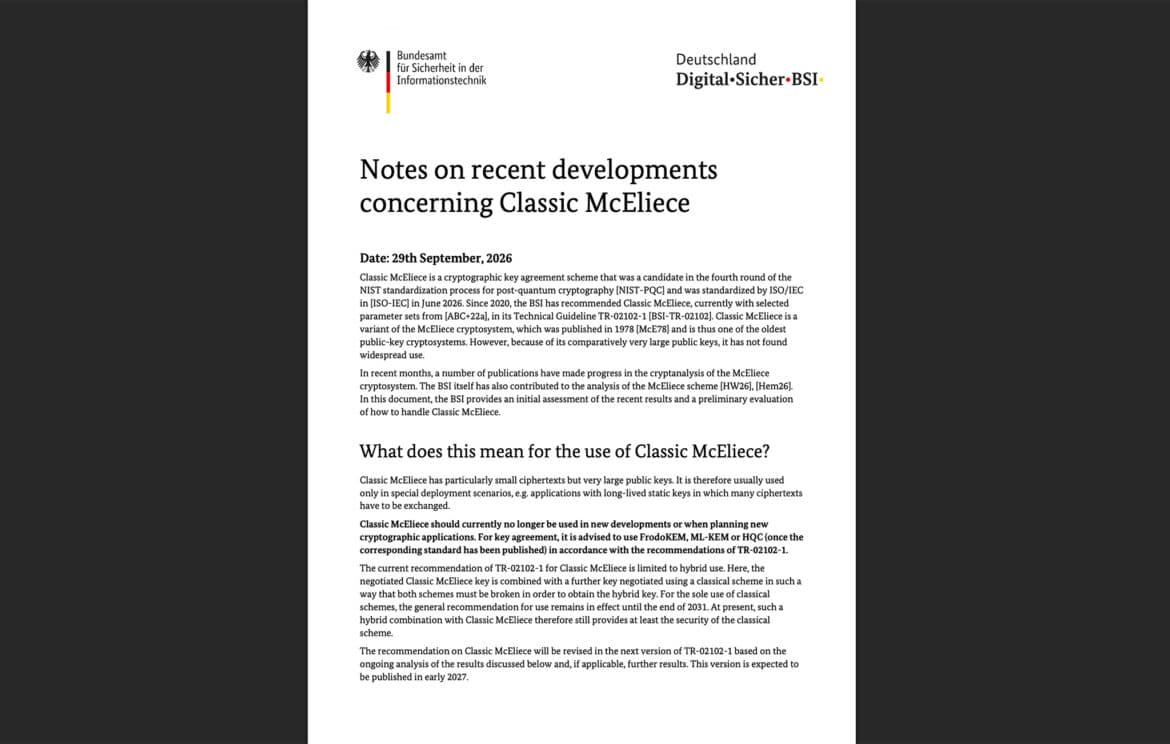
The German Federal Office for Information Security (BSI) issued a new security advisory officially recommending halting the deployment of Classic McEliece in all new IT projects [4]. In the preceding two months, new distinguishers against the algorithm were discovered internationally, and three independent research teams calculated that its actual key-recovery hardness has fallen across the board below its nominal security strength levels; although a practically feasible fast-break attack has not yet materialized, German authorities were first to hit the pause button on deployment [4].
As an historically conservative, code-based candidate widely recognized in the post-quantum cryptography community, Classic McEliece was previously shortlisted for primary consideration by the U.S. National Institute of Standards and Technology (NIST); this calculation indicating degraded security margins, coupled with the sovereign cybersecurity agency's warning, deals a major blow to commercial deployment confidence in code-based cryptographic algorithms.
This decision compels financial core systems, cross-border bank clearing networks, and government classified communications across Europe and globally to accelerate their pivot toward lattice-based cryptography, while prompting the cryptographic community to step up development of hybrid encryption protocols that do not rely on a single mathematical hardness assumption.
The U.S. Department of Energy (DOE) officially released its National Quantum Roadmap, establishing fault-tolerant quantum computing milestones anchored to 2028 as a critical target timeline [8]. The roadmap explicitly de-emphasizes metrics centered on physical qubit counts, pivoting entirely toward demonstrating tangible scientific utility as the benchmark, and outlines a modality-neutral development framework spanning superconducting, trapped-ion, neutral-atom, and other physical modalities to deeply integrate quantum processing units (QPUs) into national classical high-performance computing clusters and existing compute infrastructure across three phases [8].
Top-level strategy officially departs from the publicity cycle of simply stacking physical qubit counts, anchoring 2028 as the acceptance milestone for delivering the first error-corrected logical qubit systems with practical scientific simulation utility.
This policy forces hardware manufacturers reliant on U.S. federal funding and national laboratory contracts to restructure engineering teams, pivoting R&D focus away from merely scaling physical chip sizes toward error correction code rates and full-stack system integration.
Following the review and adoption of NATO's first quantum technology roadmap by allied nations this July, tangible procurement budgets under the initiative have now surfaced: NATO's latest public procurement notice shows an estimated budget of €8 million (approximately 62 million RMB) for its post-quantum cryptography (PQC) proof-of-concept pilot project, setting a pre-2030 milestone for the pilot. Timelines for underwater quantum sensor sea trials and the development of NATO cryptographic interoperability standards were already outlined in the July roadmap public summary, though no public deadline was provided for full PQC migration across its internal core systems [5].
The multinational military alliance has focused its quantum technology push on two key battlegrounds: precision deep-sea gravitational and magnetic positioning sensing independent of satellite navigation, and hardening defense communication channels against future decryption risks.
European domestic quantum communication and deep-sea sensing defense contractors will directly capture the first batch of dedicated NATO contracts, and the establishment of NATO standards will become a mandatory technical barrier to entry enforced across Western defense supply chains.
Supply Chains and Commercial Monetization
Results from an in-depth supply chain survey jointly conducted by six quantum industry associations across 160 quantum computing enterprises globally were announced. The data reveals that up to 90% of quantum enterprises rely on cross-border procurement for core components, and approximately 25% source critical components or raw materials directly from China [3].
The survey results uncover the objective reality of the global quantum hardware supply chain, showing deep cross-border industrial division of labor and dependence on Chinese manufacturing in cryogenic plumbing and components, high-purity specialty materials, precision optical assemblies, and microwave components.
Geopolitical compliance costs and spare-parts inventory pressures are mounting sharply for global quantum hardware startups, as uncertainties in cross-border export control policies force hardware vendors to re-evaluate bill-of-materials costs and lead-time risks.
Nasdaq-listed Swiss quantum security vendor WISeKey released its latest financial report, posting H1 2026 revenue of approximately $11.4 million against a net loss of $36.4 million—a loss exceeding three times its operating revenue [39]. Concurrently, startup Quanome's CEO is providing up to $15 million in non-dilutive capital [39].
The inverted financial figures expose the heavy R&D expenditure and substantial resistance post-quantum security chips face when penetrating conventional consumer electronics and automotive-grade markets; meanwhile, the prevalence of non-dilutive capital injections reflects a defensive mindset among founding teams striving to avoid equity dilution during secondary market downturns.
This trend cautions secondary market investors to remain prudent regarding the revenue conversion pace of quantum security pure-plays, while primary market funding windows will narrow further toward high-certainty targets backed by explicit government subsidies and industrial capital safety nets.
The collaborative project between Silicon Quantum Computing (SQC) and global energy technology giant Schneider Electric officially advanced to Phase 2 of the Australian Government's Critical Technologies Challenge Program (CTCP), securing AU$3.6 million (approximately $2.5 million) in dedicated funding alongside the University of New South Wales [36]. Leveraging SQC's proprietary Watermelon silicon-based atomic-scale manufacturing quantum hardware system, the two parties achieved a 20% improvement in forecasting accuracy over conventional baselines in actual power grid energy consumption forecasting models [21][36].
This achievement confirms the economic value of quantum hardware transitioning from pure theoretical validation to empirical energy dispatch scenarios in the industrial utility sector, establishing a mature deployment model that unites technology providers, vertical industry leaders, and government R&D subsidies.
This benchmark incentivizes more grid dispatch operators and renewable energy asset management firms to allocate dedicated innovation budgets for quantum forecasting services, accelerating the industrial adoption of silicon-based donor qubit chips in specific operations research and optimization domains.
Boston Consulting Group (BCG) published a dedicated industry study noting that as hardware scales, quantum computing enabled industrial decarbonization is projected to abate substantial industrial carbon emissions, while total system power consumption remains low and flat as compute capacity rises—avoiding the power load surges typical of conventional massive, dense compute clusters [37]. In addition, a commercial quantum conference hosted by the Electric Power Board of Chattanooga attracted over 450 multinational executives and policy officials, while the National Metrology Institute of Estonia (Metrosert) fully opened registration for the enterprise track of the QEst Hack quantum hackathon [34][35].
This conclusion relieves large enterprises of power load and environmental compliance concerns that might arise from adopting quantum compute, clearing policy obstacles for institutional investors connecting quantum computing infrastructure at the utility distribution edge.