Oct 17, 2026 – Oct 18 · Daily Brief

Online Banking Cryptographic Upgrade Against Quantum Decryption Enters Months-Long Countdown

15 items · 8 sourcesPDFThis issue's roundup is free
02Hardware

Hardware Frontiers

Ion Traps: Fused-Silica Monolithic 3D Ion Trap Overcomes High-Voltage Confinement and Heating Bottlenecks for Heavy Ions

A joint research team from Rice University, Duke University, and Translume Inc. has developed a monolithic segmented three-dimensional ion trap based on fused-silica glass micromachining, publishing comprehensive physical measurement data in Physical Review Applied[2]. The chip-scale device can withstand radiofrequency (RF) drive voltages of several hundred volts, successfully achieving stable trapping of heavy ions such as ytterbium[2].

This advancement bridges a long-standing engineering gap between manually assembled macroscopic blade-type 3D traps and micromachined planar 2D chip traps[2]. While conventional hand-assembled macro blade traps feature deep potential wells and low radial motional heating rates (measured in phonon increments per second), their assembly tolerances exceed several micrometers and cannot be standardized for batch replication; conversely, standard semiconductor 2D surface traps offer micrometer precision but struggle to tolerate the ultra-high RF voltages required to drive heavy ions[2]. This monolithic 3D microstructure directly compresses electrode alignment tolerances to the sub-micron scale while effectively suppressing the ion heating rate[2].

Benchmarked against current ion-trap state-of-the-art (SOTA): in universal commercial systems, the highest recorded two-qubit gate fidelity across all qubit pairs on a chip is 99.921% on Quantinuum Helios (all-to-all connectivity across 98 barium-137 ions), while the best laboratory record for an isolated qubit pair reaches 99.99% on prototypes from Oxford Ionics and IonQ; this result advances the miniaturization and heavy-ion confinement capabilities of dedicated physical simulation platforms[2]. The critical missing elements standing between this milestone and fault-tolerant practical utility include severe electromagnetic crosstalk between RF electrodes during multi-physical-qubit scaling, as well as the ion transport heating overhead faced by quantum charge-coupled device (QCCD) multi-zone shuttling architectures, which still require validation of sympathetic cooling protocols and gate fidelity uniformity across long ion chains.

Because heavy ions such as ytterbium serve as core physical carriers for simulating photosynthetic charge transfer and complex molecular bond fission, the monolithic micromachining process eliminates the manual barriers of experimental system assembly. This allows high-precision photochemical quantum simulation experiments—previously confined to a handful of elite national laboratories—to expand into university laboratories, establishing an alternative foundational device manufacturing pathway that diversifies beyond full-stack ion-trap hardware startups[2].

Photonics & Solid-State Spins: Gallium Phosphide–Diamond Hybrid Photonic Chip Achieves Strong Interaction Coupling

A joint scientific team from the University of Washington and Pacific Northwest National Laboratory has developed a novel hybrid photonic integrated chip by directly integrating high-index gallium phosphide (GaP) nanophotonic microcavities onto diamond substrates hosting silicon-vacancy (SiV) centers (diamond point-defect qubits), with findings officially published in the international optical journal Optica Quantum[5]. Measurements demonstrated that the optical cooperativity between the microcavity optical mode field and a single SiV center (a key figure of merit for light-qubit interaction strength) surpassed the strong coupling threshold of 1 for the first time, while maintaining a spin coherence relaxation time exceeding 0.4 milliseconds in a 4 K cryostat environment[5].

By employing micro-stamp transfer printing, this approach circumvents the lattice damage caused by direct ion-beam etching of single-crystal diamond, achieving sub-micron photonic mode confinement while preserving the ultra-narrow optical emission linewidths of diamond color centers for the first time[5]. Conventional diamond microfabrication often induces lattice strain surrounding color centers, triggering random transition frequency shifts of hundreds of gigahertz; the high refractive index (approximately 3.3) and ultra-wide transparency window of gallium phosphide enable the creation of compact microcavities, boosting color-center resonance fluorescence collection efficiency to more than five times that of conventional bulk diamond[5].

Benchmarked against photonic quantum system SOTA: in pure photonic measurement-based platforms, PsiQuantum has demonstrated dual-rail encoded SPAM (state preparation and measurement) fidelities of 99.98% and two-qubit fusion fidelities of 99.22% on GlobalFoundries 300 mm production lines; this breakthrough serves as a crucial conversion interface between optical-fiber flying qubits and solid-state stationary qubits, advancing strong coupling interactions between solid-state spins and on-chip waveguides[5]. The critical missing elements before fault-tolerant networking can be realized include: current reported fidelities remain post-selected on detecting scattered photons; the chip lacks an end-to-end optical loss budget allocation; and butt-coupling insertion losses between on-chip nanowaveguides and single-mode telecom fibers still exceed 40%, leaving thermal mismatches and packaging mechanical drift urgently in need of resolution.

Affected stakeholders span research institutions and commercial enterprises developing distributed quantum computing interconnects and long-distance quantum repeaters. By coupling the exceptional telecom-band coherence of diamond color centers with standard semiconductor manufacturing compatibility via GaP processing, this work establishes an engineering roadmap for fabricating on-chip quantum routing and switching nodes within three years[5].

Solid-State Defect Mechanisms: Lattice Phonon Scattering Model Solves Spin Relaxation Puzzle in Diamond and Silicon Carbide

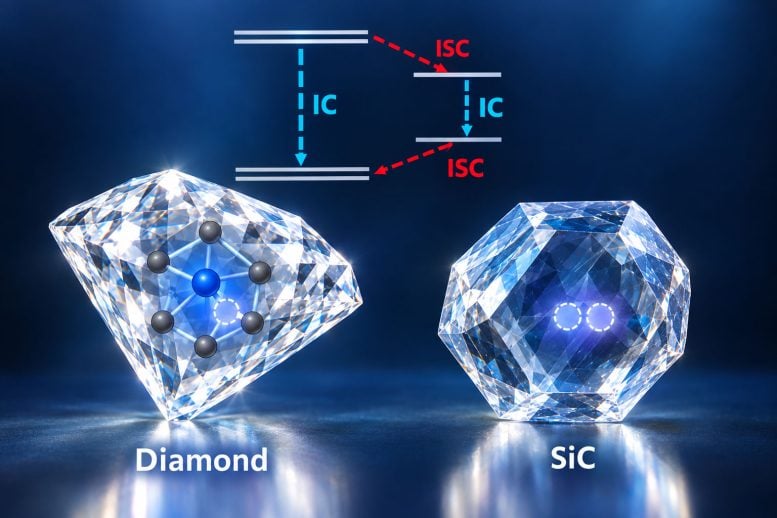
A research team at the Pritzker School of Molecular Engineering at the University of Chicago has constructed the first many-body computational physics model capable of accurately simulating the entire energy relaxation process of optically excited states in solid-state spin defects, uncovering the microscopic non-radiative decay mechanisms within nitrogen-vacancy (NV) centers in diamond and divacancy defects in silicon carbide (SiC)[13]. The model quantitatively reproduces, from first-principles calculations, the internal conversion process in which excited charges dissipate energy via lattice phonons (quanta of lattice vibrations), bringing theoretical luminescence lifetime predictions into agreement with experimental optical spectroscopy[13].

For decades, the development of quantum sensors and solid-state spin chips was hindered by a pronounced mismatch between theoretical lifetime predictions and observed spectra, primarily because prior algorithms could not quantify the non-radiative transition probability from spin-excited states into lattice mechanical vibrations[13]. By incorporating microscopic many-body electron-phonon interaction tensors into dynamical evolution simulations, the team identified the dominant role played by phonon dissipation channels, delivering a first-principles design tool for engineering defect configurations with extended coherence lifetimes[13].

This milestone will directly empower chip designers developing industrial-grade high-precision magnetometers, quantum gyroscopes, and spin memories on silicon carbide and diamond platforms, while enabling semiconductor material manufacturers to optimize impurity ratios and doping processes in epitaxial wafers based on these insights[13].

Topological Photonics: Programmable Photonic Chip Achieves First Real-Time Characterization of Topological Stability in Dissipative Systems

Researchers at the KTH Royal Institute of Technology in Sweden have developed a programmable integrated photonic chip architecture that, for the first time, directly measures topological invariants (parameters governing noise-resilient topological properties) that shield optical wave propagation from fabrication defect scattering within real-world dissipative optical devices[3]. Experimental results demonstrate that the system can dynamically reconfigure loss and coupling coefficients across an on-chip waveguide array on microsecond timescales, experimentally reconstructing a non-Hermitian (non-energy-conserving physical system) topological phase diagram[3].

Due to manufacturing imperfections, practical optical waveguides and optical fibers inevitably exhibit sidewall roughness and microscopic defects that cause severe photon scattering and phase distortion; topological photonic structures act like structural knots tied across waveguide arrays to prevent decoherence and scattering[3]. By dynamically tuning waveguide loss rates via an electro-optic modulator array, this chip circumvents the historical limitation of having to infer topological properties indirectly from idealized, lossless models, providing the first quantitative experimental calibration of topological anti-scattering robustness in a genuine chip environment[3].

Manufacturers of photonic quantum computing and fiber-optic sensing chips gain a testing platform for rapidly screening defect-resilient micro/nanophotonic waveguide designs, substantially trimming wafer tape-out trial-and-error cycles; this characterization methodology is anticipated to integrate into electronic-photonic design automation (EPDA) testing toolchains within two years[3].

03Algorithms

Algorithms & Software

Migration Budgeting: PQC Budget Builder Model Quantifies Multi-Million-Dollar Migration Costs for Multinational Banks

Marin Ivezic, a subject-matter expert with Post-Quantum, has formally introduced the PQC Migration Budget Builder, publicly unveiling the first quantitative budget estimation framework grounded in cryptographic asset inventories and regulatory deadlines, using a large European bank as a preset Worked Example to demonstrate its computational logic[8]. Using USD as the baseline currency, the model estimates that the total projected migration budget for the bank—spanning core applications, network endpoints, and hardware security modules (HSMs)—is approximately $40.9 million (within a scenario range of $22.6 million to $59.2 million), with a year-one budget request of $6.0 million and an incremental net cost of $36.6 million after netting out existing lifecycle refresh budgets[8].

The Budget Builder resolves the legacy dilemma where financial institutions relied on ambiguous heuristics when confronting post-quantum upgrades, establishing rigorous conversion formulas mapping from cryptographic asset baselines (covering 24 asset categories, including digital certificates, symmetric key protocols, and public key infrastructure) to granular labor-hour expenditures and hardware unit procurement costs[8]. The model introduces a cryptographic agility score (evaluating the software stack’s capability to rapidly swap algorithms) as a cost-discount coefficient; data shows that IT architectures possessing high agility can reduce migration labor-hours by over 60% compared to hardcoded legacy systems[8].

With global financial regulators accelerating the inclusion of post-quantum budgeting into annual IT compliance audits, CIOs at multinational commercial banks and insurance conglomerates now have a quantitative rationale to request dedicated appropriations from their boards, driving cybersecurity gateways, hardware encryptors, and code scanning vendors into institutional banking procurement tenders[8].

Maturity Quantification Standards: PQC Readiness Assessment Upgraded to v3.0 Framework

The Post-Quantum Cryptography Readiness Assessment tool for critical information infrastructure has received a comprehensive overhaul to its v3.0 framework, establishing seven core assessment dimensions—including governance architecture, asset inventory, cryptographic agility, supply chain risk, and compliance timelines—scored across a quantitative 0-to-5 tier system[7]. Operating on an entirely local-in-browser compute architecture, core enterprise asset disclosures submitted during evaluation never leave the local browser session, completely eliminating security concerns among financial institutions regarding the exposure of internal network topologies or cryptographic inventory baselines[7].

The v3.0 framework institutes a "weakest link" principle: an organization's overall post-quantum security tier is strictly bounded by its lowest-scoring individual dimension, thoroughly discrediting greenwashing practices where institutions claimed comprehensive compliance merely by migrating algorithms across a handful of peripheral systems[7]. Simultaneously, the system incorporates a regulatory database tracking statutory deadlines across 24 leading nations and international organizations, automatically matching compliance thresholds based on the enterprise's operating jurisdictions[7].

The tool lowers the operational threshold for executing security audits, enabling mid-sized and large enterprises to perform gap analyses within hours without engaging expensive external consultancies, and is poised to become a benchmark reference tool for supply chain onboarding security audits across industries[7].

Algorithm Migration Decisions: PQC Migration Advisor v2.0 Integrates 63 Algorithms and 18 Protocol Suites

Technical experts have re-architected and released the PQC Migration Advisor v2.0, expanding its underlying database to encompass 63 cryptographic algorithms (spanning candidate-for-replacement legacy algorithms, symmetric ciphers, hash functions, and post-quantum as well as hybrid algorithms), 18 mainstream network protocol suites, and regulatory mandates across 20 countries and regions[9]. The system allows users to benchmark their estimated project delivery timelines against the earliest statutory compliance deadlines, while offering one-click exports of structured implementation guidelines structured across four execution tiers[9].

The system covers the formal standards ratified by the National Institute of Standards and Technology (NIST)—ML-KEM (a lattice-based Key Encapsulation Mechanism), ML-DSA (Digital Signature Algorithm), and SLH-DSA (Stateless Hash-Based Digital Signature Algorithm)—while deeply integrating parameter overhead models for protocol stacks including TLS 1.3, IPsec, SSH, and S/MIME[9]. For the first time, the advisor provides performance degradation simulations for transitioning from hybrid key exchange (running classical and post-quantum algorithms in parallel) to pure post-quantum modes, delivering quantitative decision support for network engineers balancing latency against cryptographic strength[9].

Security protocol developers, communications providers, and open-source communities now have a unified technical migration roadmap, compelling major open-source cryptographic libraries to accelerate the deprecation of vulnerable candidate algorithms and consolidating industry resources around NIST-standardized primary selections[9].

04Industry

Industry & Ecosystem

Global Regulatory Dynamics: 162 Post-Quantum Regulatory Milestones Lock In First Mandatory Deadlines

The newly revised Global PQC Migration Timeline database has tracked and verified 162 policies and regulatory milestones with binding enforcement deadlines spanning 24 countries and regions, the Group of Seven (G7), and NATO[6]. Statistical aggregations indicate that the initial wave of mandatory post-quantum migration deadlines targeting core banking transactions, defense procurement, and critical communications networks will mature over the coming months, signaling that global cybersecurity posture is officially transitioning from voluntary pilot programs into an era of administrative enforcement[6].

The rigid tightening of compliance cycles is reshaping valuation models across the cybersecurity value chain, shifting post-quantum cryptography from a forward-looking technological reserve into a mandatory regulatory license required for corporate continuity[6]. Binding mandates—such as the White House Office of Management and Budget (OMB) memoranda and the European Union’s Digital Operational Resilience Act (DORA)—are compelling globally systemically important financial institutions (G-SIFIs) to designate 2026–2027 as statutory deadlines for completing Phase 1 public-key inventories, driving an inelastic surge in security compliance procurement budgets[6].

Sectors facing the most acute regulatory pressure—financial payments, digital government, and public energy grids—are initiating hardware procurement waves, positioning legacy tier-one cybersecurity vendors with certified hardware security modules and hybrid protocol migration capabilities to capture hundreds of millions of dollars in sovereign and enterprise contracts[6].

Endpoint Security Strategy: Small and Micro Enterprises Leverage Default Cloud Defenses to Circumvent Harvest Now, Decrypt Later Risks

Post-quantum cryptography researchers have issued a practical quantum-safe security guide tailored for small office/home office (SOHO) setups and small-to-medium-sized enterprises (SMEs), presenting a structured rationale for how smaller entities can cost-effectively navigate the "Harvest Now, Decrypt Later" (HNDL) threat landscape[14]. The guide highlights that the operational HNDL exposure confronting micro-organizations is significantly lower than that faced by multinational conglomerates and sovereign systems; moreover, mainstream cloud providers and modern browsers have already enabled post-quantum hybrid key exchange protocols by default at the transport layer, obviating the need for enterprises to procure costly, dedicated quantum-encryption hardware[14].

This assessment dispels marketing-induced anxieties across the cybersecurity market asserting that small institutions must acquire proprietary quantum-safe hardware appliances, explicitly steering corporate security expenditures away from hardware procurement toward data lifecycle management[14]. For everyday commercial entities whose commercial data secrecy shelf-life is under five years, over-investing in proprietary post-quantum defenses represents severe capital misallocation[14].

This strategic clarity will rationalize corporate information security budgets, curbing predatory commercial practices where startup hardware vendors exploit "quantum panic" to peddle overpriced, low-grade hardware to SMEs, while channeling market capital toward high-barrier security solutions built for ultra-large institutions and long-lifecycle critical assets[14].

Academic & Industry Exchanges: 83rd Warsaw Quantum Computing Workshop Focuses on Industrial Implementation

The Warsaw Quantum Computing Group has officially announced that the 83rd edition of its cutting-edge quantum computing workshop is scheduled to convene in-person on October 28, 2026, during the early morning hours Beijing Time[10]. The conference will feature specialized technical sessions addressing quantum software-hardware co-design under fault-tolerant architectures, bridging China-Europe quantum industrial ecosystems, and post-quantum security engineering practices[10]. Concurrently, major international industry forums bringing together more than 80 prominent sector leaders continue to explore deployment roadmaps for integrating quantum computing deeply with advanced digital infrastructure[1].

The quantum technology ecosystem across Central and Eastern Europe is accelerating its pivot from academic discourse to industrial technology transfer; through tight developer community engagements and cross-border research collaborations, the region is cultivating a talent cluster in quantum algorithms and security auditing that offers competitive low-cost engineering development advantages[10].

The focus of global quantum industry exchanges is transitioning steadily from rudimentary proof-of-concept academic papers toward industrial-standard software and hardware interface specifications, catalyzing durable research-and-development partnerships between multinational corporations and regional academic incubation teams[10].

05Other

Academic Frontiers

Quantum Thermodynamics: Physicists Across Four Nations Rigorously Prove Universal Speed Limit for Information Thermalization

A theoretical physics collaboration spanning the Institute for Quantum Optics and Quantum Information of the Austrian Academy of Sciences (IQOQI Vienna), TU Wien, the Universitat Autònoma de Barcelona in Spain, and the University of Geneva in Switzerland has rigorously established the first mathematical proof of a universal speed limit governing how rapidly a quantum mechanical system can reach thermal equilibrium, with the paper now formally published[4]. The study demonstrates that at any finite ambient temperature, the characteristic timescale $\tau$ for any quantum system to erase information and relax to thermal equilibrium cannot surpass half the Planckian dissipation timescale; that is, it must obey the physical inequality $\tau \ge \hbar / (2 k_B T)$, where $\hbar$ is the reduced Planck constant, $k_B$ is the Boltzmann constant, and $T$ is temperature[4].

This marks the first time in decades that physics has identified an absolute speed limit on thermalization that is completely independent of specific material compositions or interaction types[4]. Past experiments often achieved ultrafast evolution on tailored individual states by engineering sophisticated transient Hamiltonians, thereby obscuring the true physical lower bound of the broader system; by framing thermalization as a quantum information processing task and applying quantum information geometry and quantum metrology, the team proved that when a physical mechanism is required to hold universally across diverse energy states, the Planckian bound is insurmountable[4]. In the ultra-cold regime approaching absolute zero, this speed limit transitions smoothly into a bound strictly governed by the energy gap between the ground state and the first excited state ($\tau \ge \hbar / \Delta$)[4].

This fundamental law establishes theoretical boundaries for qubit reset operations (rapidly initializing qubits back to their ground state) and cooling-induced decoherence limits in superconducting and trapped-ion systems. It implies that any software or hardware optimization strategy attempting to compress qubit reset timing through pulse engineering faces an insurmountable physical boundary, directly setting an upper ceiling on the clock speed of future fault-tolerant quantum computers[4].

Strongly Correlated Many-Body Physics: Theoretical Framework for Fractional Quantum Fermi Seas Established in 1D Ultracold Atomic Gases

In a paper published in Physical Review Letters (PRL), a team led by Hanns-Christoph Nägerl at the University of Innsbruck, in collaboration with theoretical physicist Alvise Bastianello, has formulated a theoretical framework for engineering a novel non-equilibrium state of matter termed the "fractional Fermi sea" within a one-dimensional system of ultracold cesium atoms; corresponding experimental quantum simulation results are currently undergoing peer review[12]. The theoretical work demonstrates that by periodically modulating interatomic interactions between strongly repulsive and strongly attractive regimes, an ensemble of particles in a highly excited state avoids collapsing into thermal chaos, self-organizing instead into a stable, fractionally filled structure governed by hidden order[12].

This discovery challenges the conventional condensed matter understanding that fermions must strictly fill energy levels sequentially from the lowest orbitals up to the Fermi surface in accordance with the Pauli exclusion principle, revealing behaviors that diverge from classic Tomonaga-Luttinger liquid theory[12]. Standard physical intuition holds that a quantum system subjected to intense periodic external driving rapidly absorbs energy and disintegrates into an entirely disordered, thermalized chaotic state; here, analytical derivations reveal that the system can be interaction-driven into exotic quasiparticle-occupied states, offering theoretical guidance for discovering novel exotic quasiparticles dubbed "super-Fermions"[12].

By establishing the theoretical foundation for fractional quantum Fermi seas, this study showcases the immense potential of quantum simulation to push the frontiers of physics, not only deepening our grasp of non-equilibrium many-body physics but also charting new avenues for investigating exotic, strongly correlated quantum states of matter[12].

Scientific Talent Development: Caltech Scholar's Open Letter Analyzes Theoretical Research Paradigms in the AI Era

Laura Cui, a doctoral student in theoretical physics at the California Institute of Technology, has published an open letter to early-career researchers on the Quantum Frontiers blog, exploring the profound ramifications that AI-driven theorem-proving tools—exemplified by large language models—are exerting on academic career trajectories and scientific training for theorists[11]. The essay highlights OpenAI’s recent release of 722 mathematical research manuscripts (encompassing 372 major results) alongside breakthroughs on longstanding challenges like the Navier-Stokes equations, indicating that automated theorem proving is rapidly restructuring the theoretical research ecosystem[11].

Drawing upon seminars at Caltech and the author’s own interdisciplinary research trajectory, the piece observes that while senior theorists and pure mathematicians are monitoring these technological leaps with intense scrutiny, many prospective doctoral applicants have yet to grasp the potential ramifications these AI tools will have on their future academic careers[11]. In light of machine proficiencies in technical derivation and formal proof construction, the author contends that the foundational value of doctoral training in theory is shifting away from routine computational craftsmanship toward higher-order scientific acumen—specifically, extracting rigorously formulated scientific problems from raw physical intuition, bridging disparate mathematical frameworks across disciplines, and steering macro-level research trajectories through periods of acute uncertainty[11].

The open letter has catalyzed widespread discussion across early-career academic communities regarding the shifting paradigm of theoretical inquiry, underscoring that theorists in the AI era must not only master cutting-edge toolsets, but also hone their problem-definition and critical-thinking faculties to find their footing in an academic landscape reshaped by intelligent technologies[11].

06Impact

Today's Impact

  1. Technology Leads at Multinational Banks and Financial Infrastructures: Spurred by the formalization of 162 global regulatory milestones and the countdown to the first mandatory compliance deadlines, major financial institutions must immediately initiate asset-baseline-driven PQC budget modeling[6][8]. The next priority is to track operational audit criteria issued by sovereign financial regulators regarding cryptographic agility assessments, as well as the rollout of procurement tenders for hardware security module replacements.
  1. Trapped-Ion and Quantum Chemistry Simulation R&D Teams: Fused-silica monolithic 3D ion traps have successfully overcome high-voltage confinement and ion heating hurdles for heavy ions, substantially lowering the hardware barrier for heavy-ion quantum simulations[2]. The next priority is to monitor crosstalk characterization data across multi-ion chains on this monolithic architecture, and evaluate whether it can execute full-stack simulations of charge transfer dynamics in complex photosynthetic molecules.
  1. Photonic Integration and Quantum Repeater Startups: Gallium phosphide–diamond hybrid photonic microcavities have entered the strong-coupling interaction regime, confirming the viability of non-destructive transfer printing on solid-state spin color centers[5]. The next priority is to track loss-reduction efforts in chip-to-single-mode-fiber butt-coupling, and determine whether a rigorous, closed-loop end-to-end optical loss budget allocation can be achieved.
  1. IT Architecture and Network Operations Personnel at SMEs and Micro-Enterprises: Quantitative evaluations of "Harvest Now, Decrypt Later" (HNDL) exposure confirm that micro-enterprises can insulate themselves against routine threats simply by leveraging default cloud security settings[14]. The next priority is to track the default deployment footprint of hybrid key exchange protocols across leading browsers and cloud providers, avoiding indiscriminate capital expenditures on high-margin proprietary cryptographic appliances.
07Other

Editorial Commentary

Today’s industry dynamics reflect a profound divergence unfolding across the quantum technology landscape: On the defensive front, post-quantum cryptography has permanently departed the comfortable confines of theoretical discourse and academic pilots, plunging directly into the deep waters of mandatory administrative compliance and balance-sheet capital allocation. The tightening of 162 regulatory milestones worldwide, coupled with multi-million-dollar banking budget forecasting models, signals that post-quantum modernization is transforming into an inelastic capital expenditure encompassing code refactoring, hardware refreshes, and compliance certifications—accelerating commercialization across the security sector irreversibly.

Concurrently, at the fundamental physics and hardware tier, the research paradigm is casting aside superficial exaggerations of physical qubit headcounts, turning instead toward a meticulous mastery of fundamental physical laws and high-precision micro/nanoscale engineering. Whether establishing strict Planckian velocity bounds on information thermalization and erasure, mastering strong coupling in diamond color centers via semiconductor transfer printing, or reinventing ion-trap manufacturing tolerances through micromachined glass chips, these milestones convey an unambiguous technical signal: genuine leaps in computational power must be built on fine-grained control over microscopic phonon decoherence channels, non-equilibrium many-body states, and deterministic optoelectronic interconnects. Only by penetrating engineering tolerances and physical limits at the foundational layer can the dawn of fault-tolerant quantum computing truly break.