Trapped Ions
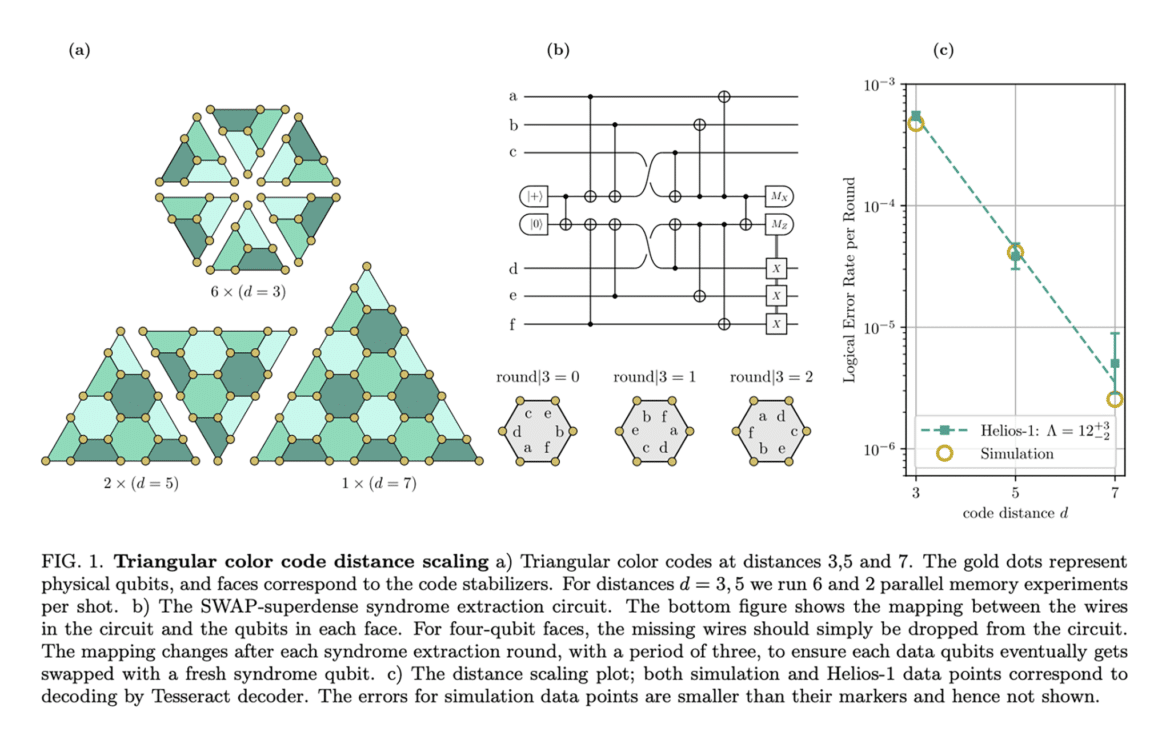
Following reports on October 19, 2026 (Beijing Time) that logical qubit (error-correction-protected information units) memory error rates were suppressed to 5×10⁻⁶, Quantinuum disclosed that its Helios trapped-ion chip, when running a distance-7 (a metric for fault-tolerant redundancy) color code (a 2D topological fault-tolerant error-correction scheme), requires nearly 200 milliseconds (approx. 200,000 microseconds) per error-correction round[13].
In terms of error suppression, the system reduces error rates by approximately 12-fold for each unit increase in code distance, yielding a suppression factor of 12—equivalent to 5.7 times the baseline of Google's Willow superconducting surface code (a 2D lattice error-correction scheme) (Λ≈2.1), while two-qubit gate (two-particle entangling logical operations) fidelity remains undisclosed[13]; however, an error-correction cycle of approximately 0.2 seconds exposes the physical bottleneck of the trapped-ion approach: constrained by ion-shuttling transport overhead and laser cooling latencies, its actual execution clock rate is only about 5 Hz, lagging six orders of magnitude behind the nanosecond-scale gate times (20 to 100 ns) of superconducting architectures, and still facing the fundamental physical hurdle of accumulated environmental decoherence (decay and degradation of quantum states) in extended algorithms[13]. While this progress cements the advantage of trapped ions in high-precision quantum memory, it compels hardware vendors to tackle low-latency ion-routing schemes to satisfy the demands of fault-tolerant computing.
UK quantum hardware firm Universal Quantum unveiled a novel error-correction decoder that empirically reduced communication error-correction overhead and transmission error rates during modular ion-trap chip interconnection[31]. By utilizing adaptive check topologies, the scheme mitigates measurement latencies across inter-chip ion transport and photonic links[31], clearing communication hurdles to break through single-chip physical trapping limits and construct thousand-qubit distributed trapped-ion clusters.
A research team at the University of Oxford extended the coherence time of a mixed-species two-ion entangled state composed of distinct elements to over 10 seconds in the laboratory[60]. Leveraging the inherent physical immunity of dual-species ions against measurement-induced light scattering crosstalk, this technique dramatically prolongs coherence times compared to conventional non-clock-state ions, approaching the second-scale baseline of single-species ion clock states[60], and accelerating the practical deployment of crosstalk-resilient interfaces for quantum repeaters and distributed nodes.
Neutral Atoms
Taiyi Quantum closed cumulative funding exceeding 1 billion RMB (approx. $149.6 million) within nine months of founding, achieving unicorn status to focus on developing fault-tolerant quantum computing hardware based on ytterbium atoms, and open-sourced its low-level compiler and control toolchain, LUOSHU[16].
Currently, the public neutral-atom SOTA is held by Atom Computing at a scale of 1,180 physical qubits, while QuEra demonstrated 96 logical qubits in Nature 2026; Taiyi Quantum adopts divalent electron energy levels of ytterbium atoms, aiming to push two-qubit gate fidelity toward the 99.5% baseline set by Harvard University, yet practical application remains bottlenecked by the platform's 1 to 10 Hz cycle repetition rate constraints and shuttling/loading losses, with its empirical hardware metrics and post-selection rates (the proportion of valid data retained after discarding errors) still awaiting validation by peer-reviewed public data[16]. This funding round breaks North America's capital monopoly over the high-precision neutral-atom track, and is projected to catalyze a domestic full-system competitive landscape before 2027.
Semiconductors and Spin Quantum Dots
Researchers manipulated electron-hole spin qubits in semiconductor quantum-dot devices using purely in-plane electric fields, with measured single-qubit gate fidelity breaking through 99%[23].
The public SOTA for single-qubit gate fidelity in spin quantum dots typically requires ≥99.9% (e.g., Diraq achieving 99.85% at 1 Kelvin), while two-qubit gate SOTA peaks at 99.99% achieved by Australia's SQC; this milestone of hole spins crossing the 99% threshold successfully leverages an in-plane field configuration to circumvent strong anisotropic decoherence noise inherent to valence-band holes, though the overall modality remains restricted to sub-10-qubit scales (SOTA device-level ≤12 qubits) and relatively low gate-operation-to-lifetime ratios (10² to 10³)[23]. This achievement confirms that hole spins can achieve high-speed, all-electrical manipulation without on-chip micromagnets, reinforcing chipmaking giants' confidence in utilizing mature semiconductor fabrication lines to manufacture quantum chips.
Superconducting and Novel Qubits
French quantum startup Alice & Bob completed testing on three cat-qubit demonstration chips under the French Defense Innovation Agency's PROQCIMA program[30]. Cat qubits (superconducting units that leverage non-linear photonic states in microwave cavities to intrinsically suppress bit flips) autonomously suppress bit-flip errors at the hardware level, reducing error-correction code redundancy from the 105:1 ratio of conventional superconducting surface codes (Google's Willow baseline) down to several dozen to one; however, their phase-flip rates increase with photon number, and two-qubit gate fidelity still trails the median baseline of 99.5% to 99.9% seen in production superconducting systems[30]. Deep involvement from French sovereign capital establishes Europe's autonomous barrier in compact superconducting architectures.
Canadian startup Iceberg Quantum completed a $6 million seed round and announced Pinnacle, its first full-stack fault-tolerant architecture centered on cryogenic chip-to-chip interconnects and low-redundancy error-correction decoding[29]. The capital will be directly allocated to tape-out testing of initial prototype chips, intensifying technological competition among North American early-stage fault-tolerant hardware architectures.
Photonics and Quantum Networks
Researchers coupled artificial giant atoms (superconducting artificial structures with dimensions comparable to microwave wavelengths) to a 1D waveguide, achieving deterministic unidirectional quantum state transfer with fidelity exceeding 99% without any external control pulses[24]. This approach eliminates phase jitter introduced by high-frequency clock pulses and crosses the 99% transfer fidelity threshold, nearing the SOTA baseline of 99.72% for fiber-based chip-to-chip interconnects, though its actual cryogenic loss budget still requires engineering validation[24]. This physical mechanism provides a low-power, passive interface solution for interconnecting modular superconducting computer racks.
Boulder-based startup EMode Photonix raised a $1 million pre-seed round to advance the development of integrated deterministic single-photon source chips[20]. The capital injection will accelerate efforts to address upstream high-purity light-source manufacturing bottlenecks in photonic quantum computing, serving the assembly of optical quantum interference networks.