Oct 26, 2026 – Oct 27 · Daily Brief

Quantum-Resistant Certificateless Protocol Secures Personal Crypto Wallets

47 items · 15 sourcesPDFThis issue's roundup is free
02Hardware

Hardware Frontiers

Superconducting Modality

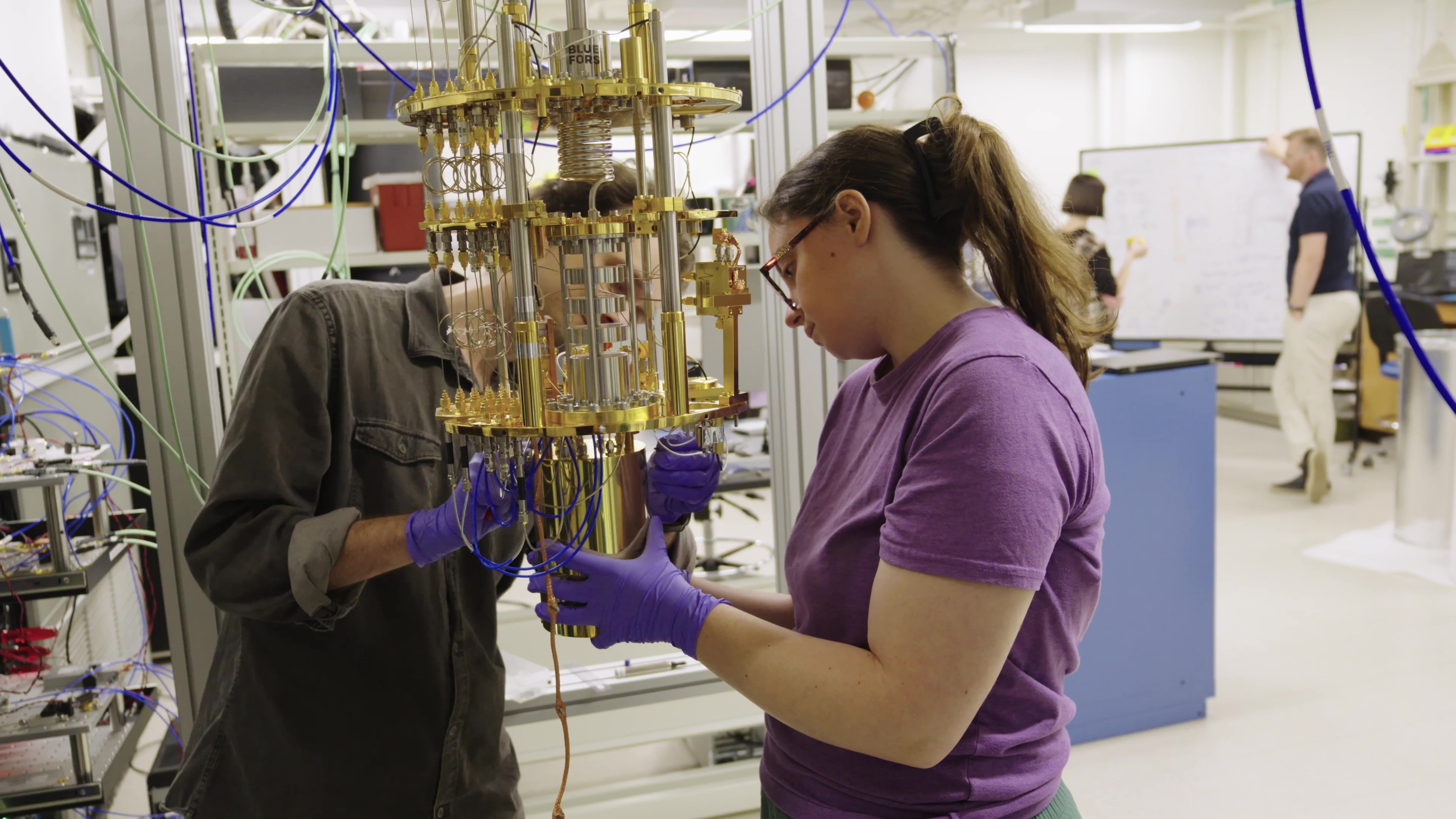
A joint team from Forschungszentrum Jülich, RWTH Aachen University, and the University of Cologne achieved single-qubit logic gate operations lasting just 6.8 nanoseconds (billionths of a second) on superconducting qubits (qubits formed by superconducting circuits), measuring an operational fidelity (a metric of operational precision) above 99.98%[6]. In terms of technical significance, this speed reduces typical superconducting single-qubit gate duration (conventionally in the 15 to 30 ns range) by more than half, with single-qubit fidelity slightly exceeding the 99.95% baseline of current cloud-accessible, production-grade systems (such as IBM Heron r2 and Google Willow); however, in full hardware benchmarking, this milestone has not yet extended to two-qubit logic gates, leaving a substantial engineering gap to bridging mainstream two-qubit gate latencies of 20 to 100 ns and mitigating two-level system (TLS, energy loss from microscopic material defects) fluctuations[6]. In terms of landscape impact, this ultra-short gate duration establishes a microwave pulse-shaping paradigm for European superconducting hardware teams exploring high-clock-rate control, poised to drive the evolution of high-frequency arbitrary waveform/pulse generation hardware over the next two to three years[6].

A novel wide-strip superconducting microstrip single-photon detector demonstrated a 99.6% resolution fidelity in multi-photon counting tests, successfully resolving up to 8 distinct photon arrival times with a peak separation of 2.15 between the electrical signals of the 7th and 8th photons[31]. In terms of technical significance, the device resolves the saturation-distortion bottleneck where conventional single-photon detectors can only differentiate a small number of coincident photons, expanding the time-resolved channel count to 8[31]. In terms of landscape impact, this high-fidelity multi-photon detection module will directly empower optical quantum computing entangled-state verification and high-throughput optical fiber communication nodes within the coming year[31].

The quantum microwave pulse optimization algorithm Q-PRONTO achieved a single-qubit gate error rate of 6.6×10⁻⁴ (corresponding to a fidelity of ~99.934%) in superconducting system tests, exhibiting quadratic convergence in optimization speed[32]. In terms of technical significance, compared with the near-linear convergence profile of conventional optimization tools, this approach synthesizes control waveforms in fewer iteration steps, though its single-qubit error rate still lags slightly behind the 99.95% baseline of top-tier production devices[32]. In terms of landscape impact, the method reduces classical computational resource overhead for low-level microwave calibration, benefiting system integrators by shortening initial bring-up calibration cycles for multi-qubit chips[32].

Trapped-Ion Modality

A German team developed LYNX, a trapped-ion (electromagnetic field-confined ion technology) processor featuring 31 physical qubits (unencoded hardware units), measuring a Quantum Volume (QV, a holistic system performance benchmark) of 2¹⁵ (32,768) across 15 physical qubits, corresponding to an average two-qubit gate error rate of 2.84×10⁻³ (fidelity ~99.716%)[27]. In terms of technical significance, against the leading publicly available trapped-ion baseline—Quantinuum Helios, which delivers a 99.921% two-qubit gate fidelity (error rate ~7.9×10⁻⁴) across all qubit pairs under 98-qubit all-to-all connectivity and a Quantum Volume of 2²⁵ (~33.55 million)—LYNX's two-qubit gate error rate is roughly 3.6 times higher, with a Quantum Volume trailing by ten binary orders of magnitude, illustrating that its multi-ion shuttling control and crosstalk suppression must still overcome high-density optoelectronic integration hurdles[27]. In terms of landscape impact, the chip provides a medium-scale domestic prototype for European trapped-ion hardware, though reaching the tier-1 global commercial compute bracket will require two to three years of iteration[27].

Solid-State Spins & Novel Energy-Level Systems

The open-source control architecture SpinQICK leverages RF-SoC (Radio Frequency System-on-Chip) technology to achieve coherent control over all-to-all connected quantum dots (semiconductor spin encoding units), directly extracting voltage noise profiles from quantum dot transport characteristics using just a single oscillation parameter Nosc=35[25]. In terms of technical significance, this breakthrough eliminates reliance on expensive, bulky discrete instrumentation; compared with the spin modality's SOTA two-qubit gate fidelity of >99% in wafer-scale production screening, low-cost control systems serve as a pivotal enabler for scaling spin qubits past the ten-qubit threshold and overcoming operational constraints[25]. In terms of landscape impact, substantially lowered R&D barriers for mid-to-small research institutions and startups will accelerate the cadence of laboratory validation for silicon spin arrays over the next two years[25].

A research team from the Department of Physics at the University of Rochester advanced high-dimensional quantum bit (qudit, multi-level quantum information unit) experiments, demonstrating high-density information encoding by manipulating three-level and higher quantum states[45]. In terms of technical significance, single-node multi-level architectures transcend conventional binary two-level constraints to provide a larger Hilbert space per physical node, theoretically reducing the physical chip footprint required for error-correcting codes by over one-third[45]. In terms of landscape impact, high-dimensional systems open a novel topological compression pathway for superconducting and semiconductor full-stack architectures, poised to reshape compiler architecture specifications in the mid-to-long term[45].

Experimentalists utilized the electron spin forces of nitrogen-vacancy (NV) centers (solid-state diamond defect spins) within diamond samples to successfully displace a micro/nanoscale macroscopic object by up to 1.5 micrometers (millionths of a meter)[9]. In terms of technical significance, this marks the first physical demonstration of microscopic electron spin quantum states directly mechanically actuating a macroscopic micromechanical structure, bridging the coupling boundary between microscopic spin coherent states and macroscopic mechanical displacement[9]. In terms of landscape impact, it establishes a novel actuation mechanism for ultra-sensitive quantum mechanical sensors and MEMS on-chip integration[9].

03Algorithms

Algorithms & Software

A research team proposed Quantum Cadence, a novel quantum-resistant blockchain consensus protocol that eliminates the conventional certificate infrastructure relying on aggregated, broadcast digital signatures across 200-node networks, instead allowing individual nodes to directly and independently tally the voting weights of incoming messages[21]. In terms of technical significance, this work introduces a signature-free post-quantum consensus mechanism that circumvents potential quantum computing vulnerabilities against elliptic-curve cryptography and aggregated public-key certificates while maintaining distributed ledger transaction throughput[21]. In terms of landscape impact, this directly addresses mainstream public blockchains and financial settlement backends heavily reliant on aggregated signatures, offering a certificate-migration-free alternative for next-generation tamper-resistant ledger architectures[21].

The theoretical team at Optqc completed continuous-variable simulations under 15.6 dB optical squeezing and two-level encoding, calculating a one-way quantum error correction (QEC, using redundancy to eliminate physical noise) error below the 10⁻⁵ threshold and establishing a finite-level logical Bell error hierarchy for the first time[19]. In terms of technical significance, this derivation proves that more complex operations exhibit comparatively lower logical error rates within optical continuous-variable regimes, pushing theoretical fault-tolerance boundaries to unprecedented precision; however, physical hardware realization remains bottlenecked by optical paths, as current loss budgets in real photonic chips under high squeezing levels (>15 dB) still struggle to satisfy fault-tolerant thresholds[19]. In terms of landscape impact, this sets new architectural design benchmarks for continuous-variable optical quantum startups and formalizes technical baselines for fault-tolerant simulation[19].

In experimental tests on a 5-qubit quantum error correction system, researchers implemented a defect-exclusion mechanism that suppressed the per-cycle logical error rate from 1.9% down to the 0.x% regime, achieving 93% fidelity logical qubit entanglement[26]. In terms of technical significance, by proactively excising physical defect sites within small-scale topologies, this scheme verifies the feasibility of non-destructive logical flip suppression in shallow circuits[26]. In terms of landscape impact, it provides a more resilient troubleshooting strategy for surface code (two-dimensional topological error-correcting code) layouts on near-term medium-scale fault-tolerant processors[26].

A fully classical optimization protocol achieved full classical training of the loss function for a 64-qubit parameterized circuit, breaking through the conventional classical state-vector simulation barrier around 30 qubits, and successfully deployed the optimized model onto IBM's ibm_berlin superconducting processor for execution[29]. In terms of technical significance, this algorithm resolves the classical intractability of deep variational quantum circuits caused by dimensional explosion, more than doubling the qubit capacity supported by classical pre-training[29]. In terms of landscape impact, it substantially lowers the trial-run costs of chemical materials and financial portfolio optimization algorithms on real quantum hardware, shortening verification cycles for hybrid compute paradigms[29].

A general framework for Hamiltonian (system total energy operator) gradient optimization of superconducting quantum circuits was published in Quantum, delivering an automated derivation tool for discovering novel qubit architectures[16]. In terms of technical significance, by substituting analytical gradients for conventional manual exhaustion and grid searches, this framework compresses the physical parameter design cycle for custom anharmonic superconducting circuits from months to days[16]. In terms of landscape impact, it drives the deep expansion of semiconductor Electronic Design Automation (EDA) tools into the quantum ASIC domain, accelerating the design-to-tapeout fabrication loop[16].

04Industry

Industry & Ecosystem

European automated quantum control software vendor QuantrolOx closed a €12 million (~$13.36 million) Series A2 funding round, bringing its cumulative external equity funding to approximately €28 million[11]. In terms of commercial significance, as 100-qubit-scale processors become mainstream, manual pulse tuning can no longer manage dynamic drift across dozens of control channels; control and calibration software is transitioning from auxiliary scripting into indispensable infrastructure for system integrators, driving up valuation multiples for the control sub-layer[11]. In terms of landscape impact, the capital will be dedicated to scaling North American commercial delivery and operations/maintenance, presenting a specialized division-of-labor challenge to hardware OEMs relying on in-house calibration tools[11].

The U.S. National Institute of Standards and Technology (NIST) finalized its implementation roadmap for post-quantum cryptography (PQC, public-key algorithms resistant to quantum attacks) migration, reiterating a strict statutory 2030 deadline for full replacement across high-value assets and critical systems across government agencies[5]. In terms of commercial significance, compliance requirements have escalated from policy recommendations into budget-backed procurement mandates with clear timelines, entering an inflexible execution phase for crypto-agility modernization and digital certificate migration[5]. In terms of landscape impact, global financial settlement networks, multinational cloud providers, and global security integrators must refactor core cryptographic interfaces over the next four years, unlocking a multi-billion-dollar retrofit market for legacy systems[5].

Trapped-ion quantum computer manufacturer IonQ was awarded $7.5 million in Phase 2 funding from the U.S. Air Force Research Laboratory (AFRL) to expand its quantum networking testbed in Rome, New York[13]. In terms of commercial significance, this phase focuses on hybrid networking across optical fiber and free-space optical links, employing quantum frequency conversion (translating ion emission wavelengths to telecom bands) to resolve cross-node wavelength mismatches and long-distance optical attenuation[13]. In terms of landscape impact, this cements IonQ’s position as a prime contractor for U.S. defense distributed quantum computing networks, propelling quantum communications from isolated laboratory fiber loops into multi-environment operational interoperability[13].

Following recent reports of IDEMIA and KT Corporation participating in South Korea’s national post-quantum pilot, the two partners officially deployed dual-standard quantum-resistant SIM cards—compatible with both NIST international standards and South Korea's native KpqC algorithms—into the South Korean military communications network[14]. In terms of commercial significance, this marks the operational deployment of post-quantum upgrades at the mobile terminal hardware chip layer, validating hot-swapping capabilities across multiple algorithms on lightweight secure elements[14]. In terms of landscape impact, it represents the world's first field deployment of dual-track post-quantum algorithms in a defense mobile network, setting a benchmark for defense communications terminal standards across the Asia-Pacific region and NATO[14].

Full-stack quantum computing provider Quantinuum entered into a commercial partnership with the GE Vernova Advanced Research Center to collaboratively leverage trapped-ion compute power to unravel the microscopic mechanisms of high-temperature superconductivity[23]. In terms of commercial significance, the collaboration bypasses classical supercomputing’s exponential bottlenecks in simulating strongly correlated electron systems, directly targeting microscopic mechanisms for generator weight reduction, offshore wind power transmission, and zero-resistance grid materials[23]. In terms of landscape impact, it validates the strategic value of high-fidelity quantum computing in core materials R&D for multi-trillion-dollar heavy industry and power sectors, with novel superconducting alloy design specifications anticipated within three to five years[23].

Global Quantum Intelligence (GQI) released its Q3 2026 Industry Monitor, showing that primary-market venture capital is accelerating its concentration into top-tier players with full-stack delivery capabilities, hardware modalities are shifting rapidly toward fault-tolerant second-generation architectures, and post-quantum compliance mandates are drastically compressing enterprise and government migration timelines[12]. In terms of commercial significance, commercial valuation models purely based on unencoded physical qubit counts have been discarded, rapidly closing the funding window for mid-tier hardware-only startups[12]. In terms of landscape impact, teams lacking a clear logical error-correction roadmap face M&A consolidation or liquidation, while full-stack leaders are raising industry entry barriers through standard lock-in[12].

Security chip and module provider SEALSQ announced plans to acquire satellite channel capacity and associated ground telemetry, tracking, and control (TT&C) services across 12 WISeSat.Space low-Earth-orbit (LEO) satellites to advance its Quantum Space Orbital Cloud (QSOC)[22]. In terms of commercial significance, this extends end-to-end tamper-resistant hardware roots of trust to low-Earth-orbit assets, establishing secure links between space-based nodes and ground terminals[22]. In terms of landscape impact, it accelerates the commercialization of quantum-resistant cryptographic protocols across space-based private LEO networks, competing directly with traditional terrestrial physical leased-line security markets[22].

05Other

Academic Frontiers

Physicists performed simulations of fermionic (fundamental matter particles) resonance scattering dynamics on a hybrid hardware architecture, suppressing the deviation between measured particle decay rates and theoretical predictions to within a few percentage points[20]. In terms of technical significance, the experiment encoded fermionic matter into discrete qubits and scalar field observables into continuous-variable modes (qumodes), demonstrating real-time strong-interaction scattering on a physical system for the first time while evading the numerical sign problem that triggers classical simulation collapse[20]. In terms of landscape impact, it provides a non-perturbative real-time evolution simulation tool for high-energy nuclear physics and particle collider experiments, opening a new frontier in computational fundamental physics[20].

A research team utilized a 256-qubit processor to observe non-equilibrium relaxation dynamics in a two-dimensional quantum magnet, measuring spin-correlation evolution behaviors that exceeded the effective computational boundary of classical tensor networks (classical many-body simulation algorithms)[30]. In terms of technical significance, on an uncorrected physical qubit array, high-precision control of long-range interactions enabled the direct extraction of macroscopic entanglement spreading data where classical algorithms fail to converge, establishing deterministic evidence of computational advantage for specific many-body physical evolution problems[30]. In terms of landscape impact, it cements the indispensability of hundred-qubit-scale simulators in strongly correlated condensed matter physics, providing experimental computational support for the discovery of novel magnetic materials[30].

An interdisciplinary team spanning space engineering and quantum computing combined Gaussian Boson Sampling (GBS, a specialized photonic sampling algorithm) with evolutionary algorithms to successfully perform collaborative active debris removal (ADR) trajectory planning across a candidate pool of up to 25 orbital space debris targets[33]. In terms of technical significance, this scheme decomposes a high-dimensional, non-convex, NP-hard combinatorial optimization problem into a two-stage hybrid pipeline, showcasing the acceleration potential of specialized photonic sampling hardware for aerospace mission scheduling[33]. In terms of landscape impact, it breaks through the operational boundaries that previously confined photonic sampling hardware to molecular vibronic spectra calculations, penetrating into commercial aerospace operations[33].

Theoretical physicists published a rigorous mathematical proof in the journal Quantum, formally establishing the hidden conjecture in Gaussian Boson Sampling[17]. In terms of technical significance, the proof supplies the linchpin in the derivation of complexity lower bounds for optical quantum sampling, establishing the mathematical completeness that classical algorithms cannot efficiently simulate this sampling process in polynomial time[17]. In terms of landscape impact, it settles the academic debate over whether classical tensor networks could effectively dismantle optical quantum computational advantage, reinforcing the technical credibility of specialized photonic quantum computing[17].

Researchers published in Quantum the first systematic method for deriving contextuality (the defining characteristic of non-classical quantum correlations) witnesses in prepare-transform-measure scenarios, utilizing linear quantifier elimination to analytically resolve classical local polytope boundaries[15]. In terms of technical significance, this method eliminates theoretical assumptions requiring specific symmetric measurements or pure-state preparation, providing a universal algebraic criterion for verifying authentic quantumness in microscopic systems[15]. In terms of landscape impact, it establishes more rigorous testing benchmarks for device-independent secure communication self-testing protocols[15].

06Other

Today's Implications

  1. Public Blockchain Validator Nodes & Crypto Wallet Ecosystems [21]: Conventional signature-based on-chain consensus faces potential cryptographic vulnerability, whereas Quantum Cadence demonstrates a certificate-free, quantum-resistant voting architecture eliminating aggregated signatures. As the attack surface of on-chain governance and consensus protocols undergoes a qualitative shift, the immediate next step is to monitor throughput stress testing and Byzantine fault tolerance verification of such signature-free protocols on major open-source testnets like Ethereum.
  2. Enterprise Cybersecurity & Defense Communications Procurement [5, 14]: NIST has firmly locked in 2030 as the final statutory deadline for post-quantum migration across federal systems, while the South Korean military has pioneered the live operational deployment of dual-algorithm quantum-resistant SIM hardware. Cryptographic migration has decisively transitioned from strategic assessment into budgetary execution; the immediate next step is to track compatibility retrofit orders for identity credentials and core switch ASICs across global systems integrators.
  3. Superconducting Full-Stack Hardware & Control Hardware/Software Vendors [6, 11, 32]: Jülich's compression of single-qubit gate duration to 6.8 ns, paired with QuantrolOx's €12M funding round, indicates that the superconducting modality is shifting from purely tallying physical qubit counts to an engineering efficiency race centered on high single-cycle clock frequencies and control automation. System bring-up thresholds and microwave latency have become key differentiators; the immediate next step is to monitor crosstalk suppression under ultrafast, parallel single- and two-qubit gate execution across multi-tens-of-qubit arrays.
  4. Heavy Industry & Clean Energy R&D Institutions [23]: The GE Vernova–Quantinuum alliance targeting high-temperature superconductivity signals that quantum hardware is officially mounting an assault on trillion-dollar industrial use cases involving microscopic mechanisms in strongly correlated materials. Traditional empirical trial-and-error materials engineering faces a simulation paradigm shift; the immediate next step is to track experimental data releases on ground-state solving for cuprate superconducting lattice Hamiltonians on all-to-all connected trapped-ion processors.
07Other

Editorial Commentary

The quantum computing industry is currently navigating a profound convergence of two driving forces: physical-layer engineering pushes the boundaries of precision and control industrialization on one side, while external statutory deadlines for cryptographic compliance apply rigid pressure on the other. From microscopic gating times shrinking into single-digit nanoseconds to automated control toolchains securing tens of millions of euros in capital, every indicator shows that hardware competition has moved beyond the showmanship of raw physical qubit counts into a systems engineering era tested by clock rates, error-correction decoding throughput, and industrial-grade tuning efficiency. Capital consolidating into top-tier players with second-generation architectures and automation capabilities reflects a market that has grown immune to mere conceptual hype and demands concrete paths to commercial viability.

Concurrently, as standards bodies anchor the global post-quantum migration of sensitive communications and critical infrastructure to 2030, quantum-resistant defense is evolving from theoretical frameworks into physical silicon and protocol overhauls across defense, government, and financial networks. For industry practitioners and investors navigating this cycle, the yardstick for full-stack system value has shifted entirely: can two-qubit gate fidelities clear fault-tolerant thresholds, can logical qubit error correction deliver a net gain, and can real-world applications address problems like high-temperature superconductivity or high-density cryptographic migration where classical computation is fundamentally powerless? Architectures that fail to establish a positive feedback loop between clock speed and error-correction efficiency will rapidly be squeezed out in the impending wave of standardization and industrial consolidation.