Oct 31, 2026 – Nov 1 · Daily Brief

100-Qubit Quantum Simulation Surpasses Gold-Standard Accuracy, Accelerating Drug Discovery

37 items · 10 sourcesPDFThis issue's roundup is free
02Hardware

Hardware Frontier

Neutral Atoms & Optical Tweezer Arrays

A physics team at Princeton University has achieved a two-qubit CZ (controlled-phase) gate fidelity of 99.76% in a cooled cesium neutral-atom optical tweezer array[7]. This fidelity matches leading room-temperature performance[7]; however, the neutral-atom approach remains constrained by the hard ceiling of low 1 to 10 Hz cycle repetition rates, and mid-circuit measurements alongside continuous loading atom losses have yet to be fully eliminated, leaving an engineering gap before achieving a practical fault-tolerant closed loop[7]. The result demonstrates that deep cryogenic environments can effectively suppress decoherence infidelity induced by thermal atomic motion, which is poised to drive neutral-atom array developers like QuEra and Pasqal to push two-qubit physical gate fidelities generally above 99.7% within the next two years[7].

Superconducting Quantum Computing

Forschungszentrum Jülich, in collaboration with RWTH Aachen University and the University of Cologne, implemented single-qubit gate operations on a superconducting transmon processor lasting only 6.8 ns with a fidelity exceeding 99.98% using innovative pulse-shaping techniques[33]. This operation speed cuts the industry standard of 20 to 50 ns by more than two-thirds; by precisely suppressing multiphoton leakage, the single-qubit gate fidelity approaches the extreme benchmark of 99.9975% set by commercial trapped-ion hardware, although coherence time fluctuations caused by two-level system (TLS) defects inherent to superconducting systems and full-chip microwave crosstalk remain core bottlenecks constraining multi-qubit scaling[33]. The scheme requires no modifications to existing wafer lithography processes and is expected to be integrated into low-level control firmware by superconducting teams such as IBM and Google within one year, tripling the number of operational quantum gates available within the same decoherence lifetime[33].

Researchers at Chalmers University of Technology in Sweden eliminated microwave parasitic crosstalk at the physical layer by tailoring the topology of parasitic capacitance on superconducting chip surfaces through destructive interference between parasitic capacitance channels, effectively suppressing uncontrolled excitations of neighboring floating transmons[28]. This passive hardware suppression scheme avoids reliance on complex out-of-phase microwave pulse compensation, improving spatial electromagnetic isolation between microwave channels by an order of magnitude[28]. This achievement significantly reduces the physical reliance of high-density multi-qubit processors on on-chip control wiring and cryogenic attenuation filtering, clearing microwave interference barriers for thousand-qubit single-chip integration[28].

A research team bridged two separate large-scale superconducting quantum processors into a unified computing cluster using four cryogenic superconducting coaxial cables, achieving low-loss transmission of fragile quantum states across inter-chip physical channels[3]. Following IBM's earlier demonstration of meter-scale superconducting microwave coupling cables achieving 99% fidelity, this marks the first verification of the feasibility of parallel multi-cable interconnections in a multi-processor bus architecture[3]. This breakthrough overcomes the constraints imposed by the physical space and thermal load of a single dilution refrigerator on chip area, accelerating distributed superconducting quantum computing clusters toward modular commercial delivery within three years[3].

Finnish quantum computing manufacturer IQM announced that on its commercial 54-qubit Emerald superconducting chip, it successfully verified global quantum entanglement across all 54 physical qubits with the aid of an automated compiler, with the multi-body quantum state fidelity surpassing the threshold for genuine multipartite entanglement[36]. This marks the first time European commercial quantum hardware has established global coherence at a full-lattice scale exceeding 50 qubits; although its median two-qubit gate fidelity still lags behind Google Willow (105 qubits, median two-qubit gate fidelity above 99.5%), it validates the engineering viability of commercial automated calibration systems on full-scale multi-qubit machines[36]. This progress directly cements IQM's core position in Europe's quantum sovereign hardware supply chain, providing a procurable commercial turnkey system for European national laboratories and regional computing centers[36].

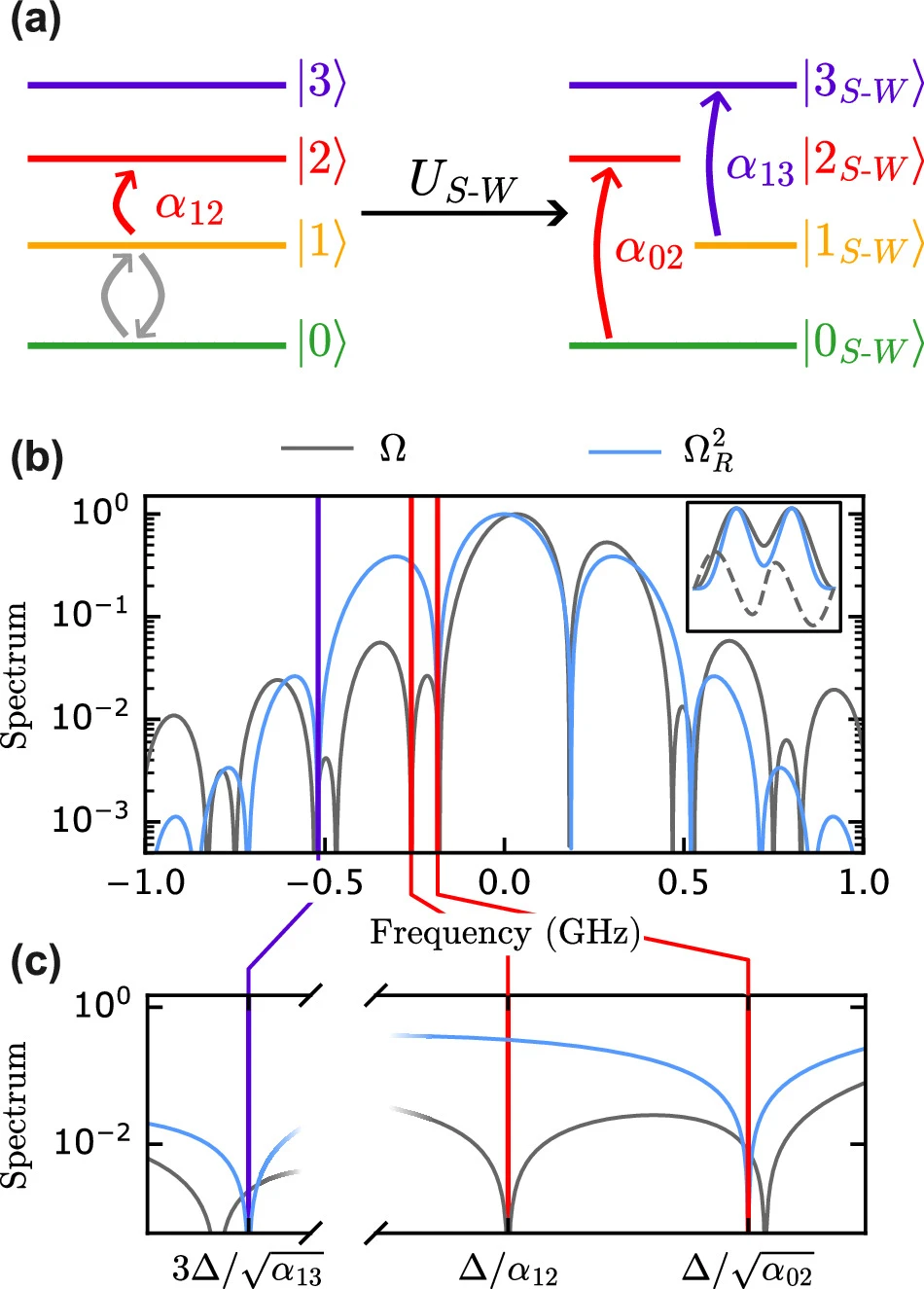
Theoretical and experimental researchers have proposed a novel quantum gate control correction method, extending the operating regime of single-qubit operations to the strong-driving limit and reducing gate infidelity by several orders of magnitude[10]. The approach overcomes the traditional breakdown of the rotating-wave approximation under strong microwave driving that previously forced a compromise on gate accuracy, enabling ultra-high-precision single-qubit phase rotations in ultra-short timeframes[10]. Given the broad versatility of this control architecture, it is expected to be widely adopted within low-level microwave pulse libraries for superconducting and spin quantum chips within one year[10].

Solid-State Spins & Precision Measurement

A physics team at TU Delft has achieved direct coherent radio-frequency NMR (nuclear magnetic resonance) manipulation of a single surface titanium-47 atom in an ultra-low-temperature STM (scanning tunneling microscope) environment using an ENDOR (electron-nuclear double resonance) measurement protocol for the first time[35]. This technique removes reliance on traditional indirect measurements via electron-nuclear hyperfine interactions, achieving high-fidelity pure addressing of individual nuclear spin quantum states[35]. This provides a completely new technical paradigm for building sub-nanometer solid-state nuclear spin quantum memories and is expected to inspire the microscopic topological design of atomic-scale quantum registers within five years[35].

Harvard University researchers precisely engineered the stress and strain distribution within micro/nano-cantilevers, exploiting phonon dissipation mechanisms to anomalously enhance the quantum coupling strength between diamond silicon-vacancy (SiV) color centers and mechanical vibrational modes while obtaining mechanical coherence stability that exceeded theoretical expectations[13]. This achievement overturns the conventional dogma that dissipation inevitably destroys quantum coherence, establishing a high-coherence hybrid quantum interface resilient to environmental noise[13]. The scheme offers a hardware pathway for developing long-distance quantum repeaters and solid-state quantum network nodes, expected to drive the hardware realization of optical fiber quantum communication repeater stations within 3 to 5 years[13].

The Joint Quantum Institute at the University of Maryland has developed a compact novel optical frequency comb device, substantially reducing the physical footprint of ultra-precise optical frequency measurement equipment[14]. This miniaturized device fills an instrumentation gap for field-portable absolute optical frequency standards, satisfying the stringent size requirements of vehicle-mounted and airborne high-precision portable atomic clocks[14]. The technology will accelerate the commercial translation of precision time-frequency instruments for defense surveying and deep-space navigation, with relevant instrument startups expected to launch field tests within two years[14].

Harry Buhrman, Chief Scientist at trapped-ion hardware leader Quantinuum, publicly argued that in the race to scale fault-tolerant computing, physical fidelity holds a decisive structural advantage over gate speed[32]. Trapped-ion platforms significantly reduce the physical resources required for quantum error correction by virtue of their ultra-low physical error rates; even with gate speeds in the microsecond range, their actual algorithmic throughput and net error correction gain far outstrip nanosecond-scale superconducting hardware plagued by higher error rates[32]. This argument intensifies the industrial debate between the trapped-ion and superconducting camps over the endgame of fault-tolerant roadmaps, directly influencing valuation models used by institutional investors for 2027–2030 commercial error-corrected systems[32].

03Algorithms

Algorithms & Software

Quantum Error Correction & Logical Tomography

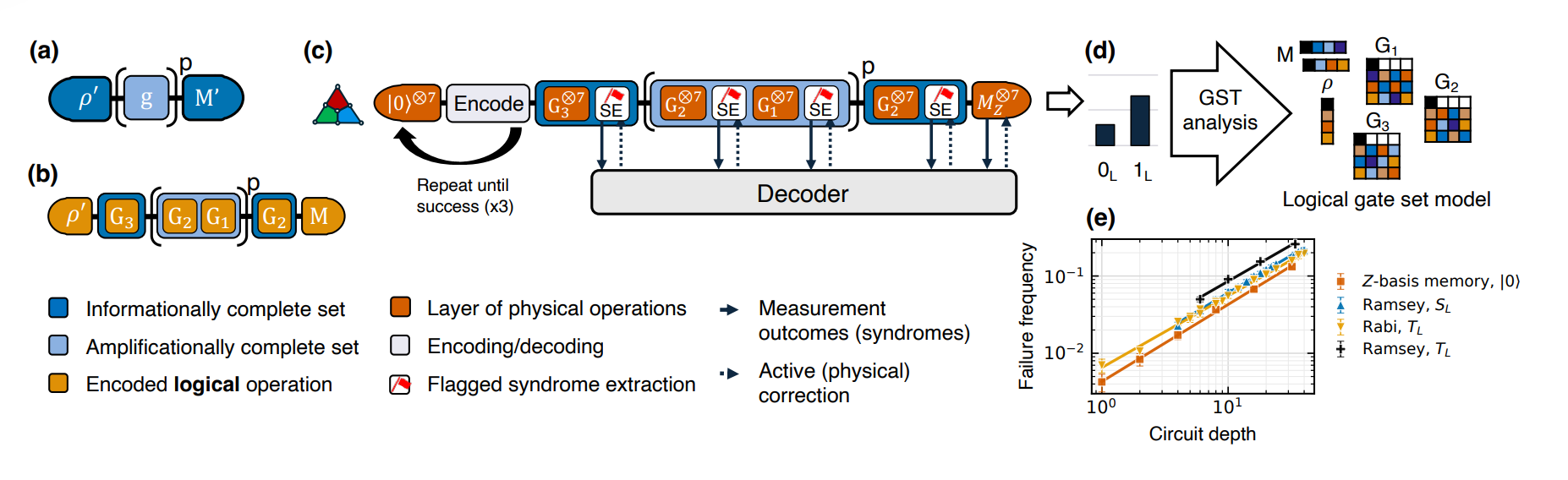
In collaboration with Sandia National Laboratories, Quantinuum achieved the first self-consistent, complete gate set tomography (GST) reconstruction of a universal single-logical-qubit gate set on a single logical qubit encoded with the [[7, 1, 3]] Steane code on System Model H1-1 trapped-ion hardware[31]. The experiment completely extracted the authentic noise tensor of logical quantum gates under fully symmetric operations for the first time, confirming residual non-Markovian coherent noise at the logical level and filling an industry void in rigorous logical-level calibration standards for fault-tolerant quantum computing[31]. This calibration protocol is poised to become the definitive verification benchmark for global fault-tolerant error correction R&D, nudging academia and commercial entities within one year from competing over physical qubit gate metrics toward publishing standardized logical gate set tomography data[31].

Theoretical physicists studying surface codes have discovered a partially decodable phase transition, confirming that dual paramagnets driven by coherent noise exhibit specific symmetry breakings that cause local decoding fidelity to approach a universal analytic function of the system's spatial aspect ratio[11]. This discovery breaks the simplified assumption that traditional error correction relies solely on phenomenological incoherent noise models, revealing the genuine geometric modulation of error correction thresholds by coherent spin flips[11]. This theoretical insight provides new boundary convergence constraints for decoders of superconducting surface codes and neutral-atom toric codes (such as tensor network decoders), helping to trim the computational latency of real-time error correction algorithms by 20% within one year[11].

Following a $10 million grant from the U.S. Defense Advanced Research Projects Agency (DARPA) on October 29, Julien Camirand Lemyre, CEO of Canadian startup Nord Quantique, systematically unveiled their bosonic code hardware roadmap, demonstrating GKP (Gottesman-Kitaev-Preskill phase-space grid bosonic error correction) codes and hypercube code error correction using microwave photons in superconducting cavities, doubling the quantum error correction gain over previous records[26]. The technology adheres to a "one microwave cavity, one logical qubit" roadmap, leveraging the infinite-dimensional continuous-variable states within the resonator to autonomously absorb photon loss, completely circumventing the physical hardware overhead of discrete qubit arrays that can reach dozens to one[26]. This technique opens a differentiated track for developing compact airborne or vehicle-mounted fault-tolerant quantum computers, highly appealing to specialized defense and aerospace customers sensitive to payload and power budgets[26].

Quantum Simulation Algorithms & Chemical Precision Breakthroughs

The IBM Quantum team at Watson developed the Variational Geometric Sampling for Quantum Diagonalization (VGSQD) algorithm, successfully simulating the electronic structure and hydrogen molecule exchange dynamics of the beryllium dimer (Be2) across 124 superconducting qubits[8]. Moving beyond the limitations of prior quantum algorithms confined to static molecular ground-state energies, this algorithm extends into dynamic molecular reaction dynamics; the deviation of its calculated Be2 potential energy curve from experimental true values surpassed the gold standard of classical computational chemistry, CCSD(T) (coupled-cluster with singles, doubles, and perturbative triples), for the first time[8]. This establishes a tangible accuracy advantage for quantum simulation in handling strongly correlated chemical reaction dynamics, providing an actionable timeline for multinational pharmaceutical companies to incorporate quantum computing power into catalyst mechanism exploration[8].

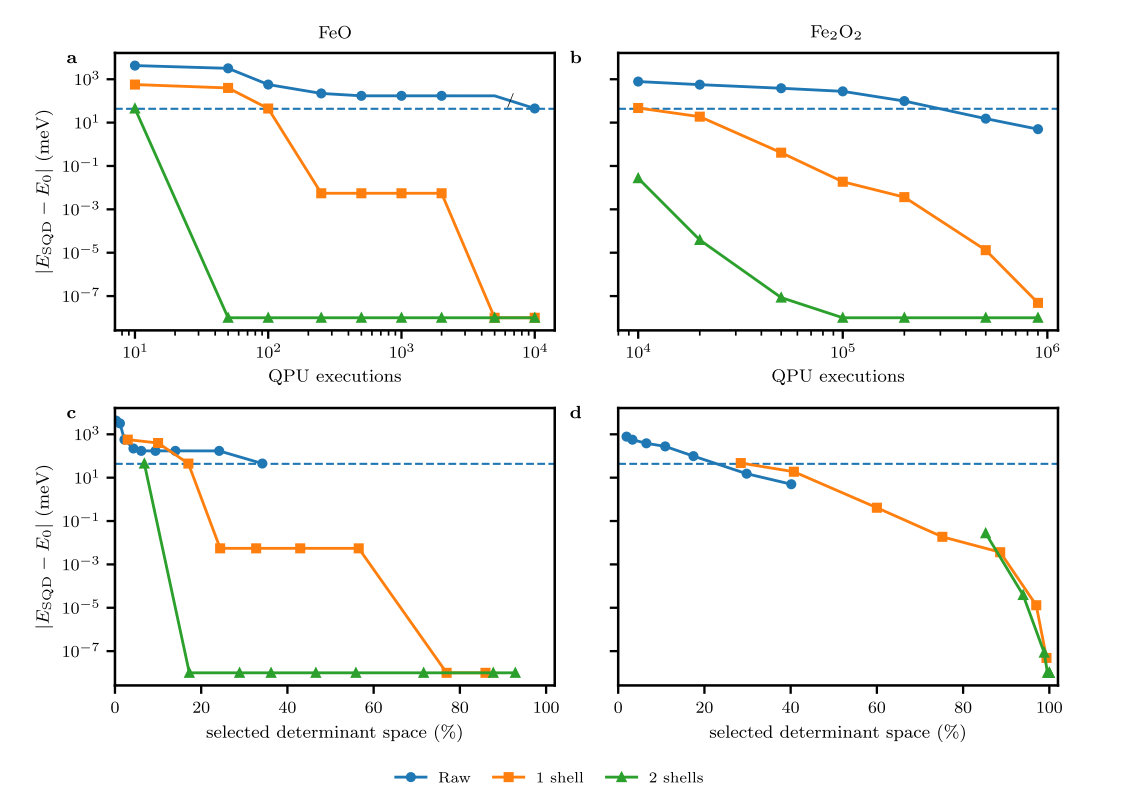
Los Alamos National Laboratory, in collaboration with quantum software developer QC Ware, performed Sampled Quantum Diagonalization (SQD) combined with first-principles tight-binding models on IBM quantum hardware to successfully simulate iron monoxide (FeO) and square-planar iron oxide clusters[29]. This hybrid workflow attained "chemical accuracy" (computational error strictly below 1 kcal/mol) in strongly correlated transition metal oxide systems for the first time, accurately resolving multireference strongly correlated electron orbital configurations that conventional DFT (density functional theory) cannot handle[29]. This approach directly empowers phase transition analysis of transition metal cathode materials for power batteries and the development of efficient industrial catalysts for ammonia synthesis, with industrial commercial clients expected to initiate customized material design validations within two years[29].

Computational physics researchers have proposed a novel error mitigation strategy combining ERPA (extended random phase approximation), cutting the energy computation error of the Variational Quantum Eigensolver (VQE) by several orders of magnitude in quantum simulations of water and cyclobutadiene molecules[17]. Compared with existing quantum subspace expansion algorithms, this technique drastically reduces measurement sampling overhead on noisy quantum hardware, effectively filtering out hardware background noise by reconstructing low-rank correlation tensors[17]. The technique significantly lowers cloud computing costs for near-term NISQ (noisy intermediate-scale quantum) devices performing molecular simulations, substantially reducing the barrier to entry for chemical enterprises utilizing cloud-based quantum computing[17].

An independent benchmark evaluation of the VQE algorithm executed on IBM quantum processors revealed that the residuals in actual molecular energy calculations exceeded the hardware's claimed uncertainty by up to 32 times; although zero-noise extrapolation reduced nearly 84% of the error in oxygen molecule simulations and randomized readout error mitigation recovered an 80-milliHartree deviation in a single task, systematic bias remained pronounced[16]. This finding exposes the heterogeneity of error mitigation techniques and the pitfalls of residual coherent noise in current shallow variational algorithms, sounding an alarm against industry over-optimism regarding algorithmic error mitigation capabilities[16]. This compels the quantum computing investment community and enterprise clients to more prudently evaluate the actual delivery capabilities of near-term noisy quantum computing, tilting cloud service procurement contracts toward introducing third-party blind testing verifications[16].

A research team proposed a novel operator truncation framework for molecular ground-state energy calculations, successfully eliminating 82.3% to 98.1% of hardware noise errors in molecular computations and converging computational accuracy to sub-milliHartree levels[15]. This milestone clears the chemical accuracy threshold required for high-precision computational chemistry, providing robust data post-processing support for noisy physical chips approaching practical chemical computation[15]. This development benefits quantum chemistry SaaS startups in optimizing their algorithmic pipelines, lowering delivery hurdles when engaging pharmaceutical clients[15].

Computer scientists have constructed the first automated verification framework capable of fully formally verifying quantum signal processing (QSP) algorithms across 256 system qubits without relying on classical reference circuits or unrolling black-box oracle calls[5]. This achievement bridges the technical gap where algorithms at the scale of hundreds of qubits could not undergo complete logical equivalence checking on classical computing systems, leveraging the intrinsic algebraic structure of QSP to achieve polynomial compression of verification dimensions[5]. The tool provides an industrial-grade compiler verification instrument for security auditing of core algorithms on future systems with hundreds of physical qubits or early logical qubits, benefiting the construction of secure quantum software stacks[5].

Combinatorial optimization benchmarks revealed that a single-layer QAOA (Quantum Approximate Optimization Algorithm) successfully suppressed the average energy expectation value from 1.675 to 0.686, yet the probability of sampling non-optimal solutions paradoxically rose[6]. Backed by solid data, the benchmark demonstrates that in discrete combinatorial optimization tasks, a "decrease in average energy" does not equate to an "increased hit rate for the global optimum," uncovering the premature convergence trap of shallow variational algorithms in complex landscapes[6]. This finding cautions algorithm R&D teams in financial portfolio optimization and smart logistics to re-evaluate the practical utility of single-layer QAOA, prompting R&D resources to pivot toward deeper circuits or hybrid quantum annealing techniques[6].
04Industry

Industry & Ecosystem

Enterprise Post-Quantum Cryptography & Network Integration

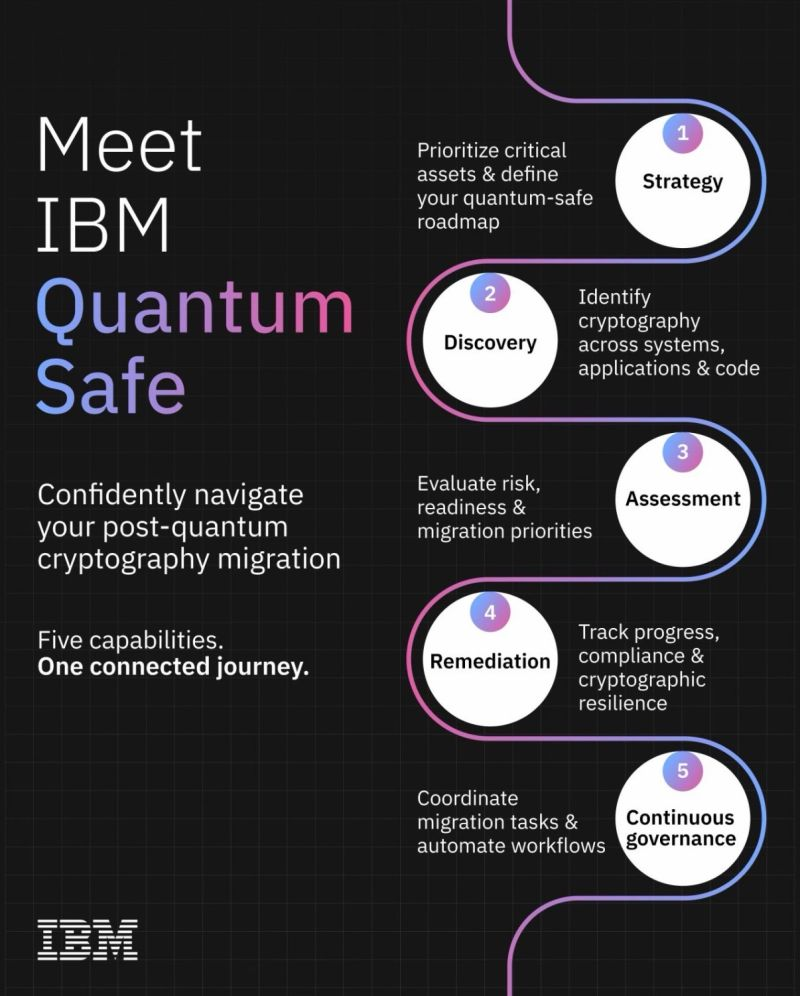
IBM has officially launched "IBM Quantum Safe," a unified enterprise-grade post-quantum cryptography software suite featuring an enterprise cryptographic asset strategic assessment platform, automated source-code cryptographic dependency scanning tools, and dynamic network protocol mediation services to systematically address the operational hurdles of enterprise migration from traditional public-key infrastructures to PQC (post-quantum cryptography)[30]. The suite establishes a full-stack commercial migration software standard spanning "vulnerability audit, code refactoring, and real-time communication interception," reshaping post-quantum remediation from costly manual consulting into an enterprise-grade standardized software business on an annual subscription model[30]. This launch is set to intensify market competition between traditional cybersecurity vendors and IT giants during the multi-trillion-dollar government and enterprise cryptographic infrastructure upgrade cycle, prompting major global financial and telecom institutions to establish dedicated PQC migration budgets before 2027[30].

U.S. telecom operator Lumen Technologies announced a comprehensive expansion of its quantum technology initiatives: on one hand partnering with The Ohio State University to investigate long-distance quantum signal relay transmission across commercial optical fiber networks, and on the other hand fully integrating post-quantum cryptographic algorithms from cybersecurity vendor Fortinet into Lumen's proprietary SASE (Secure Access Service Edge) platform[34]. This move establishes a dual-track commercial loop combining "underlying physical fiber long-haul transport trials + upper-layer software-defined enterprise edge private network encryption," representing the world's first carrier-grade benchmark case to natively and deeply embed PQC into commercial backbone networks[34]. This compels leading global telecom operators to accelerate post-quantum edge gateway upgrades to defend against "harvest now, decrypt later" long-term data interception attacks targeting cross-border financial data streams and enterprise dedicated leased lines[34].

A research team at Tel Aviv University in Israel proposed a novel quantum-resistant code-based cryptosystem utilizing masked convolutional codes, enhancing the security margin against future quantum algorithmic attacks by more than 2^200 times compared to classical McEliece and Niederreiter encryption frameworks[19]. By leveraging the hidden algebraic structure of convolutional codes, the scheme effectively resists algebraic cryptanalysis and information-set decoding attacks, while drastically reducing the cumbersome physical storage size of public keys in traditional code-based encryption algorithms[19]. This outcome provides a public-key encryption candidate architecture with immense commercial deployment potential for subsequent rounds of the National Institute of Standards and Technology (NIST) PQC standardization process[19].

Chip Sovereignty, Grants & Talent Development

Quantum computing researcher Mia Reynolds has been awarded a $5,000 Martinis Grant earmarked for tackling high-precision RF microwave pulse engineering for underlying multiscale qubit manipulation in scalable quantum computers[9]. The grant reflects a targeted incubation mechanism by the academic foundation established by superconducting quantum computing pioneers to support grassroots technical innovators in low-level microwave measurement and control[9]. This funding will continually stimulate foundational innovation vitality among microwave engineering talent across cryogenic microwave control cables, high-fidelity arbitrary waveform generators, and related fields, solidifying the engineering bedrock for scalable superconducting hardware[9].

SEALSQ, a Nasdaq-listed semiconductor security company, appeared as a core sponsor at a cutting-edge technology summit in New York, spotlighting its hardware-level post-quantum chip root of trust and sovereign cryptographic chip solutions[27]. The company showcased an edge hardware roadmap that directly burns post-quantum cryptographic algorithms into microcontrollers and smart card secure chips, emphasizing physical tamper resistance and hardware supply chain auditability[27]. This highlights the heightened sensitivity of major European and American economies regarding microelectronic hardware sovereignty in the post-quantum era, which will accelerate post-quantum hardware security upgrades for automotive edge computing units and core Industrial IoT chips[27].

The Advanced Quantum Information Theory group at City University of Hong Kong (Dongguan) officially posted a PhD recruitment announcement, with the application deadline set for January 15, 2027, Beijing Time[4]. The position focuses on foundational quantum information theory and cutting-edge error correction coding explorations, demonstrating that the Guangdong-Hong Kong-Macao Greater Bay Area continues to attract top young academic talent via high-spec research platforms to reinforce national intellectual reserves in fundamental quantum computing theory[4].

05Other

Academic Frontier

Strongly Correlated Quantum Simulation & Condensed Matter Physics

Utilizing 96 qubits, a condensed matter physics research team successfully measured the central charge of gravitational anomalies—the core signature of topological phases—in a quantum spin liquid candidate state via boundary spectroscopy with a minimal measurement error of approximately 1% (99% measurement accuracy)[18]. The experiment circumvented ultra-demanding cryogenic thermal transport macroscopic measurements and tedious quantum state tomography reconstructions, confirming for the first time that central topological invariants of strongly correlated topological matter can be extracted directly with high precision via quantum chip boundary spectroscopy[18]. This solidifies the decisive role of multi-qubit quantum simulators as instruments for unraveling microscopic mechanisms in condensed matter physics, such as fractionalized excitations and anyonic topological order[18].

Physicists have successfully simulated the Schwinger effect in an ultracold-atom optical lattice system, capturing the creation of electron-positron matter-antimatter pairs from the vacuum induced by extremely strong electric fields in quantum electrodynamics (QED)[2]. The experiment precisely replicated high-energy non-perturbative particle physics dynamics under extreme fields on a tabletop cold-atom platform, breaking free from the physical constraints of ultra-high-energy particle accelerators required for physical experiments[2]. This further broadens the application landscape of ultracold-atom simulators in strong-field physics and extreme astrophysical simulations[2].

Quantum Position Verification & Nonlinear Optics

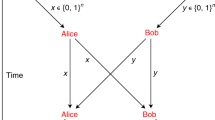
A recent study published in npj Quantum Information proposes a multi-basis Quantum Position Verification (QPV) protocol, proving its security against generalized entangled adversaries within a rigorous mathematical framework[1]. The scheme completely resolves the theoretical vulnerability where single-basis QPV was easily spoofed by adversaries collaboratively using finite entangled pairs, markedly enhancing the physical spoof-resistance of verifying geographic coordinates using single-photon time-of-flight[1]. This delivers an absolute geographic anti-spoofing solution rooted in the quantum no-cloning theorem for physical location verification of high-frequency financial trading orders and defense aerospace secure node authentication[1].

Optical physicists have derived fully quantized analytical dynamical equations for three-wave mixing nonlinear optics, constraining the computational error of the three-wave interaction model to within 0.1% across dozens of energy conversion cycles without introducing any phenomenological fitting parameters[12]. Compared to previous conventional approximation algorithms that maintained only 1% precision under a 37% pump depletion rate, this analytical formulation marks a leap in computational precision and dynamic range of applicability[12]. This delivers a rigorous analytical tool for designing high linearity and low noise in superconducting parametric amplifiers—the core front-end component in superconducting microwave readout—and will directly guide the development of next-generation high-sensitivity quantum readout chips[12].

06Impact

Today's Impact

  1. Pharmaceutical & Advanced Energy Storage Materials R&D Institutions: Directly propelled by the 124-qubit molecular dynamics simulation from the IBM Watson team[8] and the chemical-accuracy iron oxide calculations from Los Alamos[29]. The shift lies in quantum hardware outperforming the classical computational chemistry gold standard CCSD(T) for the first time in simulating multi-atom strongly correlated chemical reactions, transitioning computing power evaluation models from "academic toys" to "candidate tools with verified precision advantages." Next, closely monitor whether multinational pharmaceutical corporations formally include cloud computing test orders based on algorithms like VGSQD in their FY2027 procurement lists[8][29].
  1. Telecom Backbone & Enterprise Cloud Security Operators: Directly driven by IBM's rollout of the Quantum Safe suite[30] and Lumen's partnership with Fortinet to integrate PQC SASE solutions[34]. The shift lies in post-quantum defense officially transitioning from pure algorithmic theoretical verification into live-network integration across multi-trillion-dollar commercial dedicated networks and enterprise software, enabling end-to-end automation of proactive cryptographic asset discovery and traffic protection across enterprise IT systems[30][34]. Next, closely track the pacing of Fortune 500 enterprises initiating tenders for PQC secure access gateways over the coming 12 months[30][34].
  1. Fault-Tolerant Hardware Developers & Hard-Tech Venture Capital: Jointly shaped by Princeton's 99.76% cryogenic neutral-atom two-qubit gate[7], Jülich's 6.8 ns ultrafast superconducting gate[33], and Sandia's first complete logical gate tomography[31]. The shift lies in a complete overhaul of standards used by industry and investors to assess full-stack systems, pivoting away from chasing nominal physical qubit counts toward physical gate speed and fidelity limits, alongside logical qubit performance verified through rigorous complete tomography[7][31][33]. Next, closely track whether various technological modalities can systematically surpass physical gate thresholds with fully tomographed logical gate fidelities on hundred-qubit-scale systems prior to 2027[31][32].
  1. Public Cloud Quantum Computing Procurement & Algorithm Application Teams: Deeply cautioned by the evaluation exposing out-of-spec VQE residuals on IBM hardware[16] and the non-optimal solution trap in single-layer QAOA[6]. The shift lies in enterprise clients forming a defensive awareness regarding claimed error mitigation efficacy on noisy hardware, no longer blindly trusting unverified shallow heuristic optimizations or unblinded molecular energy curves, and forcing algorithmic development toward rigorous low-rank algorithms with low measurement overhead such as ERPA[17]. Next, closely monitor whether quantum cloud compute leasing contracts broadly adopt third-party neutral blind testing metrics as hard acceptance criteria[6][16][17].
07Other

Editorial Commentary

The quantum computing industry is undergoing a profound shift in its center of technical value: the race for nominal physical qubit counts is rapidly giving way to substantive breakthroughs in computational chemistry precision and rigorous, axiomatic verification at the logical gate level. For years, noisy quantum computing platforms have faced repeated setbacks in molecular simulation, with their outputs consistently failing to challenge the supremacy of classical density functional theory or high-order coupled-cluster algorithms. However, surpassing classical computational gold-standard accuracy across 124 qubits in real molecular dynamics simulations, alongside attaining strict chemical accuracy in strongly correlated transition metal oxides, clearly signals that pairing quantum hardware with specialized diagonalization algorithms is beginning to penetrate computational blind spots inaccessible to conventional classical supercomputers in specific microscopic dynamic regimes. Such physical-precision-driven milestones carry far greater commercial weight than merely announcing thousands of physical qubits that lack coherence protection.

At the same time, the hardware-level quest for ultimate physical fidelity is forming an industrial resonance with the counter-offensive mounted across classical cybersecurity. Two-qubit gate fidelity in neutral atoms crossing the 99.7% threshold in cryogenic conditions, superconducting single-qubit gates suppressing multiphoton leakage at an ultrafast 6.8 ns, supplemented by the formal establishment of the first full tomography standard for logical gates, all demonstrate that the hardware ecosystem is forging the foundational, industrial-grade bedrock required for genuine fault-tolerant error correction. Meanwhile, along the perimeter of classical cybersecurity, the scaled deployment of post-quantum cryptography by telecom giants and enterprise software leaders sounds the countdown for the wider industry: quantum computing is no longer a distant horizon confined to academic preprints—the disruptive restructuring and productivity enhancements it promises have already forced global digital infrastructure into an active, generational security transition.