Quantum Error Correction & Logical Tomography
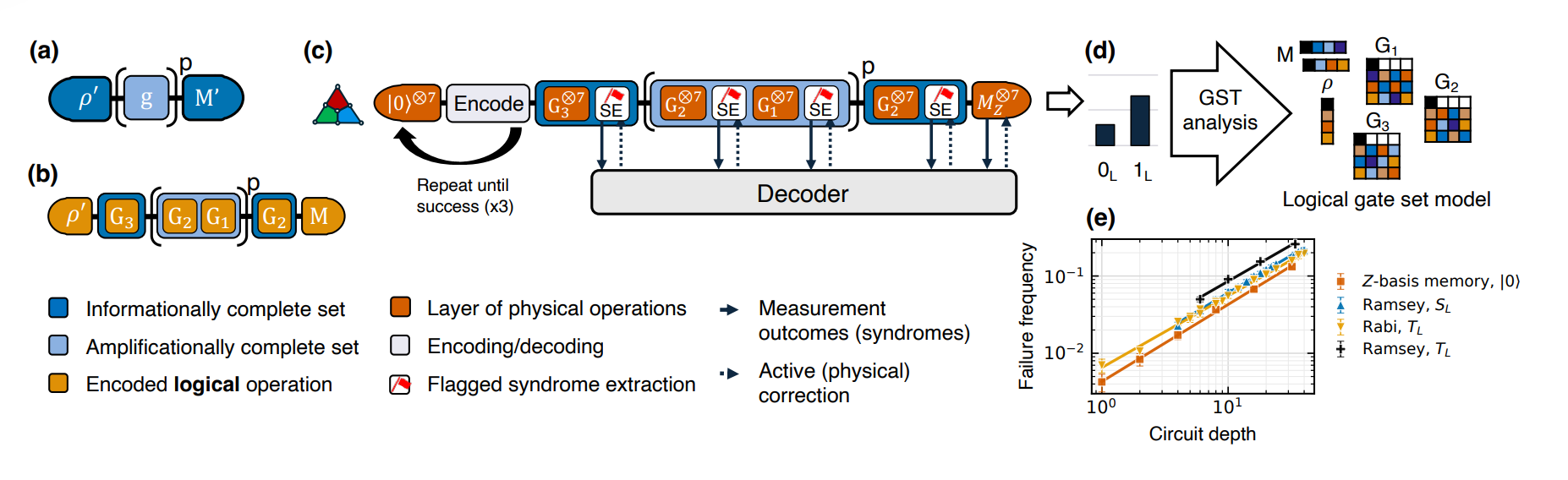
In collaboration with Sandia National Laboratories, Quantinuum achieved the first self-consistent, complete gate set tomography (GST) reconstruction of a universal single-logical-qubit gate set on a single logical qubit encoded with the [[7, 1, 3]] Steane code on System Model H1-1 trapped-ion hardware[31]. The experiment completely extracted the authentic noise tensor of logical quantum gates under fully symmetric operations for the first time, confirming residual non-Markovian coherent noise at the logical level and filling an industry void in rigorous logical-level calibration standards for fault-tolerant quantum computing[31]. This calibration protocol is poised to become the definitive verification benchmark for global fault-tolerant error correction R&D, nudging academia and commercial entities within one year from competing over physical qubit gate metrics toward publishing standardized logical gate set tomography data[31].
Theoretical physicists studying surface codes have discovered a partially decodable phase transition, confirming that dual paramagnets driven by coherent noise exhibit specific symmetry breakings that cause local decoding fidelity to approach a universal analytic function of the system's spatial aspect ratio[11]. This discovery breaks the simplified assumption that traditional error correction relies solely on phenomenological incoherent noise models, revealing the genuine geometric modulation of error correction thresholds by coherent spin flips[11]. This theoretical insight provides new boundary convergence constraints for decoders of superconducting surface codes and neutral-atom toric codes (such as tensor network decoders), helping to trim the computational latency of real-time error correction algorithms by 20% within one year[11].
Following a $10 million grant from the U.S. Defense Advanced Research Projects Agency (DARPA) on October 29, Julien Camirand Lemyre, CEO of Canadian startup Nord Quantique, systematically unveiled their bosonic code hardware roadmap, demonstrating GKP (Gottesman-Kitaev-Preskill phase-space grid bosonic error correction) codes and hypercube code error correction using microwave photons in superconducting cavities, doubling the quantum error correction gain over previous records[26]. The technology adheres to a "one microwave cavity, one logical qubit" roadmap, leveraging the infinite-dimensional continuous-variable states within the resonator to autonomously absorb photon loss, completely circumventing the physical hardware overhead of discrete qubit arrays that can reach dozens to one[26]. This technique opens a differentiated track for developing compact airborne or vehicle-mounted fault-tolerant quantum computers, highly appealing to specialized defense and aerospace customers sensitive to payload and power budgets[26].
Quantum Simulation Algorithms & Chemical Precision Breakthroughs
The IBM Quantum team at Watson developed the Variational Geometric Sampling for Quantum Diagonalization (VGSQD) algorithm, successfully simulating the electronic structure and hydrogen molecule exchange dynamics of the beryllium dimer (Be2) across 124 superconducting qubits[8]. Moving beyond the limitations of prior quantum algorithms confined to static molecular ground-state energies, this algorithm extends into dynamic molecular reaction dynamics; the deviation of its calculated Be2 potential energy curve from experimental true values surpassed the gold standard of classical computational chemistry, CCSD(T) (coupled-cluster with singles, doubles, and perturbative triples), for the first time[8]. This establishes a tangible accuracy advantage for quantum simulation in handling strongly correlated chemical reaction dynamics, providing an actionable timeline for multinational pharmaceutical companies to incorporate quantum computing power into catalyst mechanism exploration[8].
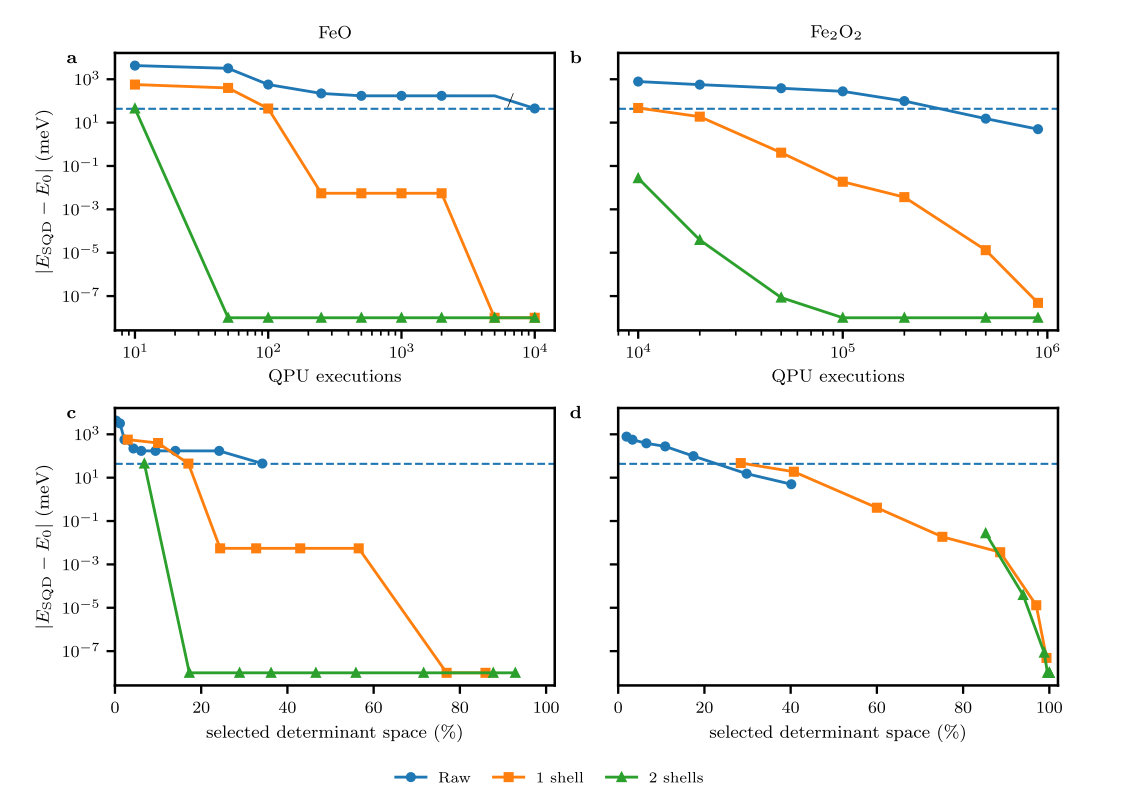
Los Alamos National Laboratory, in collaboration with quantum software developer QC Ware, performed Sampled Quantum Diagonalization (SQD) combined with first-principles tight-binding models on IBM quantum hardware to successfully simulate iron monoxide (FeO) and square-planar iron oxide clusters[29]. This hybrid workflow attained "chemical accuracy" (computational error strictly below 1 kcal/mol) in strongly correlated transition metal oxide systems for the first time, accurately resolving multireference strongly correlated electron orbital configurations that conventional DFT (density functional theory) cannot handle[29]. This approach directly empowers phase transition analysis of transition metal cathode materials for power batteries and the development of efficient industrial catalysts for ammonia synthesis, with industrial commercial clients expected to initiate customized material design validations within two years[29].
Computational physics researchers have proposed a novel error mitigation strategy combining ERPA (extended random phase approximation), cutting the energy computation error of the Variational Quantum Eigensolver (VQE) by several orders of magnitude in quantum simulations of water and cyclobutadiene molecules[17]. Compared with existing quantum subspace expansion algorithms, this technique drastically reduces measurement sampling overhead on noisy quantum hardware, effectively filtering out hardware background noise by reconstructing low-rank correlation tensors[17]. The technique significantly lowers cloud computing costs for near-term NISQ (noisy intermediate-scale quantum) devices performing molecular simulations, substantially reducing the barrier to entry for chemical enterprises utilizing cloud-based quantum computing[17].
An independent benchmark evaluation of the VQE algorithm executed on IBM quantum processors revealed that the residuals in actual molecular energy calculations exceeded the hardware's claimed uncertainty by up to 32 times; although zero-noise extrapolation reduced nearly 84% of the error in oxygen molecule simulations and randomized readout error mitigation recovered an 80-milliHartree deviation in a single task, systematic bias remained pronounced[16]. This finding exposes the heterogeneity of error mitigation techniques and the pitfalls of residual coherent noise in current shallow variational algorithms, sounding an alarm against industry over-optimism regarding algorithmic error mitigation capabilities[16]. This compels the quantum computing investment community and enterprise clients to more prudently evaluate the actual delivery capabilities of near-term noisy quantum computing, tilting cloud service procurement contracts toward introducing third-party blind testing verifications[16].
A research team proposed a novel operator truncation framework for molecular ground-state energy calculations, successfully eliminating 82.3% to 98.1% of hardware noise errors in molecular computations and converging computational accuracy to sub-milliHartree levels[15]. This milestone clears the chemical accuracy threshold required for high-precision computational chemistry, providing robust data post-processing support for noisy physical chips approaching practical chemical computation[15]. This development benefits quantum chemistry SaaS startups in optimizing their algorithmic pipelines, lowering delivery hurdles when engaging pharmaceutical clients[15].
Computer scientists have constructed the first automated verification framework capable of fully formally verifying quantum signal processing (QSP) algorithms across 256 system qubits without relying on classical reference circuits or unrolling black-box oracle calls[5]. This achievement bridges the technical gap where algorithms at the scale of hundreds of qubits could not undergo complete logical equivalence checking on classical computing systems, leveraging the intrinsic algebraic structure of QSP to achieve polynomial compression of verification dimensions[5]. The tool provides an industrial-grade compiler verification instrument for security auditing of core algorithms on future systems with hundreds of physical qubits or early logical qubits, benefiting the construction of secure quantum software stacks[5].
Combinatorial optimization benchmarks revealed that a single-layer QAOA (Quantum Approximate Optimization Algorithm) successfully suppressed the average energy expectation value from 1.675 to 0.686, yet the probability of sampling non-optimal solutions paradoxically rose[6]. Backed by solid data, the benchmark demonstrates that in discrete combinatorial optimization tasks, a "decrease in average energy" does not equate to an "increased hit rate for the global optimum," uncovering the premature convergence trap of shallow variational algorithms in complex landscapes[6]. This finding cautions algorithm R&D teams in financial portfolio optimization and smart logistics to re-evaluate the practical utility of single-layer QAOA, prompting R&D resources to pivot toward deeper circuits or hybrid quantum annealing techniques[6].