Quantum Error Correction and Decoding Algorithms
A research team developed the new Triage decoder for qLDPC (quantum low-density parity-check) codes, which reduces decoding latency by 1 to 2 orders of magnitude (a 10x to 100x speedup) while maintaining state-of-the-art error correction accuracy, paving the way for encoding hundreds of logical qubits within a scale of roughly 1,000 physical qubits[20].
Although conventional high-rate qLDPC codes can compress encoding overhead to one-tenth that of surface codes, their computational decoding complexity is exceptionally high, making it difficult to satisfy microsecond-level real-time closed-loop requirements. By dynamically prioritizing and streaming syndrome checks, the Triage decoder overcomes the computational latency bottleneck of real-time qLDPC decoding at the algorithmic level for the first time, approaching the real-time closed-loop decoding performance achieved by Google Willow using dedicated hardware for surface codes.
This development directly benefits system development teams focusing on neutral atoms and superconducting qLDPC architectures, advancing the engineering roadmap for commercial high-rate qLDPC logical processors by 12 to 18 months.
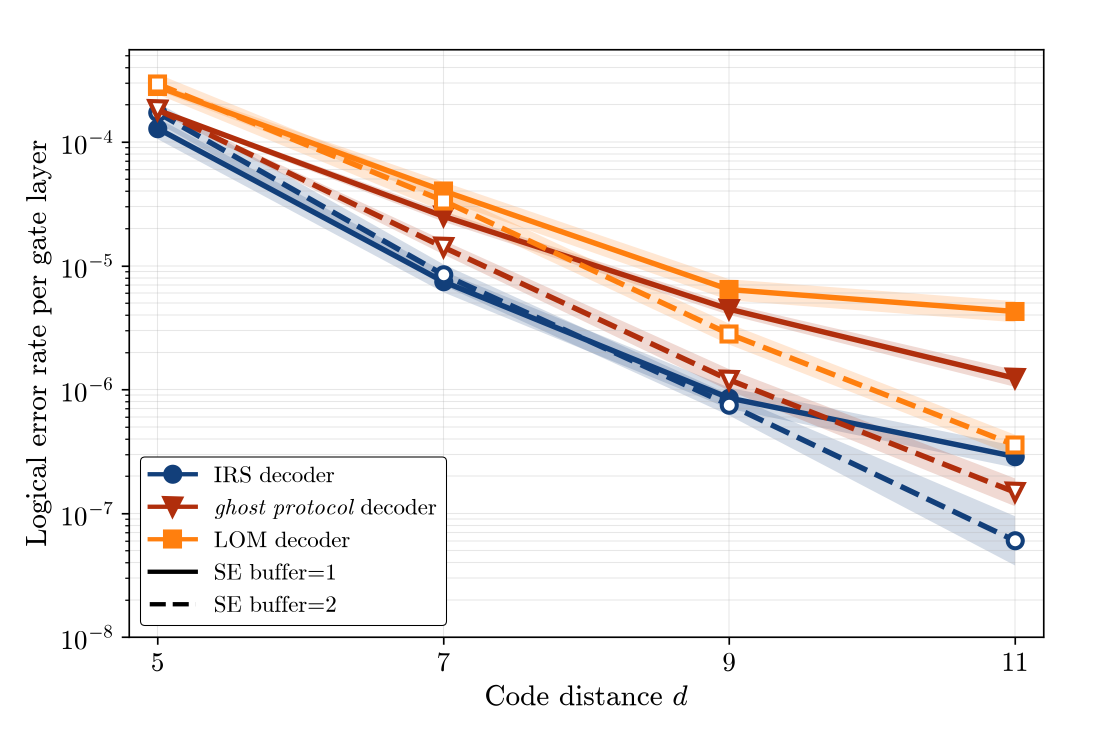
The UK-based Universal Quantum team unveiled an iterative re-decoding scheme, IRS, for rapid transversal fault-tolerant quantum logic. Based on the Propagation-Assisted Local (PAL) decoding framework, this architecture coordinates cooperative corrections across multiple logical qubit blocks, with research details officially published by Mark Webber et al.[8].
This scheme directly tackles the propagation of logical error bursts caused by cascading measurement errors when executing transversal logic gates across multiple logical blocks. The measured logical error rate drops by multiples compared to conventional independent local decoders, establishing an algorithmic moat for parallel fault-tolerant operations in distributed trapped-ion architectures.
This achievement fills a critical logical gap in parallel error correction across multiple logical cores for modular trapped-ion systems, bolstering full-stack patent portfolios.
Researchers proposed a novel correlated atom loss decoder for neutral-atom optical tweezer arrays. Experiments and simulations demonstrate that without modifying existing error-correcting code structures, it reduces the system quantum error rate caused by atom loss to one-twenty-fifth of its original level (a 25-fold reduction)[21].
In neutral-atom arrays, Rydberg-state collisions frequently trigger the correlated loss of neighboring atom pairs, which conventional decoders—treating loss as random single-qubit erasures—often fail to detect. This algorithm accurately models the correlated transition probabilities of paired loss within the decoding graph for the first time, effectively compensating for neutral-atom hardware limitations in atom retention and microsecond-scale reloading.
This constructs a pure software-level defense barrier against atom loss for the neutral-atom track, directly bolstering the resilience of neutral-atom platforms as they compete with trapped ions in multi-logical-qubit fault-tolerant systems.
A multi-stage syndrome decoding algorithm based on the Mamba state space model architecture achieved a geometric mean readout fidelity of 0.906 and reduced physical qubit logical error rates by up to 26%[25].
The algorithm utilizes linear-time-complexity state space representations to extract long-sequence syndrome measurement correlations. Although its 0.906 readout fidelity falls notably short of the 98% to 99.5% physical hardware SOTA baseline on leading superconducting chips, it proves the potential of modern continuous state sequence algorithms to extract computational performance from sub-optimal hardware and suppress correlated errors through algorithmic compensation.
This provides a cost-effective error-correction compensation pathway for resource-constrained hardware teams, promoting the firmware integration of high-performance sequence algorithms into classical error-correction co-processors.
Industry Applications and Specialized Algorithms
Fintech software vendor FirstQFM, in collaboration with the SW7 Group and Rigetti Computing, successfully conducted real-machine testing of QRC (quantum reservoir computing) for financial time-series forecasting on Rigetti's 108-qubit superconducting quantum chip Cepheus-1, outperforming classical time-series baseline models across cumulative gross profit and Sharpe ratio metrics[11].
This test validates for the first time on 100-qubit-scale superconducting hardware the feasibility of leveraging many-body entangled non-linear dynamics for high-dimensional financial time-series feature projection. However, as this demonstration is a noisy intermediate-scale heuristic application lacking provable quantum speedup, its noise robustness still requires validation through long-term real-market backtesting.
Wall Street quantitative funds and high-frequency market makers have obtained positive-return benchmark data on 100-qubit superconducting hardware in live-market time-series forecasting for the first time, which is expected to accelerate capital inflows into noisy quantum computing proof-of-concept projects.
The Vanguard Group evaluated hybrid classification models in a synthetic stock-market pump-and-dump manipulation detection benchmark. Under stringent risk-control constraints of a 15% false-positive rate, one in every two alerts flagged by the hybrid network was confirmed as an authentic suspicious account (achieving a 50% detection precision)[18].
The hybrid architecture demonstrated high sensitivity in capturing faint coordinated anomaly patterns within extremely imbalanced, high-dimensional, heterogeneous financial transaction datasets, significantly outperforming standard statistical decision trees and conventional deep classification networks in false-positive suppression.
Trillion-dollar mutual funds and securities compliance regulators may include quantum-assisted risk management in their technology assessment roadmaps for next-generation anti-money laundering and market anomaly monitoring, opening enterprise procurement opportunities for financial quantum software developers.
Following initial explorations with small-sample medical datasets, a team from Florida Atlantic University (FAU) released new findings: training a pattern-recognition model on clinical data from a tiny cohort of lung cancer patients using D-Wave annealing systems boosted prediction accuracy to 94.31% in a simulated environment[16].
The technical contribution lies in overcoming the severe overfitting caused by extremely small clinical sample sizes, verifying the generalization capability of annealing ground-state energy mapping in sparse pathological feature extraction, and demonstrating superior feature capture over classical statistical regression algorithms.
For clinical scenarios with prohibitive data acquisition costs, such as rare diseases and early-stage malignant tumors, quantum annealing offers a commercially promising clinical auxiliary diagnostic pathway, steering precision medicine toward physical annealing algorithms.
A novel post-variational quantum classifier hybrid algorithm achieved 100% complete identification of previously unseen gravitational wave signals in the Sangria open challenge blind-test dataset for the European Space Agency's LISA mission[19].
By decoupling event triggering from parameter inversion, the algorithm enables the post-variational circuit to focus on extracting waveforms with extremely low signal-to-noise ratios, completely overcoming the frequent missed detections seen in traditional matched filtering and standard variational quantum algorithms in terms of detection completeness.
This demonstrates the extreme sensitivity advantages of quantum signal processing in deep-space exploration and precision measurement signal demodulation, offering a next-generation algorithmic reserve for data processing pipelines in major scientific facilities.
Researchers designed a specific classification problem at the scale of 45 physical qubits, experimentally observing a significant generational performance gap between quantum kernel methods and classical classification algorithms, with this advantage consistently reproduced across multiple heterogeneous physical quantum processor hardware platforms[14].
This marks the first time that a quantum kernel classification advantage—backed by rigorous mathematical guarantees—has been successfully reproduced across multiple physical hardware platforms near the 50-qubit threshold of classical brute-force simulation, providing a robust rebuttal to academic skepticism claiming classical kernels can easily simulate low-depth quantum kernels.
This provides a reproducible benchmark target for identifying industrial deployment scenarios with definitive quantum advantage, bolstering R&D confidence in exploring practical utility on medium-scale noisy hardware.
A research team proposed a novel quantum state feature mapping scheme that resolves the issue where classical amplitude encoding loses absolute input magnitude during scale normalization, with experiments showing that the method improves QNN (quantum neural network) classification accuracy by 21% to 44%[15].
While amplitude encoding requires only a logarithmic number of qubits (i.e., a d-dimensional feature vector requires only log₂d qubits), traditional normalization distorts scale invariants. By extending into orthogonal phase space, this feature mapping preserves all real-valued input features, multiplying the expressive power of the quantum feature space without increasing physical qubit overhead.
This significantly mitigates feature preprocessing distortion when loading high-dimensional big data into quantum processors, delivering an immediate performance boost for algorithm teams developing quantum classifiers for image and time-series data.
Software Tools and Simulation Algorithms
The international physics journal Quantum officially published the open-source Python package QwaveMPS, a tool based on MPS (matrix product states) for high-fidelity simulation of 1D non-Markovian waveguide quantum electrodynamics (waveguide QED) many-body systems[13].
This fills a longstanding void in waveguide QED for open-source tools capable of efficiently simulating strong memory effects and continuous photonic many-body interactions, lowering the barrier for many-body waveguide simulations to standard workstations.
It empowers R&D teams working on superconducting microwave waveguides and photonic waveguide networks, substantially accelerating design iterations for chip-scale distributed quantum buses and quantum repeater devices.
A new classical simulation algorithm, vDBF, combined with Pauli operator propagation techniques, achieved an ultra-low truncation error below 1% when simulating 2D complex lattice systems of 128 physical qubits, while dramatically reducing computation time[26].
This pushes the boundary of classical supercomputing capabilities for simulating strongly entangled many-body quantum systems, elevating 100-qubit complex lattice simulation precision—previously unattainable by conventional tensor networks—to sub-percent levels, providing a robust classical benchmark for calibrating medium-scale physical chips.
This establishes a more rigorous classical competitive benchmark against medium-scale physical hardware claiming computational advantage, compelling hardware vendors to accelerate their evolution toward fully error-corrected architectures beyond 100 qubits.
The EigenOrbit research team released eigenkit, a cross-platform, vendor-neutral quantum software library, and systematically completed unified benchmark evaluations across 12 distinct quantum computing simulators and real physical hardware backends globally[36].
The library resolves the industry pain point of fragmented low-level instruction sets across different quantum hardware vendors—which historically required rewriting compilation pipelines for cross-platform porting—enabling unified abstraction layers for seamless compilation and horizontal performance benchmarking across heterogeneous backends.
This helps mitigate vendor lock-in risks for downstream application developers and accelerates the standardization of cross-hardware interoperability within the global quantum software ecosystem.