Nov 2, 2026 – Nov 3 · Daily Brief

Crypto Giants Warn Quantum Computing Poses the Greatest Threat to Digital Wallets

39 items · 9 sourcesPDFThis issue's roundup is free
02Hardware

Hardware Frontiers

Trapped Ions

UK-based Universal Quantum officially unveiled the iQPU (integrated Quantum Processing Unit), the first trapped-ion processor chip manufactured by a commercial foundry[9]. The device monolithically integrates control microelectronics directly into the chip and leverages proprietary UQConnect (inter-chip ion interconnect) technology to enable multi-module tiling, aiming to completely eliminate the dense feedthrough wiring bottlenecks faced by conventional large-scale trapped-ion systems[9].

In terms of technical metrics, this architecture marks an engineering leap for trapped ions from discrete optical assemblies to standard microelectronic semiconductor fabrication processes. Compared to the current trapped-ion SOTA system, Quantinuum Helios, which features 98 all-to-all connected physical qubits and a 99.921% all-to-all F₂Q (two-qubit gate fidelity), the iQPU charts a new foundry-integrated path. However, full-chip statistical distributions for ion-shuttling loss and cross-chip interconnect fidelity across multi-module interfaces have yet to be disclosed. Furthermore, the gate-time overhead and repetition-rate constraints imposed by ion-transport latency (typically 10 to 500 microseconds) remain critical bottlenecks dictating whether it can catch up with leading practical performance.

Regarding industrial impact, this milestone provides a viable commercial foundry model for trapped-ion hardware companies constrained by bulky optical vacuum chambers. It is expected to push the upstream supply chain over the next 2 to 3 years to accelerate the commercial finalization of wafer-scale vacuum micro-packaging components.

Superconducting Circuits

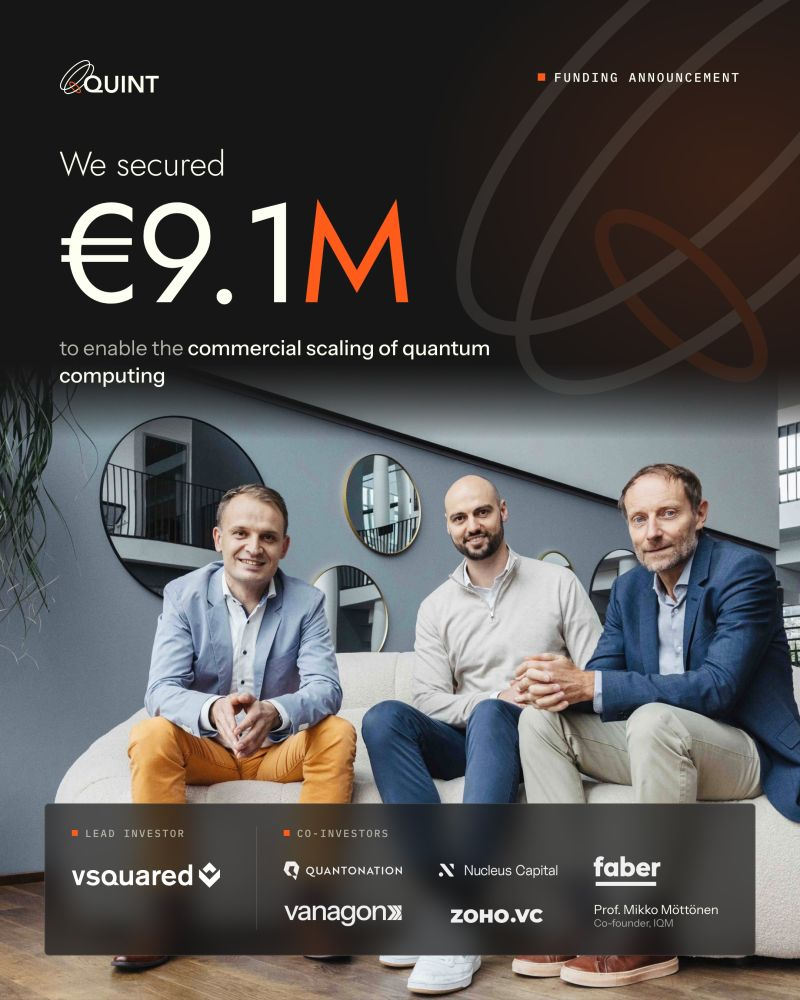
Superconducting hardware startup Quint Computing completed a €9.1M seed funding round and secured a €2.2M grant from the European Innovation Council (EIC) Pathfinder program to commercialize its patented superconducting chip architecture[12]. The design utilizes continuous electrical control in superconducting circuits to stabilize quantum states, claiming to reduce the physical qubit redundancy required for QEC (quantum error correction) to one-hundredth of conventional schemes[12].

This approach attempts to passively suppress decoherence directly from underlying physical mechanisms. If this 100-fold reduction in physical overhead is fully validated in engineering, it implies that superconducting logical-to-physical qubit encoding ratios could shrink from the 105:1 baseline of Google's Willow surface code (where a d=7 surface code requires 105 physical qubits to encode a single logical qubit) to a compact regime of approximately 1:1 to 2:1, approaching the ~2:1 level of Quantinuum's trapped-ion concatenated codes. However, these claims of outperforming public SOTA benchmarks await independent verification. Currently, empirical scaling curves for Λ (the error suppression factor, where Google Willow's 2.1 serves as the public SOTA gold standard) below the fault-tolerance threshold have not been published. Additionally, high-frequency thermal loads on microwave cabling induced by continuous electrical control, along with temporal random fluctuations from two-level system (TLS) defects inherent to superconducting materials, remain central physical roadblocks toward fault-tolerant qubits.

From a capital perspective, this financing indicates that European deep-tech venture capital is pivoting toward fundamental error-correction architecture innovations. If subsequent experimental validation succeeds, it will exert valuation-reassessment pressure on traditional superconducting hardware business models that rely on simple physical qubit scaling.

A team from the University of Regensburg in Germany published research in Physical Review Applied, experimentally demonstrating that introducing a single additional measurement prior to executing a quantum gate sequence can reduce overall qubit operational error rates by more than 50%[3].

By leveraging a prior projective measurement to actively filter out residual thermal equilibrium excitations in the initial state, this method cuts initial SPAM (state preparation and measurement) errors in half, serving as a low-hardware-cost active state purification approach. However, because this protocol only optimizes initial state preparation, it cannot address runtime decoherence or two-qubit gate errors during execution (where mainstream SOTA gate errors range between 0.1% and 0.5%). Bridging the gap to the 99.9% median two-qubit gate fidelity of current production superconducting systems still requires coordination with downstream error correction.

Requiring no modifications to on-chip hardware wiring, this algorithm can be deployed directly as a compiler calibration protocol. It is expected to be adopted as standard underlying firmware across superconducting and semiconductor cloud platforms within months, enhancing computational task fidelity at zero hardware cost.

A research team achieved a topologically protected state in an inductively shunted flux qubit superconducting circuit, experimentally verifying its intrinsic immunity to charge noise by mapping quantum dynamics onto the classical Su-Schrieffer-Heeger (SSH) topological lattice model[17].

Compared to traditional transmons, which are highly susceptible to charge perturbations, this topological circuit achieves symmetry-based noise suppression at the energy-level spectrum. However, due to its intricate inductive loop structure, gate manipulation speeds are substantially slower than the 20 to 100 nanosecond gate times of standard transmons, and multi-qubit coupling introduces significantly greater engineering complexity.

This advance delivers a novel superconducting device architecture for exploring high-coherence protected qubits and holds promise over a 3- to 5-year horizon for offering new options in constructing long-lived superconducting quantum memory units.

Israeli startup Qarakal Quantum demonstrated a novel superconducting bus architecture for superconducting chip interconnects[1].

By integrating a resonator network to achieve high-fidelity, long-range state transfer among multiple on-chip cores, the approach seeks to break the geometric connectivity limits of nearest-neighbor coupling in planar superconducting layouts, thereby enhancing the topological connectivity of superconducting processors.

This design enriches foundational interconnect solutions for quantum hardware in the Middle East and provides a fresh approach for modular, distributed superconducting scaling.

Semiconductor and Solid-State Quantum Devices

A research team achieved a breakthrough in critical microwave loss metrics within a 3D-integrated hybrid quantum dot circuit-QED (circuit quantum electrodynamics) chip, utilizing high-density indium bump vertical interconnects and NbN (niobium nitride superconducting thin film) technology to elevate the internal quality factor of resonators above 10^5 in the single-photon operating regime[22].

When conventional semiconductor quantum dot chips incorporate superconducting resonators, interface losses typically constrain quality factors below 10^4. Surpassing 10^5 crosses the critical threshold for strong coupling between spins and single microwave photons. Although still 1 to 2 orders of magnitude below the 10^6 to 10^7 high-Q baseline of pure superconducting microwave cavities, it resolves the fatal material-loss bottleneck for realizing long-range microwave-bus entanglement of silicon spin qubits.

This fabrication process establishes an industrial-grade interconnect benchmark for the 3D integration of silicon-based semiconductor quantum chips, directly benefiting industrial R&D consortia working to commercialize silicon spin chips on 300 mm production wafers.

Researchers utilizing SnV (tin-vacancy) color center qubits in diamond experimentally observed near-complete resonant optical extinction, confirming high-cooperativity strong coupling between a single color center and photons[27].

Because diamond tin-vacancy color centers possess an inversion-symmetric crystal structure, they exhibit exceptional insensitivity to lattice electric-field noise. Achieving near-total extinction confirms that the single-spin-controlled photon scattering probability approaches the theoretical limit, offering a near-ideal spin-photon entanglement node for long-distance distributed quantum repeaters; nevertheless, their multi-qubit logic entangling gate fidelity still lags behind mature trapped-ion platforms.

This finding provides a high-performance solid-state physical-layer component benchmark for distributed quantum communication networks and ultra-sensitive quantum sensing nodes.

03Algorithms

Algorithms and Software

Quantum Error Correction and Decoding Algorithms

A research team developed the new Triage decoder for qLDPC (quantum low-density parity-check) codes, which reduces decoding latency by 1 to 2 orders of magnitude (a 10x to 100x speedup) while maintaining state-of-the-art error correction accuracy, paving the way for encoding hundreds of logical qubits within a scale of roughly 1,000 physical qubits[20].

Although conventional high-rate qLDPC codes can compress encoding overhead to one-tenth that of surface codes, their computational decoding complexity is exceptionally high, making it difficult to satisfy microsecond-level real-time closed-loop requirements. By dynamically prioritizing and streaming syndrome checks, the Triage decoder overcomes the computational latency bottleneck of real-time qLDPC decoding at the algorithmic level for the first time, approaching the real-time closed-loop decoding performance achieved by Google Willow using dedicated hardware for surface codes.

This development directly benefits system development teams focusing on neutral atoms and superconducting qLDPC architectures, advancing the engineering roadmap for commercial high-rate qLDPC logical processors by 12 to 18 months.

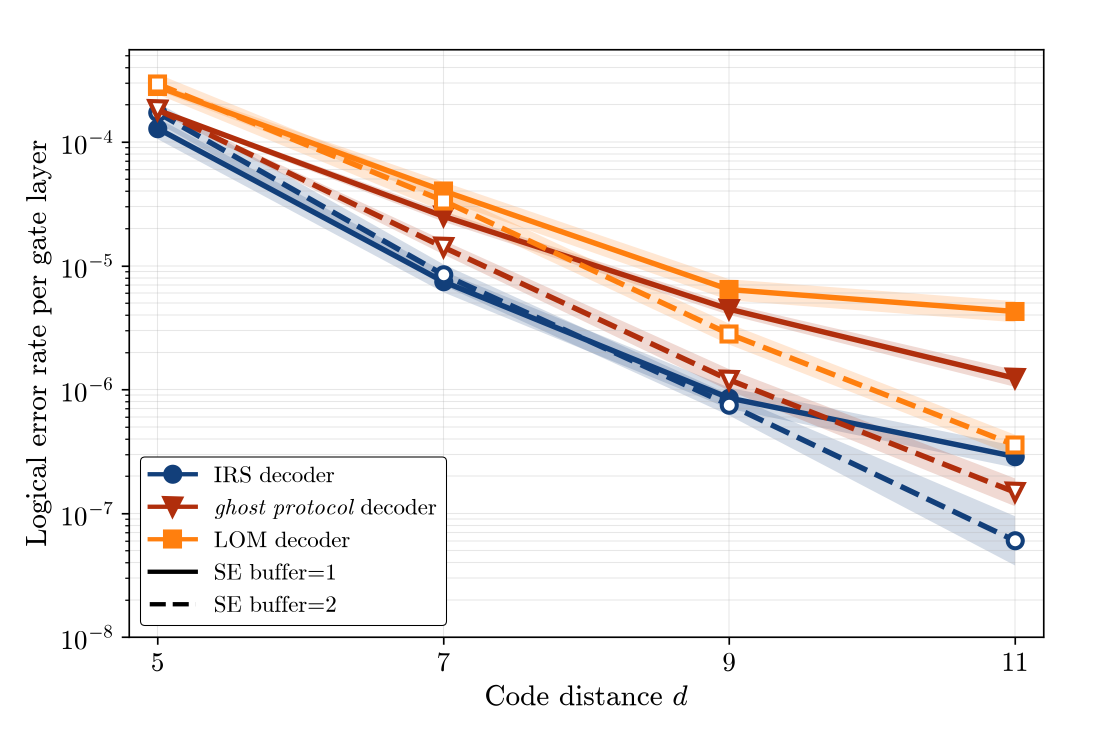
The UK-based Universal Quantum team unveiled an iterative re-decoding scheme, IRS, for rapid transversal fault-tolerant quantum logic. Based on the Propagation-Assisted Local (PAL) decoding framework, this architecture coordinates cooperative corrections across multiple logical qubit blocks, with research details officially published by Mark Webber et al.[8].

This scheme directly tackles the propagation of logical error bursts caused by cascading measurement errors when executing transversal logic gates across multiple logical blocks. The measured logical error rate drops by multiples compared to conventional independent local decoders, establishing an algorithmic moat for parallel fault-tolerant operations in distributed trapped-ion architectures.

This achievement fills a critical logical gap in parallel error correction across multiple logical cores for modular trapped-ion systems, bolstering full-stack patent portfolios.

Researchers proposed a novel correlated atom loss decoder for neutral-atom optical tweezer arrays. Experiments and simulations demonstrate that without modifying existing error-correcting code structures, it reduces the system quantum error rate caused by atom loss to one-twenty-fifth of its original level (a 25-fold reduction)[21].

In neutral-atom arrays, Rydberg-state collisions frequently trigger the correlated loss of neighboring atom pairs, which conventional decoders—treating loss as random single-qubit erasures—often fail to detect. This algorithm accurately models the correlated transition probabilities of paired loss within the decoding graph for the first time, effectively compensating for neutral-atom hardware limitations in atom retention and microsecond-scale reloading.

This constructs a pure software-level defense barrier against atom loss for the neutral-atom track, directly bolstering the resilience of neutral-atom platforms as they compete with trapped ions in multi-logical-qubit fault-tolerant systems.

A multi-stage syndrome decoding algorithm based on the Mamba state space model architecture achieved a geometric mean readout fidelity of 0.906 and reduced physical qubit logical error rates by up to 26%[25].

The algorithm utilizes linear-time-complexity state space representations to extract long-sequence syndrome measurement correlations. Although its 0.906 readout fidelity falls notably short of the 98% to 99.5% physical hardware SOTA baseline on leading superconducting chips, it proves the potential of modern continuous state sequence algorithms to extract computational performance from sub-optimal hardware and suppress correlated errors through algorithmic compensation.

This provides a cost-effective error-correction compensation pathway for resource-constrained hardware teams, promoting the firmware integration of high-performance sequence algorithms into classical error-correction co-processors.

Industry Applications and Specialized Algorithms

Fintech software vendor FirstQFM, in collaboration with the SW7 Group and Rigetti Computing, successfully conducted real-machine testing of QRC (quantum reservoir computing) for financial time-series forecasting on Rigetti's 108-qubit superconducting quantum chip Cepheus-1, outperforming classical time-series baseline models across cumulative gross profit and Sharpe ratio metrics[11].

This test validates for the first time on 100-qubit-scale superconducting hardware the feasibility of leveraging many-body entangled non-linear dynamics for high-dimensional financial time-series feature projection. However, as this demonstration is a noisy intermediate-scale heuristic application lacking provable quantum speedup, its noise robustness still requires validation through long-term real-market backtesting.

Wall Street quantitative funds and high-frequency market makers have obtained positive-return benchmark data on 100-qubit superconducting hardware in live-market time-series forecasting for the first time, which is expected to accelerate capital inflows into noisy quantum computing proof-of-concept projects.

The Vanguard Group evaluated hybrid classification models in a synthetic stock-market pump-and-dump manipulation detection benchmark. Under stringent risk-control constraints of a 15% false-positive rate, one in every two alerts flagged by the hybrid network was confirmed as an authentic suspicious account (achieving a 50% detection precision)[18].

The hybrid architecture demonstrated high sensitivity in capturing faint coordinated anomaly patterns within extremely imbalanced, high-dimensional, heterogeneous financial transaction datasets, significantly outperforming standard statistical decision trees and conventional deep classification networks in false-positive suppression.

Trillion-dollar mutual funds and securities compliance regulators may include quantum-assisted risk management in their technology assessment roadmaps for next-generation anti-money laundering and market anomaly monitoring, opening enterprise procurement opportunities for financial quantum software developers.

Following initial explorations with small-sample medical datasets, a team from Florida Atlantic University (FAU) released new findings: training a pattern-recognition model on clinical data from a tiny cohort of lung cancer patients using D-Wave annealing systems boosted prediction accuracy to 94.31% in a simulated environment[16].

The technical contribution lies in overcoming the severe overfitting caused by extremely small clinical sample sizes, verifying the generalization capability of annealing ground-state energy mapping in sparse pathological feature extraction, and demonstrating superior feature capture over classical statistical regression algorithms.

For clinical scenarios with prohibitive data acquisition costs, such as rare diseases and early-stage malignant tumors, quantum annealing offers a commercially promising clinical auxiliary diagnostic pathway, steering precision medicine toward physical annealing algorithms.

A novel post-variational quantum classifier hybrid algorithm achieved 100% complete identification of previously unseen gravitational wave signals in the Sangria open challenge blind-test dataset for the European Space Agency's LISA mission[19].

By decoupling event triggering from parameter inversion, the algorithm enables the post-variational circuit to focus on extracting waveforms with extremely low signal-to-noise ratios, completely overcoming the frequent missed detections seen in traditional matched filtering and standard variational quantum algorithms in terms of detection completeness.

This demonstrates the extreme sensitivity advantages of quantum signal processing in deep-space exploration and precision measurement signal demodulation, offering a next-generation algorithmic reserve for data processing pipelines in major scientific facilities.

Researchers designed a specific classification problem at the scale of 45 physical qubits, experimentally observing a significant generational performance gap between quantum kernel methods and classical classification algorithms, with this advantage consistently reproduced across multiple heterogeneous physical quantum processor hardware platforms[14].

This marks the first time that a quantum kernel classification advantage—backed by rigorous mathematical guarantees—has been successfully reproduced across multiple physical hardware platforms near the 50-qubit threshold of classical brute-force simulation, providing a robust rebuttal to academic skepticism claiming classical kernels can easily simulate low-depth quantum kernels.

This provides a reproducible benchmark target for identifying industrial deployment scenarios with definitive quantum advantage, bolstering R&D confidence in exploring practical utility on medium-scale noisy hardware.

A research team proposed a novel quantum state feature mapping scheme that resolves the issue where classical amplitude encoding loses absolute input magnitude during scale normalization, with experiments showing that the method improves QNN (quantum neural network) classification accuracy by 21% to 44%[15].

While amplitude encoding requires only a logarithmic number of qubits (i.e., a d-dimensional feature vector requires only log₂d qubits), traditional normalization distorts scale invariants. By extending into orthogonal phase space, this feature mapping preserves all real-valued input features, multiplying the expressive power of the quantum feature space without increasing physical qubit overhead.

This significantly mitigates feature preprocessing distortion when loading high-dimensional big data into quantum processors, delivering an immediate performance boost for algorithm teams developing quantum classifiers for image and time-series data.

Software Tools and Simulation Algorithms

The international physics journal Quantum officially published the open-source Python package QwaveMPS, a tool based on MPS (matrix product states) for high-fidelity simulation of 1D non-Markovian waveguide quantum electrodynamics (waveguide QED) many-body systems[13].

This fills a longstanding void in waveguide QED for open-source tools capable of efficiently simulating strong memory effects and continuous photonic many-body interactions, lowering the barrier for many-body waveguide simulations to standard workstations.

It empowers R&D teams working on superconducting microwave waveguides and photonic waveguide networks, substantially accelerating design iterations for chip-scale distributed quantum buses and quantum repeater devices.

A new classical simulation algorithm, vDBF, combined with Pauli operator propagation techniques, achieved an ultra-low truncation error below 1% when simulating 2D complex lattice systems of 128 physical qubits, while dramatically reducing computation time[26].

This pushes the boundary of classical supercomputing capabilities for simulating strongly entangled many-body quantum systems, elevating 100-qubit complex lattice simulation precision—previously unattainable by conventional tensor networks—to sub-percent levels, providing a robust classical benchmark for calibrating medium-scale physical chips.

This establishes a more rigorous classical competitive benchmark against medium-scale physical hardware claiming computational advantage, compelling hardware vendors to accelerate their evolution toward fully error-corrected architectures beyond 100 qubits.

The EigenOrbit research team released eigenkit, a cross-platform, vendor-neutral quantum software library, and systematically completed unified benchmark evaluations across 12 distinct quantum computing simulators and real physical hardware backends globally[36].

The library resolves the industry pain point of fragmented low-level instruction sets across different quantum hardware vendors—which historically required rewriting compilation pipelines for cross-platform porting—enabling unified abstraction layers for seamless compilation and horizontal performance benchmarking across heterogeneous backends.

This helps mitigate vendor lock-in risks for downstream application developers and accelerates the standardization of cross-hardware interoperability within the global quantum software ecosystem.

04Industry

Industry and Ecosystem

Commercial Financing and Strategic M&A

Quint Computing closed a €9.1M seed round and secured €2.2M in EIC grants, bringing its total capital to €11.3M to accelerate its superconducting error-correction solution that reduces physical overhead by a factor of 100[12].

Institutional investors placing heavy bets on fundamental physical-level error-correction innovations reflect growing fatigue among European deep-tech venture capital with the commercial narrative of merely stacking physical qubit counts. Investors increasingly favor targets with high technological barriers capable of reducing cryogenic and control hardware BOM (bill of materials) costs by two orders of magnitude directly through physical mechanisms.

Following earlier project disclosures, the quantum computing materials R&D consortium led by Japan's SoftBank Group officially unveiled implementation details: SoftBank, together with six industrial giants including TOPPAN Holdings and Asahi Kasei, will fully launch a $130M (approx. ¥20B) R&D initiative funded by NEDO (New Energy and Industrial Technology Development Organization), running from 2026 to 2028[24].

The newly disclosed details delineate clear divisions of labor among the six giants: Asahi Kasei will focus on ultra-high-purity superconducting dielectric and piezoelectric thin-film materials; TOPPAN Holdings will oversee wafer-scale sub-micron lithography masks and ultra-high-density wiring substrates; and SoftBank will build an integrated hardware-software testing platform for quantum material simulations. This industry-academia-research collaboration model represents a key strategic move in international quantum competition, aimed at securing an early supply chain moat for high-end quantum chip consumables.

Global scientific instrument manufacturer Quantum Design completed its strategic acquisition of Oxford Instruments NanoScience, forming a comprehensive instrumentation powerhouse spanning advanced physical characterization and ultra-large dilution refrigerator manufacturing[6].

By deeply integrating Oxford Instruments' ultra-large ultra-low-temperature dilution refrigeration systems (capable of supporting cooling for 1,000-qubit-scale superconducting chips) with Quantum Design's global distribution channels and electromagnetic measurement engineering capabilities, the deal consolidates a historically fragmented cryogenic refrigerator market into a dominant supplier in ultra-low-temperature infrastructure for superconducting and spin quantum computing.

Concentration in the upstream core supply chain of quantum computing has further intensified. Major quantum hardware laboratories worldwide may face weakened bargaining power when procuring large-scale dilution refrigerators, with delivery timelines and customized services becoming increasingly subject to the merged giant's supply chain allocations.

Policy, Regulation, and Geostrategy

IQM, a Finnish leader in European superconducting quantum computing, published an industrial policy strategy paper titled Quantum is Europe's Second Chance, calling on the European Commission to establish dedicated qubit foundries in the forthcoming EU Quantum Act and to implement proactive public procurement policies modeled after the US DARPA approach[10].

The initiative explicitly points out that while Europe ranks among the global leaders in public research funding volume and cloud-deployed physical QPUs, it lags severely in venture capital scale, sovereign chip volume-manufacturing capacity, and regulatory responsiveness. Without establishing dedicated European quantum wafer fabrication lines and breaking away from routine academic research subsidies, Europe risks forfeiting future sovereignty over the computing industry.

This initiative is driving consensus across European political and industrial circles on achieving technological sovereignty across the quantum supply chain. It is expected to prompt the EU to allocate dedicated foundry subsidies and public procurement funds in the upcoming act, benefiting indigenous European quantum hardware enterprises.

Aaron Fluitt, a science and technology strategist who led Argonne National Laboratory in securing a $115M grant from the U.S. Department of Energy and co-founding the Q-NEXT National Quantum Information Science Research Center, officially assumed office as the second Chief Executive Officer of the Chicago Quantum Exchange (CQE)[37].

Fluitt combines management experience across national-scale scientific facilities with the execution of major federal funding initiatives. His appointment signals that the Midwestern quantum tech corridor—anchored by the University of Chicago and Argonne National Laboratory—is officially pivoting toward industrial commercialization and capital competition for regional industry clusters.

Cross-Sector Integration and Post-Quantum Migration

Toyota Motor Corporation and the University of Chicago signed a multi-year joint R&D agreement focused on collaborative breakthroughs in future smart mobility, sustainable transportation battery material simulations, and vehicular quantum-safe secure communication systems[35].

By combining the University of Chicago's fundamental scientific strength in molecular-scale quantum chemistry simulations and solid-state spin sensing with Toyota's engineering expertise in battery electrochemical kinetics, complex route optimization, and vehicle-to-everything (V2X) cryptographic protection, the partnership establishes a new model for automotive OEMs tapping into cutting-edge computing.

This signals that downstream industrial demand for quantum computing is accelerating its penetration beyond traditional pharmaceutical and financial sectors into automotive and advanced manufacturing, driving automotive connected communication protocols toward post-quantum standards.

Web3 infrastructure provider Instanodes officially announced the development of quantum-resistant cryptographic account engineering solutions for Ethereum Virtual Machine (EVM)-compatible public blockchains and Solana, concurrently launching public-chain quantum-readiness assessments and customized migration services[23].

Addressing the fatal vulnerability of elliptic curve digital signature algorithms (ECDSA) widely used in public blockchains to future quantum computers running Shor's algorithm, Instanodes pioneered the integration of lattice-based post-quantum cryptography (PQC) signature verification logic into node relays and smart contract account abstraction layers, establishing a defensive barrier from RPC gateways to on-chain accounts.

This marks the first transition of quantum-resistant cryptographic schemes from theoretical analysis to engineering deployment across two major public blockchain ecosystems, kicking off the practical migration of trillion-dollar public chain underlying assets to post-quantum cryptographic standards.

Brian Armstrong, CEO of Coinbase, the largest compliant cryptocurrency exchange in the United States, publicly warned investors during an earnings call that from a long-term strategic perspective, the development of cryptanalytically relevant quantum computers poses the most severe existential threat to digital asset security[38].

Armstrong's remarks corrected the market's myopic over-focus on general computing hype at the expense of underlying cryptographic failure risks, emphasizing that once large-scale fault-tolerant machines capable of running Shor's algorithm emerge, traditional public-key cryptosystems will be entirely broken, necessitating underlying blockchain post-quantum upgrades years in advance.

This direct warning from the founder of a premier compliant financial platform will deeply influence how institutional investors evaluate digital asset infrastructure, significantly accelerating top public blockchain foundations in prioritizing post-quantum cryptographic roadmaps in their core development agendas.

SpecterAI Quantum Security, a post-quantum cybersecurity firm, officially signed an implementation timetable and action roadmap with HPT Vietnam, a prominent Vietnamese IT services provider, to advance the execution of their June 2026 framework agreement and jointly launch post-quantum cryptography migration across Vietnam's financial and critical information infrastructure[39].

This signifies that the wave of post-quantum cryptography migration has substantially reached emerging economies in Southeast Asia, prompting developing nation government agencies and major commercial banks to accelerate the reconfiguration of secure communication protocols.

05Other

Academic Frontiers

A joint team from the Faculty of Physics at the University of Warsaw, the Military University of Technology in Poland, IBM Research Zurich, and the French National Centre for Scientific Research (CNRS) experimentally observed a novel phase of quantum matter for the first time in an exciton-polariton Bose-Einstein condensate system: a room-temperature supersolid[2].

A supersolid is an exotic quantum state of matter that simultaneously exhibits the rigid, periodic spatial arrangement of a crystal and the zero-viscosity flow of a superfluid. Previously, supersolid physics could only be observed with extreme difficulty in ultracold atomic gases near absolute zero (in the nanokelvin regime). By harnessing exciton-polariton quasiparticles formed by strong coupling between light and matter in semiconductor microcavities, the team elevated the operating temperature of the supersolid state directly to ambient room temperature, bridging a temperature chasm that had puzzled solid-state physicists for decades.

This completely shatters the perception that supersolids belong solely to low-temperature extreme physics experiments, establishing a solid condensed-matter physics foundation for developing room-temperature dissipationless solid-state quantum transport devices, novel low-power topological photonic logic circuits, and ultra-low-energy quantum simulation chips.

The upgraded LHCb collaboration at CERN's Large Hadron Collider announced that after more than 40 years of exploration, it has finally captured new evidence of an exceptionally rare particle decay—an event occurring roughly only once in every 10 billion "Beauty" (bottom) quark decays[4]. This achievement directly pushes microscopic physical probing down to the "Zeptoverse" scale of one-billionth of a trillionth of a meter[4].

This rare leptonic decay channel is exceptionally sensitive to new physics particles beyond the Standard Model. Minute deviations in branching ratios provide the highest-precision experimental constraints to date for exploring ultralight topological axions, dark sector gauge bosons, and higher-order flavor physics interactions, further constricting the free parameter space of conventional phenomenological theories.

This offers crucial targets for fundamental physicists exploring dark matter candidates, while its ultra-low-probability event extraction algorithms and high-precision calorimeter detector arrays will feed back into the design of quantum precision metrology and ultra-sensitive single-photon detection instruments.

Recent physics research confirms that leveraging quantum steering—a unique non-local quantum correlation mechanism—can significantly improve the cooling efficiency of quantum heat engines extracting heat from thermal reservoirs[5].

Positioned between quantum entanglement and Bell non-locality, quantum steering was demonstrated in this study to break the heat-exchange limits of classical Carnot refrigerators through non-local manipulation, even in rigorous non-equilibrium thermodynamic systems subject to environmental decoherence and asymmetric measurement noise, markedly reducing the energy consumed in reverse heat extraction.

This provides novel quantum thermodynamic engineering principles for next-generation solid-state quantum pre-cooling stages in dilution refrigerators and in-situ localized cryogenic heat sinks for superconducting qubits, holding promise for mitigating the cryogenic thermal dissipation bottleneck encountered when scaling multi-qubit chips.

06Impact

Today's Impact

  1. Digital Asset and Public Blockchain Developer Ecosystem [23][38]
  • Who is affected: Core developers of major public blockchains such as Ethereum and Solana, validator node operators, and crypto-asset custodians.
  • What has changed: Coinbase's CEO publicly identified quantum cryptanalysis as the number-one long-term threat to digital assets[38], and Instanodes took the lead in launching quantum-resistant account engineering solutions and assessment frameworks[23], marking a shift for post-quantum cryptographic upgrades from theoretical analysis into practical node and smart contract refactoring.
  • What to watch next: Closely monitor whether the Ethereum Foundation and Solana officials incorporate lattice-based cryptographic signature verification into upcoming hard-fork upgrade proposals, as well as post-quantum firmware release schedules from institutional cold-wallet vendors.
  1. Superconducting Quantum Hardware Startups and Venture Capital [3][12]
  • Who is affected: Superconducting chip startups, control hardware development teams, and European deep-tech venture capital firms.
  • What has changed: Quint Computing secured eight-figure euro backing for its continuous electrical control scheme that reduces physical error correction overhead by a factor of 100[12], and the University of Regensburg demonstrated that a single prior measurement cuts qubit error rates in half[3], disrupting the capital narrative reliant solely on scaling physical qubit counts.
  • What to watch next: Keep a close eye on whether Quint Computing can tape out multi-qubit chips before 2027 with experimentally published Λ error suppression curves, and track deployment and verification results of Regensburg's pre-measurement protocol across commercial superconducting cloud platforms.
  1. Quantum Error Correction Software and Neutral-Atom Developers [20][21]
  • Who is affected: Hardware vendors focusing on neutral atoms and high-rate error-correcting codes (e.g., QuEra), alongside quantum error correction algorithm developers.
  • What has changed: The Triage decoder slashed qLDPC decoding latency by 10x to 100x[20], and the paired atom loss decoder reduced loss-induced error rates by 25x[21]; algorithmic breakthroughs have resolved two engineering vulnerabilities in real-time error correction loops and tweezer atom loss.
  • What to watch next: Observe whether leading neutral-atom vendors such as QuEra integrate correlated atom loss decoding firmware into their 100-logical-qubit chips, and whether FPGA real-time decoding pipelines can execute closed-loop decoding on 1,000-qubit qLDPC codes within nanosecond clock cycles.
  1. High-End Instrumentation and Chip Foundry Supply Chains [6][9][10]
  • Who is affected: Dilution refrigerator customers, semiconductor foundries, and European quantum hardware startups.
  • What has changed: Universal Quantum's iQPU achieved full integration via commercial wafer foundries[9], IQM highlighted European foundry and procurement shortfalls to spur the EU Quantum Act[10], and Quantum Design acquired Oxford Instruments NanoScience to form a dilution refrigerator mega-monopoly[6]; the industrial division of labor is accelerating from academic artisanal shops into highly verticalized industrial foundry models.
  • What to watch next: Monitor whether Brussels deliberations on the EU Quantum Act explicitly designate budgets for dedicated foundries, and track lead times and pricing trends for global large-volume dilution refrigerators following the Oxford Instruments-Quantum Design merger.
07Other

Editorial Commentary

Surveying today's industry dynamics, the global quantum computing industry is undergoing a paradigm shift from a "blind arms race in physical qubit counts" toward "engineering integration and the aggressive minimization of error correction overhead." Whether it is the UK's Universal Quantum launching foundry-integrated trapped-ion chips to eliminate cabling bottlenecks, Quint Computing betting on continuous electrical control to slash physical redundancy a hundredfold, or the Triage decoding algorithm reducing high-rate error correction latency by two orders of magnitude, industry anxieties have converged: within limited cryogenic space, wiring thermal loads, and classical computational latency budgets, the engineering cost of reaching fault-tolerant quantum computing must be brought down to commercially viable levels. The era of brute-force scaling reliant purely on bespoke laboratory optical benches or indefinitely expanding dilution refrigerator footprints is drawing to a close.

Simultaneously, security anxieties among enterprise buyers are rapidly accelerating commercial adoption timelines. From Vanguard testing stock manipulation detection, to Toyota positioning for future mobility and vehicular cryptographic defenses, to Ethereum and Solana seeing their first quantum-resistant account engineering solutions, decision-makers across downstream critical infrastructure no longer view quantum computing power as an abstract theoretical prospect. Coinbase leadership's explicit warning regarding cryptographic vulnerabilities underscores deep concerns in compliant finance over the obsolescence of underlying public-key infrastructure. For capital markets and industry alike, system overhaul driven by post-quantum cryptographic migration has emerged as one of the most certain multi-billion-dollar security spending sectors, while generational leaps in hardware error correction continue to reshape the foundational strategic assets of advanced computing.