Nov 3, 2026 – Nov 4 · Daily Brief

Record 8 Billion Yuan Acquisition Drives Quantum Defense to Block Hackers

50 items · 12 sourcesPDFThis issue's roundup is free
02Hardware

Hardware Frontiers

Silicon-Based Semiconductors and Integrated Circuits

A quantum hardware team from the Spanish Center for Nanomaterials and Nanotechnology (ICN2), together with Quantum Motion, the London Centre for Nanotechnology, Imperial College London, and the University of Cambridge, published a paper in Nature Electronics, demonstrating for the first time the fabrication of novel superinductors (high-impedance, low-loss quantum inductors) within a commercial complementary metal-oxide-semiconductor (CMOS, the mainstream chip manufacturing process) silicon integrated circuit[5].

Superinductors are core components for building fluxonium qubits (superconducting qubits resilient to charge noise) and topologically protected superconducting qubits; previously, they relied on non-standard superconducting thin films such as granular aluminum, which are difficult to integrate into foundry fabrication lines. This milestone demonstrates for the first time that commercial semiconductor foundries can directly manufacture superinductor components[5]. In terms of progress, this process fully aligns silicon-based superconducting component fabrication with mature wafer foundries; however, compared to the current superconducting hardware state of the art (SOTA) baseline (where the median energy relaxation time T1 of Google's Willow chip is 100 microseconds), high-frequency losses from two-level systems (TLS, microscopic material defect loss centers) at the silicon-silicon dioxide interface remain pronounced, and coherence lifetimes still lack the atomic-level interface passivation required to reach the thousand-microsecond scale needed for fault-tolerant computing[5].

This breakthrough eliminates engineering barriers preventing semiconductor foundries from processing complex superconducting quantum devices, prompting foundry giants such as GlobalFoundries and TSMC to reassess fab compatibility for superconducting hybrid chips, and is expected to catalyze electronic design automation (EDA) toolchains specifically tailored for silicon-superconducting heterogeneous chips within the next 2 to 3 years[5].

Australian silicon spin quantum computing company Diraq announced the official deployment of its proprietary silicon spin quantum dot (electron spin states trapped in semiconductors) system inside an Equinix commercial colocation data center in Sydney. The system has achieved 24/7 stable operation, making it the world’s first complete silicon quantum computing system deployed in a commercial colocation data center[25].

In terms of advancement, the system demonstrates compact modular integration of dilution refrigerators with room-temperature electronic control systems, with vibration damping and electromagnetic isolation meeting commercial data center hosting standards. However, benchmarked against the silicon spin SOTA baseline (SQC's atomic-scale manufacturing achieving 99.99% two-qubit gate fidelity, and Diraq's previously published 98.92% two-qubit gate fidelity in the 1 Kelvin regime), this machine's two-qubit gate error rate remains nearly an order of magnitude higher than the aforementioned record, and its physical qubit count remains within several dozen, falling short of the physical scale threshold required for practical error correction[25].

This deployment validates the compact footprint and low power consumption advantages of the silicon spin roadmap, posing a differentiated alternative to infrastructure models reliant on large-scale superconducting facilities, and is expected to accelerate cloud providers integrating on-chip quantum coprocessors at lower infrastructure costs over the next 3 to 5 years[25].

Neutral-Atom and Trapped-Ion Systems

On a cryogenic neutral-atom experimental platform, a research team utilized a deep-cryogenic shielding system to extend the trapping lifetime of strontium-88 neutral atoms in an optical tweezer (laser micron-scale particle trapping tool) array to over 2 hours[28].

In room-temperature vacuum chambers, the trapping lifetime of atoms in optical tweezers is typically 10 to 60 seconds, primarily limited by collisions with background residual gas molecules. This experiment improved the atom trapping lifetime by more than 100-fold compared to room-temperature optical tweezers, completely eliminating the physical risk of accidental atom loss during long, complex quantum circuit executions[28]. Benchmarked against the neutral-atom SOTA baseline (Harvard University's 99.5% parallel two-qubit gate fidelity across 60 atoms, and QuEra's demonstration of 96 logical qubits), this experiment pushes the limits of vacuum decoherence protection; however, practical implementation remains constrained by low cycle repetition rates caused by laser cooling and loading (currently only 1 to 10 Hz) and mid-circuit readout crosstalk, still necessitating the introduction of dual-color optical tweezers and continuous-loading atom-replenishment mechanisms[28].

This technique provides critical environmental support for neutral-atom array developers such as QuEra and Pasqal to engineer fault-tolerant machines with code distance d ≥ 7, and is expected to become the standard vacuum configuration for industrial-grade neutral-atom systems by 2027[28].

Trapped-ion hardware vendor IonQ entered into a collaboration agreement with the Quantum Technologies Connection in Connecticut, providing universities and research institutions in the state with over 150 hours of cloud-based access to physical trapped-ion computing power[14].

This marks the first time a regional industrial consortium has allocated hardware runtime through centralized procurement for materials science and combinatorial optimization research, driving algorithmic benchmarking of trapped-ion platforms in real-world environments[14]. This initiative directly boosts IonQ's penetration across North American academic and research circles, and will yield multiple comparative evaluation studies on topological state simulations over the next 1 to 2 years[14].

Industry benchmark data indicates that researchers validated encrypted image transmission under noisy conditions on IBM's 156-qubit superconducting Heron processor; concurrently, Rigetti hardware outperformed classical baseline models in financial time-series forecasting benchmarks[50].

IBM Heron's production-grade two-qubit gate fidelity exhibits a median of 99.5% to 99.9%, which, while not yet surpassing the commercial record of 99.921% all-to-all connectivity held by Quantinuum's trapped-ion Helios system, validates the engineering parallelism of superconducting architectures at the hundred-qubit scale. Meanwhile, although Rigetti's system has scaled to 108 physical qubits, a significant generational technology gap remains when compared to the below-threshold surface code error correction capabilities demonstrated by Google's Willow (achieving an error suppression factor of 2.1)[50]. These benchmarks demonstrate that hundred-qubit-scale noisy hardware already possesses prototyping value for specialized financial optimization and communication fault-tolerance verification[50].

Superconducting Junction Materials and Macroscopic Devices

A research team at the University of California, Santa Barbara officially joined the $27.9 million Manufacturing and Architecture for Resilient Quantum Information Systems (MARQUIS) institute, focusing on atomic-level material restructuring of the Josephson junction—the core nonlinear element of superconducting qubits[17].

Conventional superconducting chips utilize aluminum/aluminum oxide barrier layers that contain substantial microscopic defects, which serve as the primary source of energy relaxation and temporal parameter drift. This project seeks to introduce epitaxial single-crystal materials to suppress defects[17]. Compared to the current superconducting baseline, where median coherence times in existing chips are generally constrained by defects to the 100-microsecond range, successful development of single-crystal barrier layers could push coherence lifetimes beyond 500 microseconds; however, the engineering challenge lies in cross-wafer thin-film uniformity and yield[17]. This research directly serves material selection for next-generation fault-tolerant superconducting chips, with a technology incubation cycle estimated at 3 to 5 years[17].

Physicists utilized continuous quantum weak measurement techniques to successfully control a suspended microrotor with a mass of 1 milligram, achieving ultra-low environmental thermal decoherence isolation and precisely resolving faint thermal fluctuation signals in the ultra-low frequency band of 7 nanohertz[18].

This breakthrough pushes quantum state coherent measurement capabilities for macroscopic objects into the milligram regime, setting a new mass ceiling for high-sensitivity quantum measurements of macroscopic mechanical resonators[18]. This progress opens a novel hardware path for high-sensitivity ground-based testbeds for space gravitational wave detection and ultra-weak dark matter interaction detectors[18].

03Algorithms

Algorithms and Software

Fault Tolerance, Error Correction, and Compilation Optimization

The IBM Quantum team, in collaboration with the Joint Center for Quantum Information and Computer Science (QuICS) at the University of Maryland, leveraged deterministic solvers and automated search algorithms within algebraic topology structures to discover over 500 novel, high-efficiency magic-state factory architectures, fully open-sourcing the circuit topology models[11].

Non-Clifford logical gates, indispensable for universal quantum computing, must be synthesized via magic-state distillation; historically, their physical qubit and spacetime overhead accounted for more than 90% of total system resources. The 500+ architectures uncovered by the new algorithm significantly reduce the resource requirements for preparing non-Clifford states[11]. Benchmarked against the current SOTA level (Quantinuum’s transversal gates across 48 logical qubits and concatenated code 2:1 encoding ratio), this achievement fills the compilation efficiency gap of superconducting square grid topologies when executing universal fault-tolerant gate operations[11]. This algorithm library provides plug-and-play compilation templates for hardware teams worldwide utilizing surface code architectures, advancing the physical timeline for fault-tolerant quantum computers to run practical algorithms by 1 to 2 years[11].

IonQ published an official blog post titled From Magic States to Full-Stack Accounting: Fault-Tolerant Quantum Computing Resource Estimation Matures, proposing a full-stack hardware-software resource accounting model that overturns conventional empirical assumptions[2].

The study points out that with iterative improvements in logical operations, the core system bottleneck has shifted from pure magic-state preparation to long-range routing congestion, syndrome decoding latency, and on-chip control wiring thermal loads; for all-to-all connected trapped-ion systems, the weight of aggregate interconnect overhead has overtaken pure algorithmic gate counts[2]. This model urges the algorithmic research community to move beyond the limitation of evaluating complexity solely by logical gate counts, introducing profound revisions to the capital evaluation logic surrounding hardware-software co-design[2].

Researchers successfully deployed an algorithm-assisted, eight-qubit toric code (a two-periodic topological quantum error-correcting code) array on superconducting hardware and completed verification of a closed-loop syndrome measurement pipeline[29].

Compared to Google's Willow chip, which demonstrated d=7 surface code error correction on 105 physical qubits, this 8-qubit toric code represents a small-scale foundational validation that has not yet crossed the fault-tolerant threshold where error rates decrease exponentially with increasing code distance. Its primary value lies in demonstrating an error-correction software workflow that dynamically calibrates localized hardware defects[29]. This approach provides institutions lacking ultra-large-scale hardware with a cost-effective benchmark software tool to validate topological error-correction protocols[29].

Industrial Simulation and Specialized Algorithms

An interdisciplinary team spanning atmospheric physics and quantum algorithms published a study in a Nature sub-journal proposing a novel quantum algorithm to simulate cloud droplet microphysical collision-coalescence, compressing the qubit complexity required for multi-particle fluid dynamics simulation from the square-root of N in prior quantum algorithms down to logarithmic N (O(log N))[26].

This marks the first logarithmic reduction of grid-state encoding achieved in the field of aerosol fluid microphysical simulation, meaning that just several dozen logical qubits can complete the microscopic evolutionary inversion of collisions among hundreds of millions of micron-scale water droplets[26]. The algorithm shortens the R&D cycle for quantum computing to penetrate short-term nowcasting of extreme precipitation and global climate models, providing a direct catalyst for upgrading weather radar and meteorological satellite data inversion software[26].

Photonic quantum computing company PsiQuantum utilized its proprietary quantum circuit design suite, PsiQuantum Construct, to design specialized simulation circuits capable of generating exponential microscopic pore features in porous materials, eliminating the circuit depth explosion bottleneck during quantum state preparation for microscopic geometric modeling[24].

By leveraging fractal tensor decompositions, this solution compresses the circuit depth required to map microscopic geometric boundary conditions into quantum states by more than two orders of magnitude[24]. This directly aids material science giants in screening molecules for direct air carbon capture materials and porous electrolytes in solid-state batteries, enhancing algorithmic execution efficiency in industrial R&D scenarios[24].

TuringQ, in collaboration with Shanghai Jiao Tong University, made headway in modeling chaotic flow dynamics by constructing conditional quantum prior distributions using integrated photonic quantum chips. In validating against the classical Lorenz-63 nonlinear chaotic convection model, they achieved an average 56.9% reduction in Jensen-Shannon divergence (a metric measuring probability distribution similarity)[20].

The study confirms that high-dimensional photonic entanglement priors can suppress chaotic divergence errors caused by sensitivity to initial conditions in turbulent numerical simulations[20]. This demonstrates a path forward for deeply integrating photonic quantum computing with specialized fluid physics, providing a novel computational tool for aerodynamic drag-reduction design and hypersonic flow simulations[20].

Quantum annealing technology developer D-Wave announced an algorithmic architecture upgrade to its Stride hybrid solver on the Leap quantum cloud platform, alongside the rollout of a "Practical Quantum Optimization" professional developer training program[15].

The upgraded hybrid solver optimizes task co-allocation between classical heuristic search and quantum annealing processors, significantly reducing solution time and improving solution quality for industrial optimization problems such as traveling salesperson routing and discrete assembly line balancing[15]. This enhances D-Wave's competitiveness in discrete scheduling scenarios, including automotive manufacturing scheduling and port warehouse logistics, accelerating the conversion of proof-of-concept orders into long-term enterprise procurement agreements[15].

An interdisciplinary medical research team utilized a quantum recurrent neural network architecture to perform binary classification of sleep apnea using clinical respiratory physiological time-series data, matching the diagnostic accuracy of classical deep networks on real-world clinical datasets while drastically reducing model parameter counts[21].

This validates the unique advantage of parameterized quantum circuits in characterizing nonlinear temporal physiological signals with low parameter overhead, paving the way for embedding quantum algorithmic cores into low-power portable medical monitoring chips in the future[21].

Quantum software firm Qoro Quantum announced the launch of a managed GPU cloud simulation compute tier for its Python-based Divi simulation framework, providing on-demand scheduling support for NVIDIA A10G and T4 acceleration clusters[12].

This service frees users from the complex operational burden of self-hosting clusters and underlying communication drivers, lowering the computational barrier for hundred-qubit-scale noisy circuits and tensor network simulations, directly serving universities and startups in rapid algorithm prototyping[12].

04Industry

Industry and Ecosystem

Capital M&A and Strategic Financing

Publicly traded trapped-ion quantum computing company IonQ announced the official completion of its acquisition of cybersecurity technology firm Elisity for an aggregate consideration of $1.15 billion, with specific closing terms undisclosed[13].

This transaction sets a record for the highest valuation single commercial M&A deal in the global quantum computing industry. Elisity specializes in identity-based zero-trust (a security architecture based on continuous verification) network microsegmentation technology; through this transaction, IonQ deeply binds post-quantum cryptographic algorithms with real-time network intrusion prevention capabilities, officially entering the trillion-dollar enterprise cybersecurity market[13]. This move breaks the monolithic business model of pure-play quantum hardware vendors relying on R&D subsidies and distant cloud subscription horizons, providing IonQ with immediate enterprise security subscription revenues ahead of full-stack fault-tolerant machine maturity, and driving public equity markets to reshape their valuation logic for quantum hardware companies around cybersecurity cash flows[13].

Chinese quantum precision measurement company Zhejiang Guoce Quantum Technology Co., Ltd. announced the completion of a Pre-B strategic financing round exceeding RMB 100 million (approximately $15 million), with proceeds designated for expanding automated production lines and deepening commercial penetration of its quantum precision measurement products[45].

This confirms that quantum precision measurement, as the fastest-commercializing subsector within the quantum technology ecosystem, has already achieved self-sustaining commercial capability across semiconductor wafer inspection, geological exploration, and high-end scientific instrumentation, with domestic industrial capital doubling down counter-cyclically on hardware players with stable delivery track records[45].

London Stock Exchange-listed Quantum Base announced that its Head of Materials Science R&D was awarded a £700,000 "Future Leaders Fellowship" grant by UK Research and Innovation (UKRI)[44].

The grant will be dedicated to advancing standardized certification of nanoscale quantum fingerprinting and anti-counterfeiting identification technologies, accelerating the scaled rollout of homegrown UK quantum security IP across pharmaceutical tracking and tamper-proof supply chains[44].

A report released by the European Innovation Council (EIC) Scaling Club indicated that cumulative funding secured by selected European deep-tech companies surpassed €4 billion, with fundraising velocity outpacing comparable peers by 2.3 times, where quantum computing hardware and software projects served as key pillars for major capital allocations[43].

This reflects Europe's strategy of utilizing pan-European sovereign innovation funds to reinforce financial backing for critical quantum supply chains, counterbalancing the investment scale advantages of North American and Asian capital in deep tech[43].

Network Communications and Financial Security Deployments

IoT hardware integrator Acceleronix, in partnership with smart card manufacturing giant IDEMIA Secure Transactions and French telecom operator Orange, jointly launched a commercial quantum-resistant embedded SIM (eSIM) solution supporting single-SKU (global unified minimum stock keeping unit) manufacturing, with live network interoperability demonstrations scheduled for electronica 2026 in Munich, Germany[23].

Conventional cross-border IoT hardware deployments often require swapping card hardware variants across different mobile network operators. By leveraging on-site profile instant provisioning, this solution allows connected vehicles, industrial gateways, and smartphones to embed quantum-resistant root-of-trust certificates directly during factory production. Devices connect out-of-the-box to the Orange network, eliminating the future risk of communication links being compromised by quantum computational power[23]. This sets an industry precedent in the European telecom sector for factory-level pre-provisioning of quantum-resistant security in smart terminals, prompting global module and baseband chip manufacturers to accelerate hardware-level security integration roadmaps[23].

The Ethereum core developer team announced that leanVM—a minimal zero-knowledge virtual machine designed for Ethereum's quantum-resistant technical roadmap—has officially passed post-quantum cryptographic formal verification (mathematical proofs demonstrating code is free of vulnerabilities), locking in the quantum-resistant security transition standard for the mainnet hard fork scheduled for December 2028[27].

Formal verification eliminates logic reentrancy and verification bugs in the virtual machine instruction set during post-quantum hash-based signature migration, establishing a definitive defensive timetable for hundreds of billions of dollars in decentralized crypto assets against future quantum brute-force decryption attacks, while initiating a two-year cryptographic upgrade transition period across the global blockchain ecosystem[27].

Fintech researchers presented a novel automated teller machine (ATM) withdrawal authentication system based on the no-cloning theorem of single-photon states at a professional conference, aiming to completely obsolete physical debit cards and eliminate physical skimming and side-channel fraud[30].

The architecture utilizes the physical law that microscopic quantum states are irreversibly destroyed upon interception to serve as dynamic withdrawal credentials, establishing a physical-grade defense line for financial self-service kiosks against billions of dollars in annual counterfeit card fraud and prompting banking clearing systems to initiate technical feasibility studies for Quantum Key Distribution infrastructure[30].

Researchers developed a novel quantum key distribution authentication mechanism based on hybrid entangled Physical Unclonable Functions (PUFs, anti-counterfeiting leveraging microscopic hardware characteristics), achieving information-theoretically secure (mathematically unbreakable regardless of computational power) mutual identity verification for the first time without requiring pre-shared keys[31].

This scheme resolves the technical contradiction wherein conventional quantum secure communication networks had to rely on pre-shared symmetric keys for initial identity verification, significantly streamlining operational and logistical complexity when scaling metropolitan quantum secure communication networks, to the benefit of quantum network equipment vendors[31].

In a published article, the CEO of network infrastructure company ZeroTier pointed out that to counter the long-term quantum threat of "harvest now, decrypt later," the core imperative for multinational financial institutions is not one-off procurement of a fixed post-quantum algorithm, but rather engineering a crypto-agile architecture supporting rapid, seamless hot-swapping. This perspective is reshaping Wall Street's procurement criteria for cybersecurity operational tooling[49].

Industry Applications and Ecosystem Collaborations

At the 2026 World Internet Conference held in Wuzhen, Zhejiang, the "Jiuzhang 4" photonic quantum computing prototype developed by a research team from the University of Science and Technology of China was awarded the World Internet Conference Leading Science and Technology Award[46].

While Jiuzhang 4 demonstrated computational advantages in specialized Gaussian boson sampling tasks, an objective assessment is warranted: the prototype remains a non-universal, application-specific photonic quantum sampling apparatus. Compared to current universal photonic quantum hardware SOTA baselines (such as PsiQuantum’s fusion-based universal chip architecture or Xanadu's Aurora multi-chip entanglement interconnect platform in Canada), the Jiuzhang series lacks on-chip fault-tolerant logical qubits and programmable universal quantum logic gates, rendering it unsuitable for universal algorithmic computing[46]. The award consolidates China's academic standing in specialized photonic quantum sampling and serves as an industry-academia demonstration model for domestic photonic quantum hardware and industrial modeling[46].

A global quantum chemistry and life sciences industry report indicated that multinational pharmaceutical and chemical giants have transitioned from early theoretical exploration to establishing dedicated quantum chemistry technology units. Companies such as Roche and BASF are tackling catalyst design challenges through long-term outsourcing partnerships leveraging noisy hardware and classical-quantum hybrid algorithms, making quantum simulation software the fastest-converting domain for commercial revenue in the quantum sector[1].

The inaugural World Quantum Cannes Festival will be held November 17–18, 2026, at the Palais des Festivals in Cannes, France. Spearheaded by local authorities and research teams, the conference focuses on showcasing practical commercial solutions for global quantum technologies, signaling Southern Europe's accelerated push to build quantum industry clusters anchored by regional technology parks[47].

05Other

Academic Frontiers

Quantum Control and Condensed-Matter Topological Phases

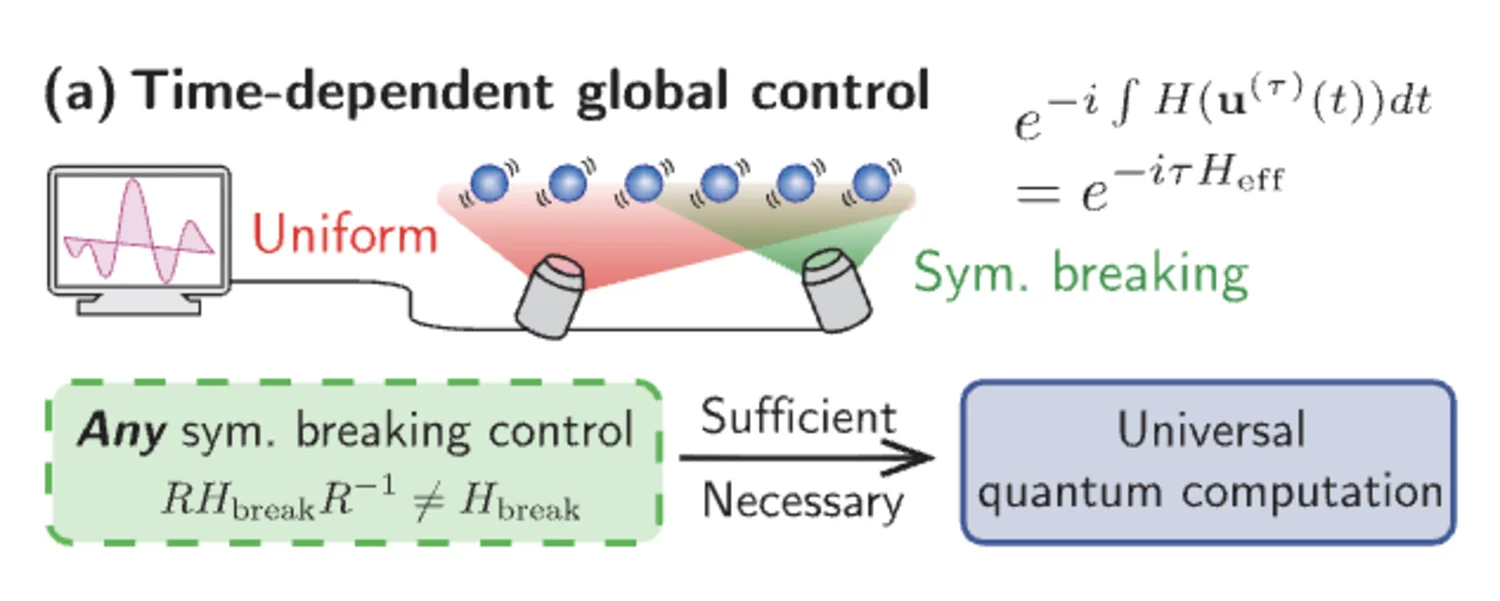
Physicist Hongye Hu and collaborators are set to publish a paper in Nature Physics (currently available as a preprint), demonstrating the successful induction and coherent control of strongly interacting three-body interactions in a Rydberg neutral-atom array, achieved solely via global electromagnetic microwave pulses combined with lattice geometric inversion symmetry breaking[48].

Conventional neutral-atom quantum computing relies heavily on individual-qubit optical addressing lasers; as systems scale to thousands of atoms, calibration complexity and optical spot crosstalk across independent laser pathways become engineering bottlenecks to chip scaling. This work demonstrates from topological dynamics that illuminating the array with a single spatially unresolved global microwave field alongside broken symmetry suffices to traverse the Hilbert space and achieve universal quantum control[48]. Benchmarked against the SOTA baseline of Harvard University's single-site focused two-qubit gates achieving 99.5% fidelity, this addressability-free scheme remains in the low-order dynamical exploration stage with lower multi-body gate fidelities; its core contribution lies in proving the theoretical feasibility of universal entanglement control without localized addressing lasers[48]. This theory challenges the technical dogma that ultra-large-scale quantum arrays must feature thousands of independent laser control channels, pointing toward a radically simplified optical path design for large-scale neutral-atom quantum simulators[48].

A condensed-matter physics team observed topologically protected chiral phases and massless chiral fermion excitations for the first time in an amorphous metallic solid entirely lacking long-range lattice periodicity[6].

The physics community long held that topologically non-trivial states strictly required crystalline point group symmetries. This finding proves that even in spatially disordered metallic glasses, dissipationless edge state conduction channels can stably persist via short-range orbital entanglement[6]. This provides an entirely new physical foundation for fabricating low-cost, self-healing, fault-tolerant topological electronic devices without requiring expensive, ultra-high-purity single-crystal growth[6].

Scientists at the SLAC National Accelerator Laboratory in the U.S. utilized proprietary high-energy synchrotron resonant X-ray scattering techniques to capture definitive evidence of altermagnetism (a third branch of magnetism combining zero stray fields with strong spin polarization) in solid crystals, confirming this novel magnetic phase distinct from conventional ferromagnetism and antiferromagnetism[16].

Altermagnetism macroscopically exhibits the extreme stability of antiferromagnets with zero stray magnetic field, while microscopically displaying the large spin-polarization splitting characteristic of ferromagnets, reconciling undisturbed information storage with high-sensitivity readout[16]. This discovery provides an ideal material candidate for developing ultra-high-density non-volatile quantum spin memories and low-crosstalk flux switches for superconducting qubits[16].

Fundamental Physics Tests and Dynamical Simulations

The KM3NeT International Deep-Sea Neutrino Telescope Collaboration released its latest physical measurement data. By conducting detailed spectral and oscillation path inversions on 5,828 ultra-high-energy atmospheric neutrino events recorded by deep Mediterranean seabed detectors, the team imposed the world's most stringent experimental constraints to date on Planck-scale Lorentz invariance violation[8].

The data indicates that at extreme limits approaching the Planck energy, Einstein's special relativity local spacetime symmetry remains exceptionally robust, once again tightening the upper limit on momentum dispersion parameters induced by potential quantum spacetime foam effects by nearly an order of magnitude[8]. This result effectively rules out dozens of candidate phenomenological quantum gravity theories, narrowing the mathematical landscape for theoretical physicists constructing grand unified theories of quantum gravity[8].

A theoretical physics team proposed a neural-network predictive method for quantum spin many-body evolution that bypasses traditional partial differential equation time-step numerical integration, achieving a 5th percentile fidelity of 0.9947 across 24 consecutive driving cycles under strong periodic driving configurations[22].

This approach circumvents the exponential truncation errors that accumulate rapidly over time in classical numerical simulations, enabling ultra-fast, precise inversion of strongly driven many-body spin dynamics on classical computers[22]. This delivers a nanosecond-scale feedforward closed-loop compensation algorithm for underlying microwave control pulse waveforms in trapped-ion and superconducting quantum processors, helping suppress phase drift caused by long pulse sequences[22].

An optical team utilized a two-photon entangled source generated via spontaneous parametric down-conversion (SPDC, where high-energy photons split into entangled pairs) to achieve high-spatial-resolution imaging of internal zebrafish larval tissue using conventional silicon-based single-photon avalanche detectors—without directly detecting 1550 nm infrared photons—reaching a record dimensionless resolution metric of approximately 1460[19].

This overcomes the engineering barriers of infrared detectors, which suffer from high dark current noise and require costly cryogenic cooling, enabling room-temperature, low-cost silicon chips to achieve high-definition, non-destructive imaging of living organisms at telecommunication wavelengths. It removes hardware roadblocks for quantum ghost imaging to enter medical microscopy and non-destructive wafer defect inspection[19].

Theoretical physicists studying the statistical mechanics of random quantum systems proposed an analytical criterion to disentangle and reconstruct intrinsic quantum random distribution fingerprints from external environment-induced decoherence, successfully resolving mixed-state density matrix evolution under intertwined random scrambling and external dissipation[3]. This criterion provides a rigorous analytical tool for quantum chaos research in open systems, as well as a theoretical filtering model for noisy quantum processors to distinguish intrinsic system infidelity from external Markovian noise[3].

An ultrafast optics team discovered that using a pair of precision-clock-tuned ultrashort laser pulse trains nonlinearly amplifies the coherent motion of atomic layers in quantum crystalline materials, thereby directionally modulating lattice structures and electronic band structures on femtosecond timescales[4]. This method confirms that pulse shaping excites coherent phonon modes with lower thermal damage compared to single pulses, providing a novel control modality for designing low-energy optically controlled superconducting states and ultrafast solid-state quantum switches[4].

06Impact

Today's Impact

  1. Enterprise Cybersecurity and IT Infrastructure Giants

- Who is affected: Multinational enterprise CISOs, financial and government cloud infrastructure providers.

- What changed: IonQ's $1.15 billion full acquisition of Elisity[13] marks post-quantum defense moving beyond theoretical demonstrations into deep commercial integration with enterprise zero-trust microsegmentation networks; concurrently, IDEMIA and Orange launched single-SKU smart cards with factory-grade quantum resistance[23], and Ethereum locked in its 2028 quantum-resistant hard fork timetable[27]. Quantum-resistant retrofits have shifted from "a compliance vision five years out" to mandatory selection criteria incorporated directly into current fiscal-year procurement budgets.

- What to watch next: Keep a close eye on Orange's quantum-resistant eSIM live-network interoperability test performance on smart devices at electronica in Munich in mid-November 2026[23], and whether major public blockchain platforms accelerate timelines to match Ethereum's quantum-resistant hard fork roadmap[27].

  1. Fault-Tolerant Quantum Computing Hardware Developers

- Who is affected: Mainstream quantum hardware vendors and academic teams including IBM, Google, Quantinuum, and QuEra.

- What changed: IBM and QuICS open-sourced over 500 high-efficiency magic-state factory models[11], which, alongside IonQ's published full-stack resource accounting methodology[2], shifts the evaluation benchmark for fault-tolerant quantum hardware from isolated debates over magic-state overhead to comprehensive full-stack accounting encompassing physical connectivity, control latency, and wiring thermal loads. Concurrently, commercial CMOS lines successfully fabricated superinductors[5], and neutral-atom strontium trap coherence lifetimes broke through to 2 hours[28], systematically addressing physical scaling bottlenecks across hardware modalities.

- What to watch next: Observe whether market leaders like Google and Quantinuum launch physical benchmark comparisons against IBM's open-sourced magic-state factory topologies[11], and whether cryogenic neutral-atom platforms can demonstrate parallel entangling gates with over 99.5% fidelity within the 2-hour extended lifetime window[28].

  1. Industrial Simulation Software and Operations Research End Users

- Who is affected: New energy vehicle manufacturers, meteorological disaster early warning agencies, and biopharmaceutical/chemical advanced materials enterprises.

- What changed: Meteorological cloud droplet microphysics simulations achieved logarithmic qubit compression[26], TuringQ effectively suppressed chaotic turbulent divergence using photonic priors[20], PsiQuantum accelerated porous material adsorption simulations with fractal circuits[24], and D-Wave upgraded its hybrid solver to improve convergence speeds for assembly line scheduling[15]. Quantum algorithms are shedding conceptual physical toy models to penetrate tangible industrial scenarios, including discrete assembly scheduling, solid-state electrolyte screening, and extreme weather numerical modeling.

- What to watch next: Closely track quantified validation data on production-line cost reductions, operational efficiencies, and material screening disclosures released by industrial giants such as Volkswagen and BASF utilizing D-Wave's Stride solver[15] or PsiQuantum's Construct platform[24].

  1. Deep-Tech Venture Capital and Capital Markets

- Who is affected: Hard-tech VC firms, public-market quantum stock investors, and private equity M&A funds.

- What changed: IonQ's billion-dollar M&A transaction[13] reshaped secondary-market valuation models for quantum computing, proving that quantum companies can construct resilient cash-flow moats by horizontally integrating mature cybersecurity assets. Meanwhile, Europe's EIC mobilized €4 billion in deep-tech financing[43], and China's Guoce Quantum closed a Pre-B round exceeding RMB 100 million[45], illustrating a resilient tripolar global quantum landscape across the US, China, and Europe capable of sustained, counter-cyclical capital formation.

- What to watch next: Monitor the actual financial proportion of cybersecurity subscription revenues in IonQ's quarterly earnings reports following the consolidation of Elisity[13], as well as subsequent IPO tutoring and production ramp-up progress among domestic precision measurement leaders[45].

07Other

Editorial Commentary

As 2026 draws to a close, the quantum computing industry is undergoing a profound paradigm shift at its foundational layer. For years, academia and capital markets evaluated quantum roadmaps through a single-dimensional technical tournament—obsessing over how many nines followed the decimal point in gate fidelity or when physical qubit counts would breach the thousand-qubit threshold. Yet, as commercial CMOS lines successfully fabricate core superconducting superinductor components and cryogenic vacuum chambers push neutral-atom lifetimes past two hours, the competitive axis of hardware evolution is quietly pivoting from "laboratory proof-of-principle breakthroughs" to "wafer foundry yields and industrial uptime." Concurrently, algorithmic resource accounting is abandoning the narrow focus on abstract logical gate counts, incorporating data routing congestion, decoding latency, and dilution refrigerator thermal dissipation as co-equal constraints within a full-stack framework. This signals that fault-tolerant quantum computing has definitively departed from whiteboard theory, entering a mature phase of precise engineering blueprints and system-level constraint trade-offs.

On the commercial front, the execution of a billion-dollar cybersecurity acquisition sends an unambiguous message to the broader high-tech investment community: in the marathon toward one million physical qubits and large-scale fault-tolerant code-breaking, narrative bubbles predicated solely on distant R&D subscriptions and government grants are deflating. Whether through Ethereum formalizing a hard-fork defensive timetable or telecom giants baking quantum-resistant root certificates directly into factory silicon, post-quantum cybersecurity defense has emerged as today's most tangibly monetizable cash-flow moat. For researchers and capital allocators alike, the post-PoC playbook is unmistakable: only teams capable of bridging the manufacturing gap to existing semiconductor foundry ecosystems while monetizing long-term computing disruption into near-term enterprise security cash flows will smoothly navigate the commercial deep waters of this technological marathon.