Nov 7, 2026 – Nov 8 · Daily Brief

Measured Quantum Error Rate Drops by 14%, Moving One Step Closer to Practical Application

10 items · 6 sourcesPDFThis issue's roundup is free
02Hardware

Hardware Frontiers

Neutral Atom Arrays & Ultrafast Optical Field Control

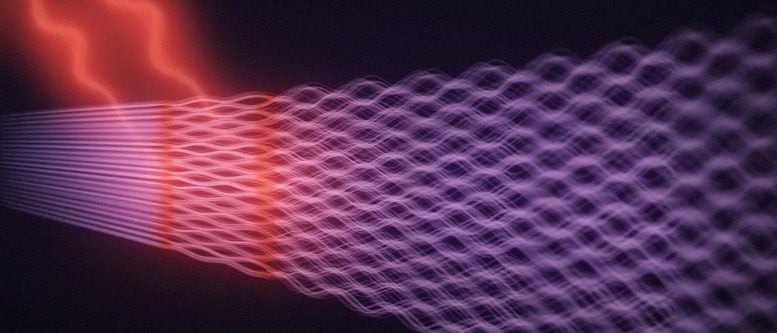
Following recent preliminary discussions on anomalous damping phenomena in strong laser fields, a research team disclosed the latest quantitative observation data on microscopic transitions on November 9, 2026 (Beijing Time), confirming that laser pulses can control atomic layer motion in quantum materials[9].

Physicists discovered an intrinsic quantum measurement limit for electrons at extreme spatiotemporal scales on November 8, 2026 (Beijing Time), confirming that non-commuting correlations across spatial and temporal dimensions constrain the minimum spread envelope of electron wave packets—a breakthrough that could pave the way for electronic devices with response speeds up to 100,000 times faster than current levels[6]. At the attosecond (10⁻¹⁸ s) timescale and angstrom (10⁻¹⁰ m) spatial scale, this advance resolves for the first time in a fully coherent state the quantum coherent transition extremes of charge carriers at solid-state interfaces, bypassing the gigahertz (GHz, billion hertz) operating clock barrier of conventional semiconductors constrained by phonon scattering and picosecond (10⁻¹² s) thermal dissipation.

Silicon Spin Chips & Integration Processes

Silicon quantum chip startup Equal1 appointed a veteran semiconductor foundry executive as Vice President of Engineering Operations on November 8, 2026 (Beijing Time) to fully lead advanced-node tape-outs and commercial delivery pipelines for its fully integrated quantum SoC (System-on-Chip)[4]. SOTA Benchmarking: The current publicly acknowledged best two-qubit gate fidelity for the spin quantum dot approach is 99.99% achieved by Australia's SQC team in December 2025 and over 99% measured by the Diraq team on a 300 mm fab line. However, the core focus of Equal1’s roadmap is not solely pursuing peak gate fidelity, but exploring the monolithic integration of qubit arrays and cryogenic CMOS (the mainstream semiconductor manufacturing process) control logic on the same silicon die. The critical bottleneck toward fault-tolerant operation remains its operational fidelity hovering between 98% and 99%—lagging mainstream SOTA error rates by approximately an order of magnitude—and it has yet to demonstrate fault-tolerant encoded logical error correction operations. This executive appointment will accelerate the engineering integration of spin chips with mature commercial foundry processes, creating substitution pressure over the next 1 to 2 years on superconducting control system supply chains centered on discrete cryogenic microwave cabling.

03Algorithms

Algorithms & Software

Surface Code Error Correction & Complexity Theory Boundaries

UK-based quantum error correction company Riverlane demonstrated a data-driven Detector Error Model (DEM, a graph-theoretic model characterizing statistical correlations between error correction syndromes and physical noise) augmentation technique on November 9, 2026 (Beijing Time). By reverse-mining unmodeled spatiotemporal correlated errors from real syndrome measurement data, the technique reduced surface code logical error rates by 14% in physical quantum chip benchmarks and up to 75% in numerical simulations[3]. SOTA Benchmarking: The currently accepted gold standard for surface code error suppression factor is Google's Willow system with Λ ≈ 2.1 (exponential decay in logical error rate as code distance increases from d=3 to d=7). Traditional error-correction schemes generally rely on preset, uncorrelated independent Pauli error graphs, causing decoders to systematically overestimate or mismatch when facing non-Markovian noise in hardware. Riverlane’s innovation requires no underlying hardware modifications; purely by using measurement stream data to update decoding hypergraph weights online, it achieved a 14% logical error reduction on physical hardware. However, this method remains limited to small-to-medium code distances and still lacks global suppression capabilities against widespread, multi-qubit instantaneous crosstalk triggered by high-energy cosmic ray events. This milestone directly empowers superconducting and neutral-atom full-stack teams pursuing the surface code roadmap and is expected to be integrated into FPGA (Field-Programmable Gate Array) and ASIC (Application-Specific Integrated Circuit) real-time decoding hardware via firmware in 2027, pushing industry-wide logical qubit error correction overhead closer to practical thresholds.

A team of theoretical computer scientists officially presented a rigorous mathematical proof of the Aaronson-Ambainis conjecture using automated reasoning and deduction systems on November 8, 2026 (Beijing Time), establishing a fundamental theorem in Boolean function analysis and computational complexity theory showing that low-degree polynomials on the Boolean hypercube must contain highly influential variables with high sensitivity[5]. This proof closes the theoretical gap between quantum query complexity and classical polynomial degree from first mathematical principles for the first time, rigorously demonstrating that in any black-box setting, the speedup of quantum algorithms computing polynomial properties is strictly bounded by classical polynomials, completely eliminating the possibility of quantum computing achieving exponential speedups over classical algorithms in unstructured black-box search. This work settles a 17-year-old complexity hypothesis debate in the theoretical community, shifting algorithm researchers' focus from unrealistic generic black-box speedups toward cryptanalysis and physical simulation algorithms featuring specific hidden algebraic structures, reshaping algorithmic funding priorities for sovereign R&D funds over the next 3 to 5 years.

04Industry

Industry & Ecosystem

Regional Testbed Incubation & Core Target Valuations

The Company Lab (CO.LAB) in Chattanooga, Tennessee, officially launched the inaugural CO.LAB Q Commercialization Studio on November 8, 2026 (Beijing Time), accepting four quantum startups—RidgeQuantum, Superquantum, esoteriq, and Kottackal Business Solutions—to kick off a 12-month industrial technology incubation cycle[2]. Leveraging the commercial metropolitan quantum network operated by the local Electric Power Board of Chattanooga (EPB), the program allows selected startups zero-CapEx access to live, operational metro fiber quantum nodes and testbeds, advancing startups from prototype validation to on-site client delivery within the 12-month program. This initiative establishes a municipal infrastructure-driven quantum incubation paradigm, directly positioning selected companies to compete for regional power grid secure communications and distributed sensing contracts in the second half of 2027, creating a locational competitive moat against competitors lacking access to local public testbeds.

Inside Quantum Technology (IQT), in its Sunday Special mainstream media roundup published on November 8, 2026 (Beijing Time), cited reports suggesting that a market-overlooked publicly traded quantum company's stock could surge by over 100% (doubling its valuation)[1]. The coverage shifts the valuation focus for quantum hardware companies from mere physical qubit scaling to recurring cloud compute service revenue and the cost-efficiency ratio per logical error-corrected qubit, reflecting how buy-side capital, after moving past conceptual hype, is establishing a new valuation metric centered on commercial revenue-generation capabilities. This assessment effectively remedies the public capital market's liquidity pricing discount on secondary-market quantum technology stocks, and is expected to guide more deep-tech long-horizon hedge funds and sovereign pension funds to increase allocation exposure to full-stack hardware players in Q4 2026.

Canadian quantum security vendor Quantum eMotion, hybrid quantum compute startup Qtonic Quantum, the Chicago Quantum Exchange (CQE), and Ireland-based Equal1 announced a flurry of core executive appointments on November 8, 2026 (Beijing Time), bringing in senior leaders responsible for semiconductor volume manufacturing, global business development, and academic-industry technology transfer[4]. Executive profiles broadly exhibit a transition from "academic laboratory scientists" to "industry veterans experienced in mature semiconductor foundry operations," signaling that participating companies are shifting their strategic focus from scientific feasibility validation toward scaled volume production and customer cash-collection management. This development will accelerate commercial adoption of QRNG (Quantum Random Number Generator) hardware modules in financial communication terminals and is expected to drive convergence of quantum-safe hardware certification standards across North America and Europe over the next 6 to 12 months.

05Other

Academic Frontiers

Relativistic Many-Body Simulation & Foundational Complexity Theory

A multinational collaborative experimental team published experimental and theoretical computational findings on November 9, 2026 (Beijing Time), observing and confirming for the first time that Einstein's special relativity effects create novel covalent configurations in heavy-element polyatomic molecules that break conventional chemical bonding rules[10]. In superheavy element molecular orbitals, strong relativistic effects cause core electrons to travel at a significant fraction of the speed of light, inducing pronounced relativistic mass increases and spin-orbit splitting.

In the process of tackling the Aaronson-Ambainis conjecture, the theoretical research team disclosed relevant theoretical progress on Scott Aaronson's personal blog on November 8, 2026 (Beijing Time)[5], presenting a quantitative inequality for the maximum derivative of arbitrary bounded polynomials in Boolean hypercube analysis[5]. This achievement establishes a novel mathematical tool at the intersection of functional analysis and theoretical computer science. It not only strictly anchors the lower bound of quantum query complexity to polynomial degrees, but also completely clarifies the reachable boundaries between the classical randomized algorithm model BPP (Bounded-error Probabilistic Polynomial time) and the quantum computing model BQP (Bounded-error Quantum Polynomial time) in an oracle (black-box) setting. This conclusion clarifies the theoretical limits of quantum speedup under unstructured black-box models, leading global cryptography standardization bodies to focus post-quantum cryptographic (PQC) defense designs more heavily on the lattice-based cryptographic security of non-polynomial structures.

06Impact

Today's Impact

  1. Fault-Tolerant Surface Code Full-Stack Teams & Hardware/Software Integrators: Riverlane reduced surface code logical error rates by 14% using empirical syndrome data[3], overturning the theoretical assumption that decoders must rely on ideal, uncorrelated Pauli noise models. Next, focus on the end-to-end physical hardware validation of its data-driven detector error model on Google's Willow superconducting processor, particularly its empirical boost to the error suppression factor Λ.
  2. Secondary Market Quantum Technology Investors & Deep-Tech Fund Managers: An IQT investment column presented strong upside expectations of over 100% for undervalued quantum targets[1], shifting the public capital markets' pessimistic consensus regarding overly long profitability cycles and weak revenue generation among hardware firms. Next, closely track upcoming Q4 institutional ownership filings and recurring cloud compute contract renewal rates across public companies.
  3. Early- to Mid-Stage Quantum Deep-Tech Startups & Regional Ecosystem Builders: Chattanooga's CO.LAB Q launched incubation for its inaugural cohort of four startups[2], breaking the dilemma where early-stage startups had to rely on capital-intensive proprietary test infrastructure. Next, monitor whether commercial validation use cases for energy grids can be successfully demonstrated over the live EPB metropolitan quantum network within the 12-month timeframe.
  4. Cryptographers & Quantum Algorithm Theoreticians: The full proof of the Aaronson-Ambainis conjecture[5] dispels longstanding ambiguities and wishful thinking regarding black-box quantum speedups, clearly defining the theoretical upper bound for unstructured query speedup. Next, track whether PQC (Post-Quantum Cryptography) evaluation bodies will accordingly tighten structural security standards for post-quantum cryptographic algorithms.
  5. Industrial Drug Discovery & Advanced Materials Simulation Divisions: The discovery of anomalous chemical bonding induced by relativistic effects[10] challenges traditional computational chemistry paradigms that over-rely on classical density functional theory, establishing strongly correlated heavy-element many-body systems as high-value targets for quantum simulation. Next, observe whether leading multinational pharmaceutical and nuclear energy giants begin routine procurement of quantum chemistry simulation cloud compute in their 2027 R&D budgets.
07Other

Editorial Review

From foundational algorithmic refinements to evolving hardware architectures, the quantum computing industry is undergoing a profound paradigm shift from "conceptual sprints" to "engineering accountability." For years, academia and industry have pursued higher physical qubit counts under idealized assumptions; however, non-Markovian noise and spatiotemporal correlated crosstalk in real-world hardware environments often substantially erode nominal physical metrics when translated into logical fidelity. The evolution of data-driven error correction models demonstrated by Riverlane clearly illustrates that without disruptive wafer redesigns, reverse-extracting real correlated errors directly from physical hardware measurement streams is sufficient to slash logical error rates by over 10% on physical chips. This cost-effective path of extracting error-correction performance from classical statistical inference is redefining the capital and temporal cost required for the industry to cross the fault-tolerance threshold.

Concurrently, the settling of foundational mathematical theory and the tangible emergence of regional commercial ecosystems are purging speculative hype and cementing hard-core value. The rigorous establishment of theoretical boundaries ends irrational fantasies about quantum speedup capabilities, refocusing algorithm R&D on physically grounded, high-value challenges. Meanwhile, the deployment of local public network testbeds and the appointment of industry veterans to executive suites signal that the technology is accelerating its integration into traditional infrastructure and standardized semiconductor supply chains. Future competition will no longer be dictated by grand narratives or inflated specifications; those who can execute high-value industrial benchmark problems with the lowest error-correction overhead, and achieve commercial revenue-generating loops within real-world infrastructure first, will stand firm in the post-hype industry shakeout.