Nov 8, 2026 – Nov 9 · Daily Brief

Post-quantum encryption and decryption reaches 90G per second, eliminating network latency

40 items · 9 sourcesPDFThis issue's roundup is free
02Hardware

Hardware Frontiers

Neutral Molecules and Ultracold Atoms

Researchers at institutions including Harvard University achieved a two-qubit entangled state fidelity of 97.6% in a laser-cooled calcium monofluoride (CaF) polar molecule system, breaking the world record for directly laser-cooled molecular platforms[25]. Technical implications: benchmarked against current hardware state-of-the-art (SOTA) baselines, this result pushes polar molecule entanglement metrics close to the operational regime, but a gap remains compared to trapped-ion SOTA (IonQ's reported single-pair entanglement fidelity of 99.99%, Quantinuum's commercial all-to-all pair fidelity of 99.921%), and it trails neutral-atom Rydberg state systems (Harvard's parallel controlled-Z gate fidelity of 99.5%); it still lacks the millisecond-scale fast gate operations and the engineering closed loop of optical tweezer arrays continuously reloading lost atoms required to reach the surface code (the mainstream fault-tolerant topological error correction code) threshold (typically requiring >99%). Landscape impact: polar molecules possess rich vibrational and rotational internal energy levels, making them natural carriers for many-body condensed-matter simulations; however, slow gate operations make it difficult to challenge the dominance of superconducting and trapped-ion architectures in general-purpose fault-tolerant quantum computing in the near term.

An international research team utilized quantum destructive interference to stably maintain a molecular bound state above the dissociation threshold in an ultracold lithium-6 atom system, effectively concealing it within the scattering continuum[4]. Technical implications: this experiment represents the first use of destructive interference to block open decay channels in the continuum, overcoming the conventional constraint that weakly bound molecules spontaneously collapse once exceeding the dissociation energy, thereby providing a brand-new discrete coherent state for many-body physics simulation. Landscape impact: this control method expands the interaction tuning dimensions of ultracold neutral atom quantum simulators and provides a precision tool for investigating strongly correlated fermionic many-body physics.

Silicon Spin Quantum Computing

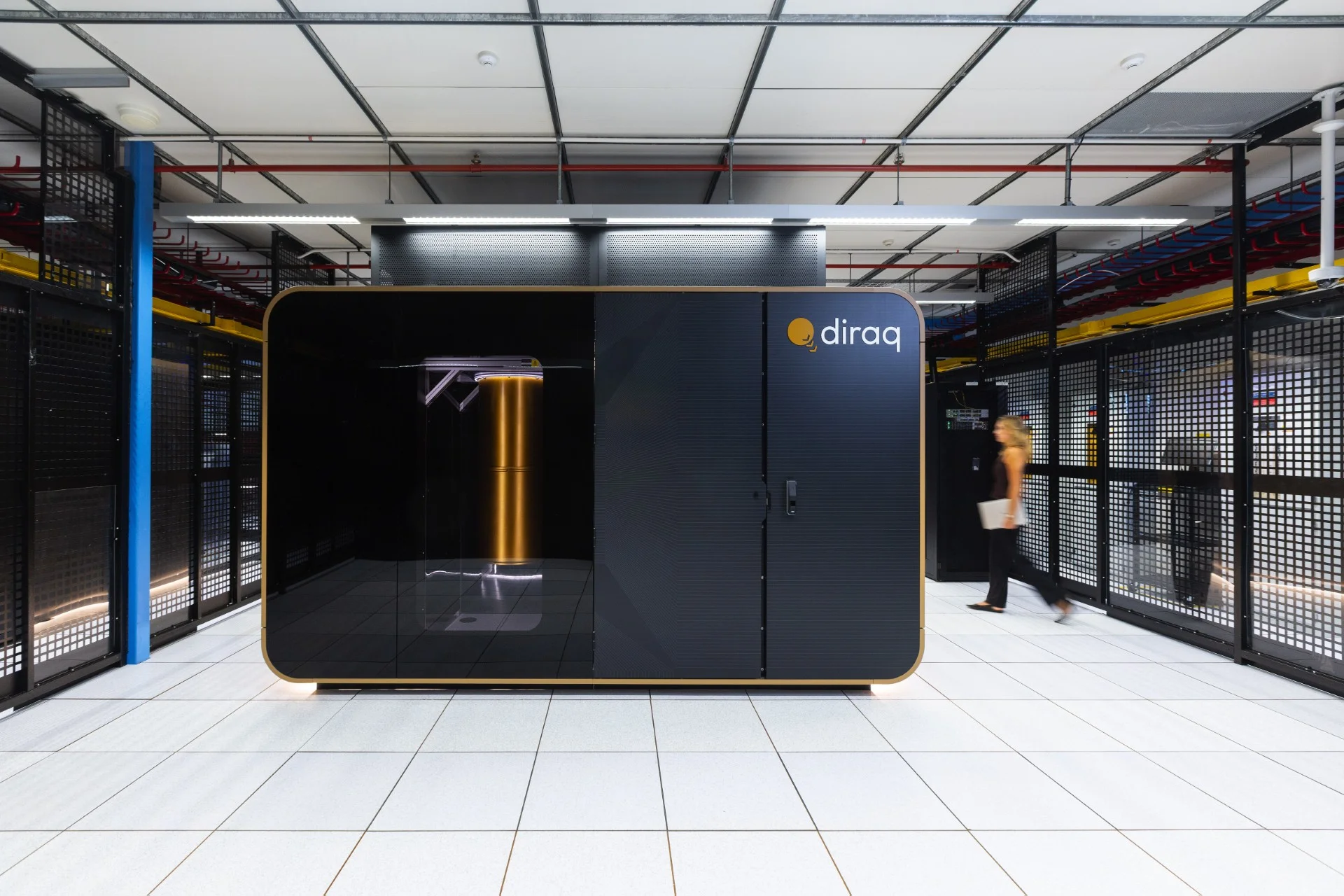
Following earlier reports of silicon spin chip wafer manufacturing progress, Australia's Diraq announced the on-site full-system installation, deployment, and operational launch of the world's first silicon spin quantum computer inside an Equinix (NASDAQ: EQIX) commercial data center in Sydney, concurrently releasing an industry application white paper[32]. Technical implications: compared to spin quantum dot SOTA baselines (SQC's atomic-precision donor qubit two-qubit gate fidelity reaching 99.99%, Diraq's earlier spot tests on 300 mm wafers reaching 99% and 98.92% at 1 Kelvin), this full-system deployment validates the engineering compatibility of spin systems fabricated on mature CMOS (complementary metal-oxide-semiconductor) lines operating at shallow cryogenic temperatures above 1 Kelvin; however, the system's physical qubit count currently remains at the order of ten qubits (the industry's highest characterized array is 1,024 quantum dots), and full-system gate fidelity distributions under concurrent operation as well as logical error correction verification data have not yet been disclosed. Landscape impact: traditional colocation hosting giants are officially embracing commercial dilution refrigerators, sparing enterprises the prohibitive capital expense of building custom ultra-low-temperature facilities and accelerating the practical deployment timeline of hybrid quantum-classical computing to within three years.

A team led by Prof. Haipeng Lu at the Hong Kong University of Science and Technology developed a novel chiral perovskite multiple-quantum-well system, extending electron spin polarization lifetime at room temperature by approximately 300 times compared to conventional semiconductor materials[23]. Technical implications: by utilizing the chiral-induced spin selectivity (CISS) effect of the microstructure and bandgap engineering, this approach effectively suppresses spin-flip scattering caused by room-temperature lattice thermal vibrations, overcoming the coherence bottleneck where solid-state spin materials cannot sustain extended spin states at room temperature without a magnetic field. Landscape impact: this progress significantly reduces the reliance of spintronic devices on ultra-low-temperature cryogenic cooling equipment, opening a new material pathway for low-power room-temperature spin memories and all-optical spin logic chips.

Hybrid Superconducting and Semiconductor Architectures

Physics Reports published a review paper systematically evaluating hybrid quantum computing architectures combining semiconductor materials and superconductors, including gate-tunable transmons, fluxoniums, Andreev level qubits, and Majorana parity qubits[10]. Technical implications: hybrid architectures enable native voltage tuning of qubit transition frequencies via electrostatic fields, circumventing the strong magnetic field crosstalk of traditional superconducting flux loops and offering intrinsic topological noise-resilience potential; however, high dielectric losses at material heterostructure interfaces cause coherence time T1 to generally lag behind pure superconducting SOTA baselines (Google Willow superconducting devices achieve T1 ~100 µs). Landscape impact: R&D entities deeply invested in topological and hybrid routes, such as Microsoft, continue to regard this as a long-term candidate pathway for achieving high-density integration and low-power on-chip control, though process maturity is still expected to take 5 to 10 years.

Singapore's Horizon Quantum Computing integrated its Triple Alpha integrated development environment (IDE) with Oxford Quantum Circuits' (OQC) 32-qubit Toshiko superconducting processor, enabling pulse-level direct orchestration and automated gate calibration on the underlying hardware[13]. Technical implications: compared to superconducting SOTA baselines (IBM Nighthawk with 120 physical qubits, Google Willow at 105 qubits achieving below-threshold surface code), OQC's 32-qubit coaxial architecture is at a validation scale; open pulse-level interfaces allow developers to directly shape microwave waveforms to suppress decoherence and correct neighboring qubit crosstalk, exemplifying a typical pathway of compensating for hardware gate fidelity limitations through low-level software optimization. Landscape impact: superconducting hardware services are breaking away from the traditional black-box execution model, providing independent third-party software vendors with commercial interfaces for deep firmware calibration and low-level compiler testing.

Semiconductor equipment manufacturer EV Group (EVG) announced wafer-level advanced packaging and ultra-low-temperature 3D bonding integration process solutions tailored for multi-qubit quantum chips, supporting high-density interconnects and superconducting flip-chip bonding[39]. Technical implications: this process addresses the coefficient of thermal expansion (CTE) mismatch and microwave loss challenges in stacking multi-layer superconducting chips at cryogenic temperatures, offering standardized wafer-level packaging support for superconducting and silicon spin chips to overcome the hundred-qubit wiring bottleneck. Landscape impact: a traditional high-end semiconductor packaging equipment giant entering the dedicated quantum supply chain accelerates the standardization of chip foundry ecosystems and lowers tape-out, packaging, and testing barriers for emerging quantum chip startups.

Quantum Sensing and Precision Measurement

Experimental physicists have fabricated the fastest-spinning micro-levitated rotating magnet to date, completely eliminating mechanical contact friction via magnetic levitation and constructing an ultra-low-noise quantum sensing system in cryogenic environments[5]. Technical implications: by highly sensitively coupling macroscopic spin angular momentum with weak external force fields, the system achieves ultra-high sensitivity detection of minute magnetic fields and mechanical perturbations, setting a new physical sensitivity record for levitated micro-objects probing weak interactions. Landscape impact: this technique provides a brand-new experimental tool for precision searches of dark matter candidate particles and ultra-high-precision passive gyroscopic navigation.

A team at Columbia University upgraded their stroboscopic scattering microscopy (stroboSCAT) system, using stroboscopic lasers to directly visualize energy flow processes of electrons and microscopic quasiparticles inside quantum materials[2]. Technical implications: by directly capturing non-equilibrium quasiparticle migration and diffusion trajectories at simultaneous nanosecond and nanometer spatiotemporal resolutions, the apparatus eliminates uncertainties inherent in traditional indirect spectral inversion. Landscape impact: this tool provides an intuitive microscopic characterization instrument for probing high-temperature superconductivity mechanisms and troubleshooting interfacial energy dissipation inside novel quantum dot materials.

Researchers developed a high-precision correlated measurement method based on optical response fingerprints to rapidly identify different atomic-scale point defect structures inside quantum materials[3]. Technical implications: the study maps the microscopic lattice distortions of single-spin luminescent defects one-to-one to their emission spectral signatures, resolving the long-standing spectral overlap challenge in locating and classifying quantum spin defects. Landscape impact: this technique will directly serve industrial-grade non-destructive quality inspection and sorting workflows for solid-state single-photon sources and diamond color-center quantum sensors.

Researchers at Tokyo Metropolitan University discovered in single-walled carbon nanotubes that trions (charged quasiparticles composed of two electrons and one hole) exhibit specific optical rotation responses directly determined by structural chirality[6]. Technical implications: the experiment confirms for the first time that charged trions obey robust chiral optical selection rules, achieving deterministic control over the angular momentum states of 1D carrier complexes via polarized light. Landscape impact: this finding provides a novel physical mechanism for developing nanoscale polarized single-photon devices and chiral quantum light sources.

03Algorithms

Algorithms and Software

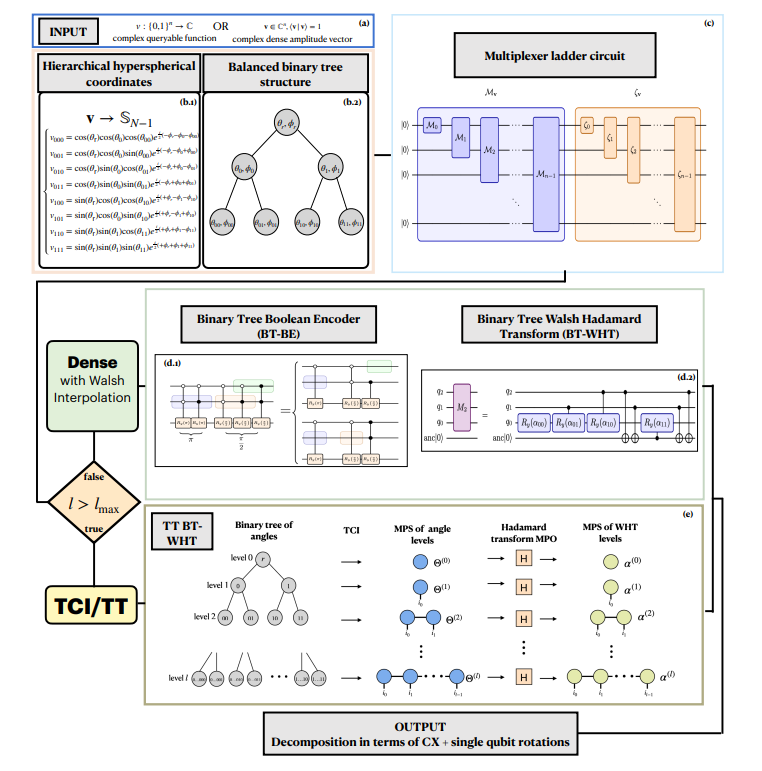
A team from the German Aerospace Center (DLR) and the University of Cologne proposed a scalable unitary data encoding scheme combining tensor networks, Boolean logic simplification, and Walsh-Hadamard transforms, reducing classical data loading circuit depth to sublinear order and validating it on a 20-qubit physical system[11]. Technical implications: this approach breaks the theoretical barrier where circuit depth exponentially explodes with data size during classical data loading into quantum states, significantly compressing initial state preparation time and gate error accumulation in NISQ (noisy intermediate-scale quantum) algorithms. Landscape impact: the scheme removes the input-side bottleneck for data-intensive computations such as fluid dynamics PDE solvers and financial derivative Monte Carlo sampling, substantially advancing the practical application timeline.

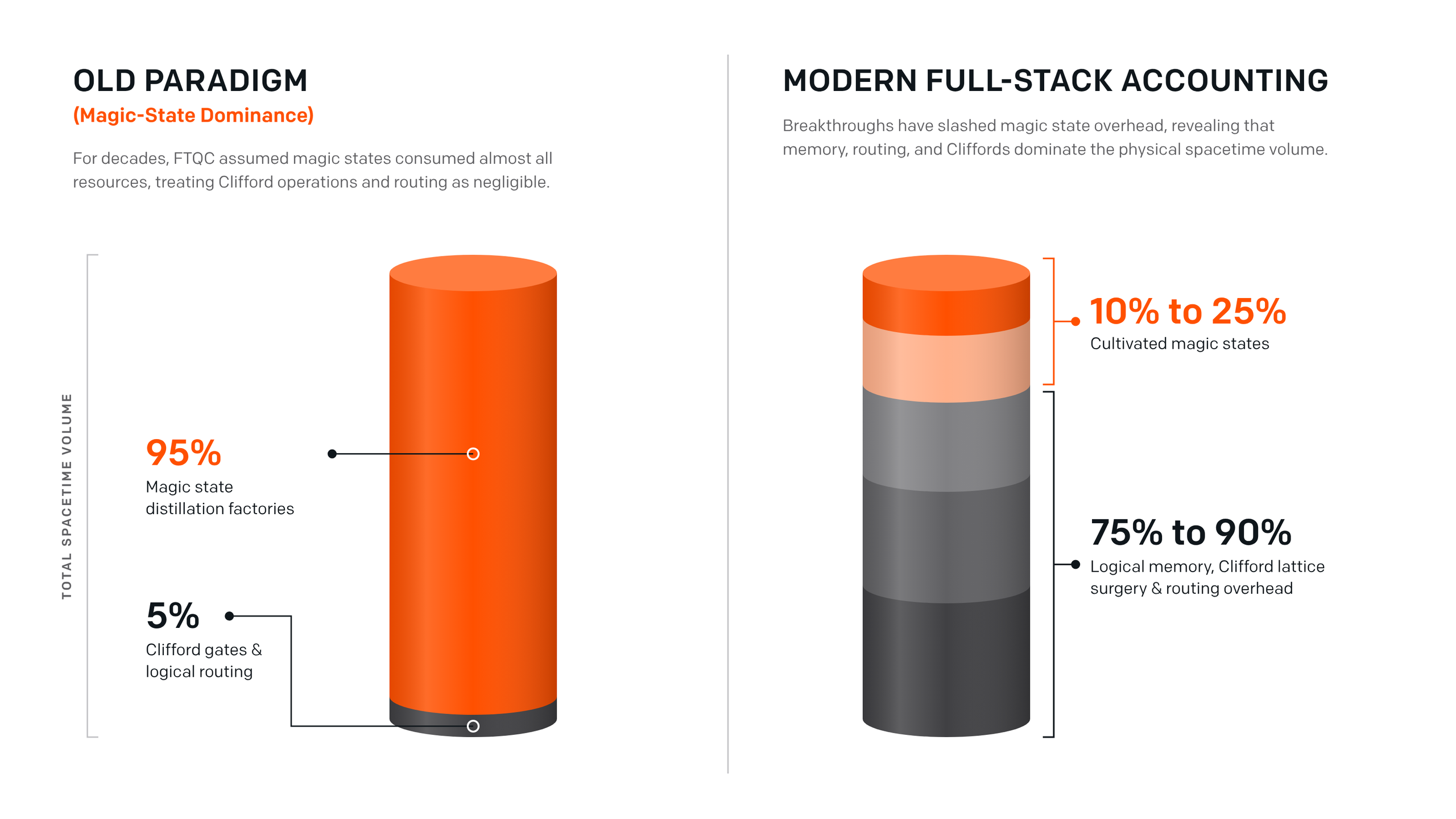
Following their earlier preliminary resource estimation report, trapped-ion hardware vendor IonQ and quantum software company Classiq jointly released updated resource estimates for fault-tolerant quantum computing, establishing that the count of non-Clifford gates (high-overhead universal quantum gates) is no longer the primary bottleneck governing overall system performance; instead, physical spacetime volume is dominated by qubit routing, Clifford gate execution, and memory coherence time[12]. Technical implications: thanks to algorithmic optimizations in magic state distillation (protocols for purifying high-fidelity logical states), the focus of fault-tolerant compilation has shifted from solely minimizing T-gate counts to a holistic spacetime volume optimization that balances physical chip geometry, communication congestion, and error correction cycles. Landscape impact: this compels full-stack compiler development to pivot toward layout and routing optimizations deeply tied to physical hardware topologies, further highlighting the theoretical advantages of trapped-ion architectures in all-to-all connectivity routing while placing higher optimization demands on routing compilers for grid-topology superconducting chips.

Following earlier reports of automated deduction systems generating proof steps, a Stanford University research team, through rigorous derivation and logical verification, officially confirmed that the 18-year-standing Aaronson-Ambainis conjecture has been fully proven as a mathematical theorem[16]. Technical implications: this theorem establishes the intrinsic equivalence bound between the polynomial degree of Boolean functions and quantum query complexity, providing necessary and sufficient criteria for whether quantum algorithms can achieve exponential speedups in the black-box oracle model and resolving long-standing theoretical debates over the limits of black-box quantum speedups. Landscape impact: by cementing the foundational boundaries of quantum speedup, it steers R&D institutions away from futile investments in unstructured black-box search problems and refocuses resources onto practical polynomial-speedup tracks with algebraic structure.

In quantum simulation experiments of Ising and Heisenberg spin chains, researchers compared two compilation strategies—parameterized optimization and Riemannian optimization—leveraging intrinsic physical symmetries of the system to drastically compress time-evolution circuit depth[19]. Technical implications: the experiments demonstrate that tailoring variational circuit architectures to specific Hamiltonian symmetries significantly outperforms generic circuit compression algorithms, avoiding redundant gate overhead introduced by indiscriminate unitary decomposition. Landscape impact: this method provides a topological noise-reduction paradigm for domain-specific compilers in quantum chemistry and condensed-matter simulations, enabling near-term hardware to simulate strongly correlated physical systems over longer evolution times.

A research team observed the strong Mpemba effect (an anomalous thermal relaxation phenomenon where hotter systems cool faster) on a single-qubit optical experimental platform for the first time, showing that a quantum system initially further from thermal equilibrium relaxes into equilibrium with the environment faster than one initially disturbed gently[7]. Technical implications: the experiment uncovers anomalous phase-space trajectories during non-equilibrium thermodynamic relaxation in open quantum systems, confirming that initial-state coherence can counterintuitively regulate decoherence relaxation rates. Landscape impact: this mechanism offers an unintuitive dynamical acceleration protocol for ultrafast qubit reset and the design of cooling cycles in microscopic quantum heat engines.

Theoretical physicists derived rigorous new bounds for detecting the violation of information causality, proving that an extremely weak channel with near-zero channel capacity is sufficient to directly detect violations of causality by non-local correlations via a single measurement[15]. Technical implications: this result simplifies non-local correlation certification—which previously relied on complex multi-step hierarchical tests—into high-sensitivity discrimination of a single violation instance, generalizing the derivation paradigm of the Tsirelson bound (the upper limit of non-local correlations in quantum mechanics). Landscape impact: it substantially streamlines security certification algorithms for device-independent quantum key distribution and random number generators, reducing hardware sampling overhead during security quality assurance.

04Industry

Industry and Ecosystem

Network visibility solution provider Niagara Networks announced that its ePacketron platform officially supports line-rate decryption of TLS 1.3 traffic employing PQC (post-quantum cryptography) algorithms, reaching a throughput of 90 gigabits per second (Gbps)[24]. Commercial implications: this appliance scales post-quantum decryption performance from experimental hundreds-of-megabits or low-gigabit throughput to the high-concurrency throughput required by telecom backbones and hyperscale cloud data centers, resolving the critical commercial pain point where enterprises transitioning to PQC suffered severe deep packet inspection (DPI) performance drops that stalled business operations. Landscape impact: this marks the transition of post-quantum defenses from pure algorithmic standardization and software patching into a tens-of-billions-of-dollars hardware refresh cycle encompassing network ASICs (application-specific integrated circuits) and data-plane acceleration cards.

Finnish superconducting quantum computing company IQM and Advanced Micro Devices (AMD) jointly constructed a heterogeneous hybrid computing architecture, dynamically partitioning complex molecular ground-state energy calculations between IQM quantum computers and AMD high-performance GPUs[20]. Commercial implications: this workflow employs quantum co-processors to solve highly complex, strongly correlated electron wavefunctions while delegating peripheral single-particle integrals and tensor contractions to mature GPU clusters, forging an engineering compromise that circumvents full-scale hardware expansion. Landscape impact: it reflects traditional chipmaker AMD's proactive posture in hybrid quantum-classical orchestration, encouraging pharmaceutical and materials science giants to attach quantum processing modules directly to existing compute clusters.

Cybersecurity service provider Secured Quantum Services officially launched the first commercial quantum utility service nodes in Albuquerque, New Mexico, utilizing underlying Toshiba QKD (quantum key distribution) systems[27]. Commercial implications: leveraging Toshiba commercial hardware, the project establishes a regional quantum key pool and charges government and enterprise clients utility fees based on key consumption volume, exploring a monetization model that transitions QKD networks from bespoke government projects to standardized public utilities. Landscape impact: anchored by the Albuquerque hub and nearby national laboratories, New Mexico is rapidly taking shape as a quantum-secure government and enterprise demonstration cluster in the American Southwest.

Trapped-ion quantum computing platform company IonQ (NYSE: IONQ) and major U.S. government IT solutions contractor Carahsoft announced a strategic distribution agreement under which Carahsoft will distribute IonQ's full-stack quantum computing, networking, and sensing solutions to U.S. federal agencies and their industry partners[33]. Commercial implications: Carahsoft holds comprehensive U.S. federal and state procurement schedule credentials; this partnership creates a direct compliant channel for IonQ to access major government procurement budgets and long-term technical validation contracts. Landscape impact: it accelerates the penetration of quantum computing into U.S. defense, intelligence, and civilian federal agencies, boosting trapped-ion market share expectations in government procurement.

U.S. post-quantum cryptography provider PQSecure Technologies announced a distribution partnership with Carahsoft, appointing Carahsoft as its public sector distributor to deploy post-quantum encryption IP cores and software libraries across government agencies[34]. Commercial implications: by tapping into the leading government procurement channel, this partnership directly channels early- to mid-stage cryptographic IP into critical government infrastructure procurement catalogs. Landscape impact: it further solidifies Carahsoft's channel dominance in the federal post-quantum migration ecosystem, squeezing smaller cryptographic startups that lack government contracting credentials.

German photonic quantum computing company Q.ANT and European SME cloud hosting provider IONOS jointly launched a pilot project, integrating commercial photonic quantum computing hardware into a standard bare-metal server data center environment for the first time[35]. Commercial implications: this breaks the paradigm where photonic quantum prototypes remain confined to laboratories or bespoke testbeds, validating real-world workloads on mature commercial cloud infrastructure. Landscape impact: it provides European SMEs with low-barrier cloud access to photonic quantum co-processors, advancing photonic compute from a scientific concept to a commercial cloud value-added service.

Munich-based hybrid quantum-classical computing software developer hzero announced its emergence from stealth with early-stage funding from venture capital firms including LEA Ventures, FORWARD.one, and Leo Capital[37]. Commercial implications: the company specializes in developing task coordination and resource scheduling middleware across QPUs (quantum processing units) and conventional HPC (high-performance computing) clusters, filling the orchestration vacuum between underlying hardware and industrial workflows. Landscape impact: it highlights European venture capital shifting bets toward asset-light, highly generalizable hybrid compute operating systems amid elevated valuations for full-stack hardware.

The Australian Research Council (ARC) announced an AUD 4.9 million grant to establish a Quantum Security Testing Centre, with Monash University participating as a core member, aiming to develop specialized testing tools to safeguard Australia's digital infrastructure against future quantum decryption threats[22]. Commercial implications: targeted national research funding backing neutral third-party assessment benchmarks establishes compliance certification criteria for the adoption of post-quantum solutions across finance, telecommunications, and energy sectors. Landscape impact: it drives the Asia-Pacific region toward building an autonomous post-quantum security evaluation framework, avoiding total reliance on single external standards for compliance and cryptographic auditing.

At the National Quantum Technologies Showcase 2026 in London, UK Research and Innovation (UKRI) released an evaluation report on a decade of UK national investments in quantum technologies, systematically reviewing the impact of sustained centralized funding on the research ecosystem, talent cultivation, and industrial clusters[36]. Commercial implications: through a decade of continuous public investment, the UK has fostered a complete industrial cluster covering full-stack hardware, cryogenic components, and error-correcting algorithms. Landscape impact: it provides global policymakers with a long-term model of state-coordinated investment in quantum frontiers, reinforcing the UK's strategic post-Brexit positioning in frontier quantum technologies.

NASDAQ-listed Quanome Technologies (NASDAQ: QNME) announced the execution of a binding investment agreement to make a strategic investment in QAI Labs, a tech startup developing the NOVA-3 early-stage life sciences computing platform[40]. Commercial implications: a publicly traded quantum information company is expanding downstream into computational biology and drug discovery via capital ties, cultivating a secondary growth engine. Landscape impact: it promotes the cross-disciplinary convergence of quantum computing and life sciences, accelerating the penetration of high-dimensional molecular simulation into early-stage drug discovery pipelines.

Canadian quantum system developer Q-Block Computing announced the establishment of its global headquarters in Ottawa to coordinate R&D, engineering, and administrative resources, unifying prototype design facilities in Ontario and hardware manufacturing facilities in Alberta[14]. Commercial implications: it consolidates regional R&D and foundry supply chains, shortening the cycle from design to wafer fab for quantum photonic networking and precision timing hardware. Landscape impact: it strengthens Canada's industrial clustering in quantum photonics and secure timing hardware.

Pradeep Niroula, founder and CEO of Magic State Labs, stated in an interview that cross-disciplinary intellectual mobility is the core asset currently driving cross-cutting quantum hardware and algorithm R&D, requiring startups to dismantle traditional silos between physics and computer science[8]. Landscape impact: it highlights how the quantum talent race has shifted from purely theoretical physics backgrounds to multifaceted talent equipped with full-stack engineering systems thinking.

Vietnamese IT giant FPT Corporation unveiled a five-pillar plan to deepen Vietnam-Japan tech cooperation at a tech forum in Tokyo, listing quantum computing as a core technology pillar and signing multiple memoranda of understanding[21]. Commercial implications: Southeast Asian traditional IT service giants are beginning to build frontier quantum talent reserves and cross-border partnership networks. Landscape impact: it expands the Asia-Pacific quantum collaboration network into emerging Southeast Asian technology hubs.
05Other

Academic Frontiers

International theoretical physicists proposed a new proof establishing that one-sided device-independent quantum key distribution (1sDI-QKD) protocols no longer require high-purity maximally entangled states; unconditionally secure communications can be achieved even with weakly pure bipartite entangled states that are arbitrarily close to separable states[26]. Technical implications: this finding eliminates the rigid requirement of traditional device-independent protocols on ultra-high-fidelity entanglement sources, proving that one-sided uncalibrated systems can still extract non-local secret keys even over harsh channels where detector efficiency merely meets critical thresholds and entanglement is severely degraded. Landscape impact: it drastically lowers the hardware fabrication and maintenance costs of high-quality photonic entanglement sources for metropolitan and long-haul quantum key distribution networks, removing a theoretical obstacle to designing low-cost, lightweight QKD transmitters.

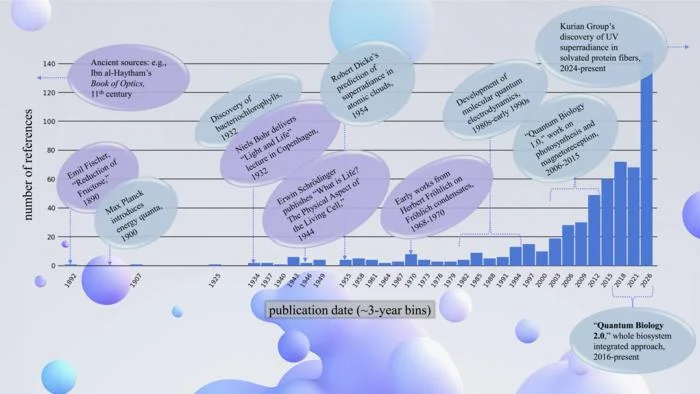
A research team at Howard University published a review paper in quantum biology, systematically outlining the physical mechanisms by which protein networks sustain microscopic quantum coherence in the warm, wet environments of living cells, along with their potential quantum sensing mechanisms[38]. Technical implications: from a microscopic molecular dynamics perspective, the paper clarifies how biological macromolecules counter thermal decoherence through many-body vibrational coupling and geometric topological protection, refuting the conventional notion that functional quantum coherence cannot exist in room-temperature biological systems. Landscape impact: it provides foundational mechanistic guidance for designing novel biomimetic quantum sensors and highly specific in vivo imaging techniques that do not require cryogenic freezing, attracting life sciences investment funds to the bio-quantum interface.

An academic review systematically categorized the evolutionary paths of quantum games, classifying them into three major paradigms: cloud circuit access on real quantum hardware, offline educational simulators on portable laptops, and citizen-science distributed crowdsourced computing[17]. Technical implications: by translating intuitive quantum superposition, entanglement, and measurement collapse rules into interactive mechanics through gamified interfaces, the review explores the feasibility of crowdsourcing public compute to assist in discovering optimal quantum solutions. Landscape impact: it promotes quantum science popularization and early-stage education for next-generation quantum engineers, broadening lightweight cloud monetization avenues for quantum hardware.

06Impact

Today's Impact

  1. Backbone Network Communications Vendors and Data Centers Directly affected by Niagara Networks' release of a 90 Gbps post-quantum TLS 1.3 decryption system[24]. Previously, the industry widely feared that the enlarged key and signature sizes of post-quantum algorithms would severely degrade deep packet inspection, paralyzing cybersecurity appliances with decryption latency; this demonstrated throughput proves that post-quantum traffic decryption can fully match mainstream backbone line rates, eliminating a key commercial performance bottleneck. The next watchpoint is whether traditional cybersecurity giants such as Cisco and Fortinet accelerate rollouts of hardware appliances integrating dedicated PQC ASIC decryption chips by 2027.
  2. Fault-Tolerant Quantum Compiler Developers and Full-Stack Architects Directly guided by new findings from IonQ and Classiq regarding fault-tolerant resource overheads[12]. Traditional error-correcting compilation has long treated "reducing non-Clifford gate (T-gate) counts" as the golden rule; however, new estimates show that logical gate optimization has taken a back seat, with physical qubit routing topologies, Clifford gate spacetime scheduling, and coherence memory retention times now dictating overall physical system volume. The next watchpoint is whether major open-source and commercial error correction software stacks refactor their cost functions in upcoming releases, shifting toward scheduling algorithms heavily weighted by physical spatial topologies and wiring congestion.
  3. Commercial Data Center Infrastructure and Cloud Computing Operators Tangibly driven by Diraq's full-system deployment in an Equinix commercial data center and Q.ANT's integration onto IONOS bare-metal servers[32][35]. Quantum computing is rapidly shedding its experimental university laboratory nature and moving directly into civilian industrial-grade commercial colocation facilities, operating alongside conventional supercomputing and server racks. The next watchpoints include engineering retrofit standards for dilution refrigerator heat dissipation and vibration dampening in commercial data centers, as well as the maturity of automated billing interfaces for hybrid classical-quantum scheduling on cloud platforms.
  4. Algorithm Theorists and Frontier Investment Institutions Affected by Stanford University's rigorous verification confirming the proof of the Aaronson-Ambainis conjecture[16]. This 18-year theoretical conjecture has officially been elevated to a mathematical theorem, establishing the necessary and sufficient criteria for quantum computing to achieve exponential speedups in the black-box model and decisively invalidating blind attempts to find quantum exponential advantages in unstructured searches. The next watchpoint is primary market investors' due diligence on projects claiming generic exponential speedup algorithms, driving capital toward practical tracks with rigorous polynomial-speedup proofs, such as hidden subgroup problems and topological matter simulation.
07Other

Editorial Commentary

Today's developments collectively outline a distinct shift: quantum computing technology is accelerating from an exploratory laboratory "showroom mode" focused purely on raw physical metrics into a "systems engineering mode" deeply integrated with existing information infrastructure. From a silicon spin computer operating on-site inside a Sydney commercial data center, to photonic computing modules integrated into bare-metal servers on a European cloud platform, to post-quantum decryption appliances achieving line rates of 90 gigabits per second across data communication backbones, the industry is no longer delivering isolated theoretical concepts to the market. Instead, it is delivering engineering interfaces ready to plug and play into existing facility power supplies, fiber networks, and compiler pipelines. This collective convergence toward engineering practicality signals that the industry has officially moved past its nascent era of debating qubit counts detached from real-world application contexts.

Echoing this shift is a profound restructuring of theoretical and algorithmic understanding. The formalization of the Aaronson-Ambainis conjecture establishes fundamental mathematical boundaries for quantum speedup, drawing clear physical lines against speculative algorithmic hype. Meanwhile, the dethroning of non-Clifford gates as the dominant bottleneck in fault-tolerant architecture resource modeling shifts the focus of full-stack software-hardware optimization from abstract algebraic reduction directly to classical engineering challenges: physical qubit routing topologies and spacetime volume scheduling. Capital markets and technology decision-makers must clearly recognize that victory in commercializing quantum computing no longer hinges solely on isolated breakthroughs in microscopic parameters of a given physical qubit technology. Rather, it depends on who can erect practical, scalable engineering moats across foundational infrastructure—3D chip packaging, full-stack pulse calibration, heterogeneous compute orchestration, and standards-compliant hardware-software interfaces.